PCI Developers Navbar

Tag: iotble

  • Beyond Connectivity: How Bluetooth Low Energy Is Making IoT Devices Smarter in 2026

    Beyond Connectivity: How Bluetooth Low Energy Is Making IoT Devices Smarter in 2026

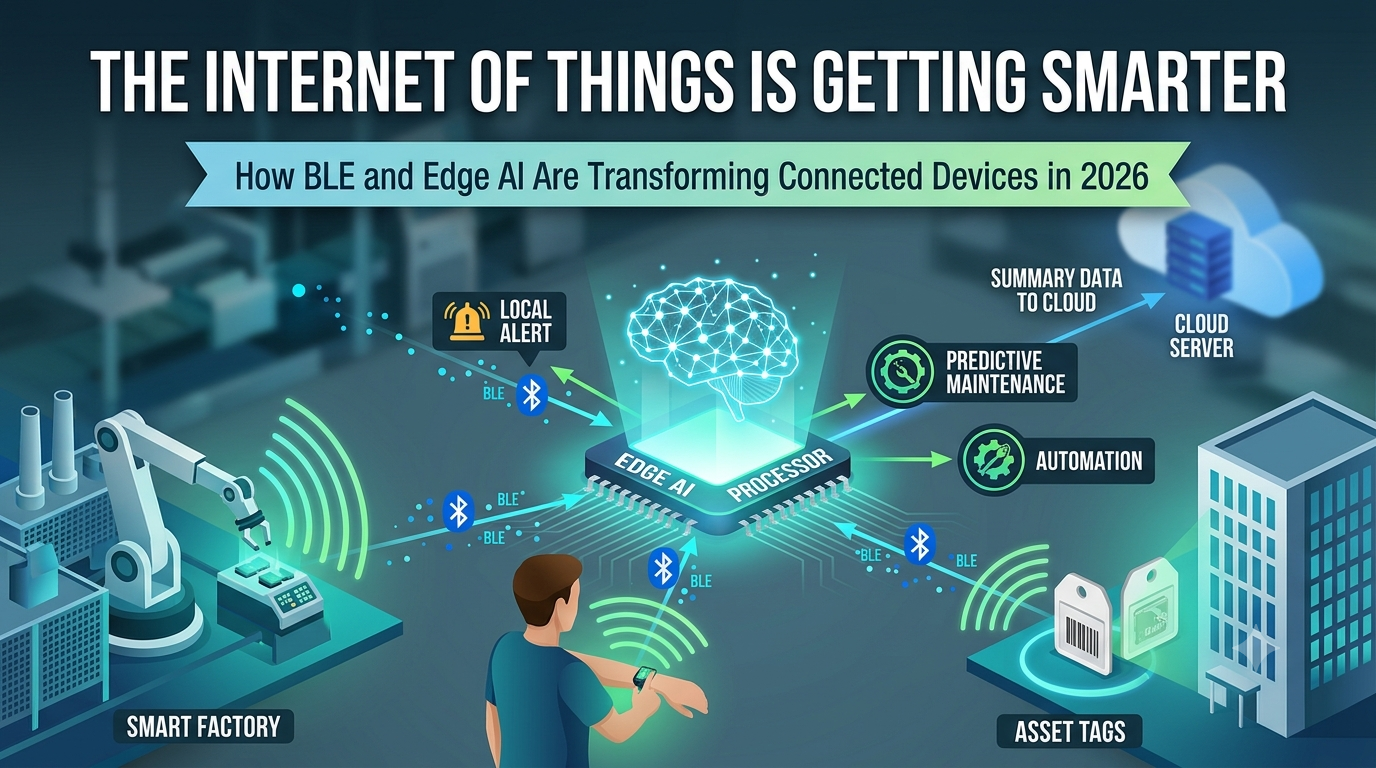
    The Internet of Things (IoT) is changing how businesses monitor equipment, manage resources, track assets, and interact with connected products.

    From smart homes and wearable devices to industrial monitoring systems, connected technology is becoming an important part of modern operations.

    But connecting devices is only the beginning.

    Businesses also need communication technologies that consume less energy, support reliable data exchange, and work efficiently across different IoT environments.

    This is where Bluetooth Low Energy (BLE) becomes valuable.

    Bluetooth Low Energy is designed for wireless communication with relatively low power consumption, making it suitable for devices that need to operate for extended periods without frequent battery replacement.

    In 2026, BLE continues to play an important role in connected product development, sensor networks, asset tracking, and smart device ecosystems.

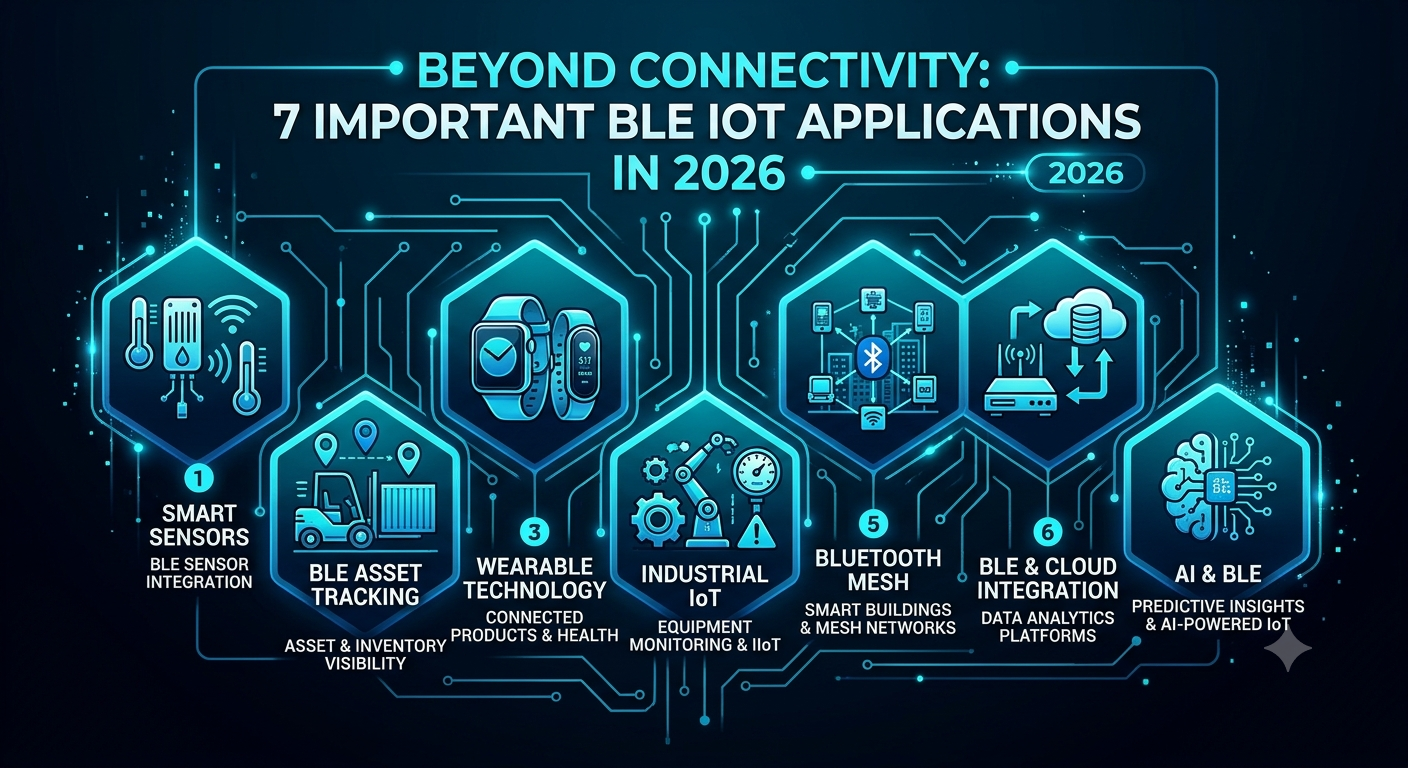
    Let’s explore seven important applications and developments shaping Bluetooth Low Energy IoT solutions.

    1. Smart Sensors Are Making IoT Monitoring More Efficient

    Sensors are among the most important components of IoT ecosystems.

    They collect information about environmental conditions, equipment performance, movement, and other physical parameters.

    BLE-enabled sensors can transmit collected information to smartphones, gateways, and compatible monitoring systems.

    Common applications include:

    • Temperature monitoring.
    • Humidity measurement.
    • Motion detection.
    • Environmental monitoring.
    • Equipment condition monitoring.
    • Occupancy detection.

    For example, a warehouse can use BLE temperature sensors to monitor storage conditions. The collected information can be transferred to a gateway and displayed through a centralized dashboard.

    This helps businesses improve visibility into their operations.

    2. BLE Asset Tracking Is Improving Business Visibility

    Managing physical assets across warehouses, offices, hospitals, and industrial facilities can be challenging.

    Businesses need to know where important equipment is located and whether it is being used efficiently.

    BLE beacons and compatible tracking devices can help address these challenges.

    A BLE-based asset tracking solution may include:

    • BLE tags attached to assets.
    • Fixed BLE gateways or receivers.
    • Mobile applications for monitoring.
    • Cloud-based data processing.
    • Location and movement dashboards.

    For example, hospitals can use BLE tags to monitor the movement of medical equipment within supported facilities.

    Warehouses can use connected tags to improve asset visibility and inventory workflows.

    The accuracy of tracking depends on device placement, signal conditions, receiver density, and the positioning technology being used.

    3. Bluetooth Low Energy Is Transforming Wearable Technology

    Wearable devices have become an important part of the connected technology industry.

    Smartwatches, fitness trackers, health monitoring accessories, and industrial wearables rely on efficient wireless communication.

    BLE makes it possible for compatible wearable devices to exchange information with smartphones and other connected systems while conserving battery power.

    Some common applications include:

    • Fitness activity tracking.
    • Heart-rate data transmission.
    • Smart wearable notifications.
    • Personal safety devices.
    • Industrial worker monitoring.
    • Connected accessories.

    For product manufacturers, BLE integration can help develop compact and energy-efficient wearable solutions.

    However, healthcare-related products must also consider appropriate device validation, privacy, and applicable regulatory requirements.

    4. Industrial IoT Is Using BLE for Smarter Operations

    Industrial environments often contain large numbers of machines, sensors, and monitoring devices.

    Connecting these devices can improve operational visibility and support more efficient maintenance workflows.

    BLE can be used for industrial applications such as:

    Equipment Monitoring: Collect sensor readings from compatible machinery.

    Environmental Monitoring: Track temperature, humidity, and other environmental conditions.

    Asset Management: Improve visibility into tools and equipment.

    Worker Safety: Support proximity-based alerts and connected safety devices.

    Maintenance Operations: Provide technicians with wireless access to equipment information.

    BLE is not a replacement for every industrial communication protocol. Its suitability depends on coverage, interference, latency, data throughput, and reliability requirements.

    A well-designed IoT architecture can combine BLE with gateways and other industrial networking technologies.

    5. Bluetooth Mesh Is Supporting Connected Building Ecosystems

    Managing multiple connected devices in a building can become complicated when each device operates independently.

    Bluetooth Mesh networking provides a communication approach that allows supported devices to communicate through a mesh network.

    This technology can support applications such as:

    • Smart lighting control.
    • Building automation.
    • Occupancy-based lighting.
    • Connected commercial spaces.
    • Sensor-based environmental monitoring.

    For example, an office building can use Bluetooth Mesh-enabled lighting systems to coordinate lighting controls across different rooms and areas.

    Mesh networking can help support large connected environments, although the network design must account for device capacity, message traffic, and application requirements.

    6. BLE and Cloud Integration Are Creating More Connected IoT Platforms

    A BLE device can collect valuable information, but businesses often need more than local device communication.

    They want centralized dashboards, historical reporting, alerts, analytics, and remote monitoring.

    This is where BLE-to-cloud integration becomes important.

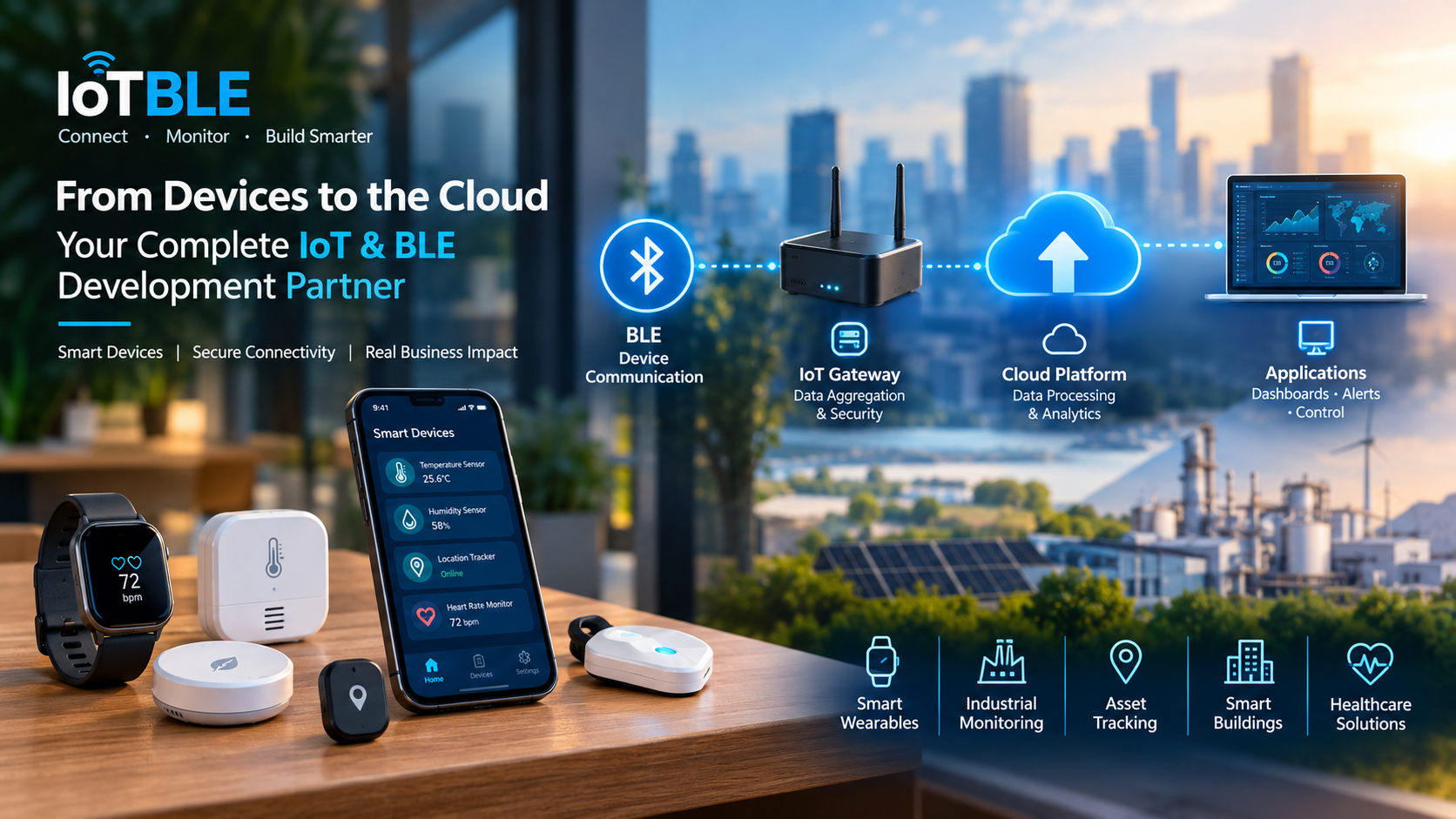
    A typical architecture may work like this:

    1. A BLE sensor collects information.
    2. A compatible smartphone or gateway receives the data.
    3. The gateway processes and forwards relevant information.
    4. A cloud platform stores and analyzes the data.
    5. Users access insights through a web or mobile application.

    This architecture allows businesses to manage connected devices across multiple locations.

    It can also support integration with business applications, monitoring platforms, and analytics systems.

    7. AI and BLE Are Creating Opportunities for Intelligent IoT Applications

    Artificial intelligence is introducing new opportunities for IoT product development.

    BLE devices can provide data that AI-enabled platforms use to identify patterns, detect unusual conditions, and support predictive insights.

    Consider these examples:

    Predictive Maintenance: Analyze equipment sensor data to identify patterns associated with possible failures.

    Smart Building Management: Use occupancy and environmental information to support building optimization.

    Asset Utilization: Analyze tracking information to understand how frequently equipment is used.

    Environmental Intelligence: Identify unusual temperature or humidity patterns.

    Connected Product Analytics: Analyze device usage information to improve product functionality.

    BLE itself does not provide artificial intelligence. Instead, it serves as a communication technology within a larger connected system that may include cloud computing, analytics, and AI models.

    Important Considerations When Developing BLE-Based IoT Products

    Building a successful BLE-enabled product requires careful planning beyond selecting a Bluetooth module.

    Businesses should evaluate several technical considerations.

    Power Consumption

    Battery-powered IoT devices need efficient communication strategies.

    Developers should optimize advertising intervals, connection intervals, transmission frequency, and device sleep modes according to application requirements.

    Device Compatibility

    BLE products should be tested across supported smartphones, operating systems, gateways, and Bluetooth hardware.

    Compatibility testing helps identify communication and interoperability issues.

    Data Security

    IoT applications must protect device communication and sensitive information.

    Important considerations include secure pairing, appropriate authentication, encryption, secure firmware updates, and access management.

    Connectivity and Range

    BLE performance depends on transmit power, antenna design, physical surroundings, interference, and receiver capabilities.

    Developers should validate real-world connectivity rather than relying only on theoretical range specifications.

    Firmware and Mobile Application Development

    The device firmware and companion application must work together reliably.

    A well-designed BLE product should support device discovery, pairing, connection management, data exchange, error handling, and firmware maintenance.

    How IoTBLE Supports Modern Bluetooth and IoT Product Development

    Developing a successful IoT product requires coordination between hardware, firmware, wireless communication, mobile applications, and cloud platforms.

    At IoTBLE, the focus is on Bluetooth Low Energy and connected IoT development solutions that help businesses turn product concepts into practical connected technologies.

    From BLE device integration and sensor connectivity to custom mobile applications and IoT platform development, the right technical architecture can help businesses create scalable connected products.

    Whether you’re developing a smart sensor, wearable device, industrial monitoring solution, or connected consumer product, selecting the right BLE implementation strategy is an important step towards long-term product success.

    Final Thoughts

    Bluetooth Low Energy continues to be an important communication technology for modern IoT products.

    Its energy-efficient wireless communication capabilities make it suitable for a wide range of applications, including asset tracking, wearable technology, smart buildings, and industrial monitoring.

    However, successful IoT development requires more than wireless connectivity.

    Businesses must also consider device compatibility, firmware performance, data security, gateway architecture, cloud integration, and long-term scalability.

    As connected products become more intelligent in 2026, BLE will continue to provide an important foundation for building efficient and innovative IoT ecosystems.

    Planning to develop a Bluetooth-enabled IoT product?

    Connect with IoTBLE to explore BLE development, IoT device integration, and custom connected product solutions.


    Frequently Asked Questions

    1. What is Bluetooth Low Energy in IoT?

    Bluetooth Low Energy is a wireless communication technology designed for devices that need to exchange information while consuming relatively little power.

    2. Why is BLE important for IoT product development?

    BLE supports energy-efficient wireless communication, making it suitable for battery-powered sensors, wearables, asset trackers, and connected consumer products.

    3. What is the difference between Bluetooth Classic and BLE?

    Bluetooth Classic is commonly used for applications such as continuous audio streaming, while BLE is designed for lower-power communication and periodic data exchange.

    4. Can BLE devices connect directly to the cloud?

    BLE devices generally require an intermediary, such as a smartphone or gateway, to communicate with cloud platforms over an internet connection.

    5. What is Bluetooth Mesh networking?

    Bluetooth Mesh is a networking technology that allows compatible devices to communicate through a mesh network, supporting applications such as smart lighting and building automation.

    6. Is BLE suitable for industrial IoT applications?

    Yes. BLE can support industrial sensor monitoring, asset tracking, equipment monitoring, and worker safety applications when its range, reliability, and environmental requirements are properly evaluated.

    7. Can AI work with Bluetooth Low Energy devices?

    Yes. BLE devices can transmit sensor data to applications and cloud platforms where AI models can analyze patterns, identify anomalies, and generate predictive insights.
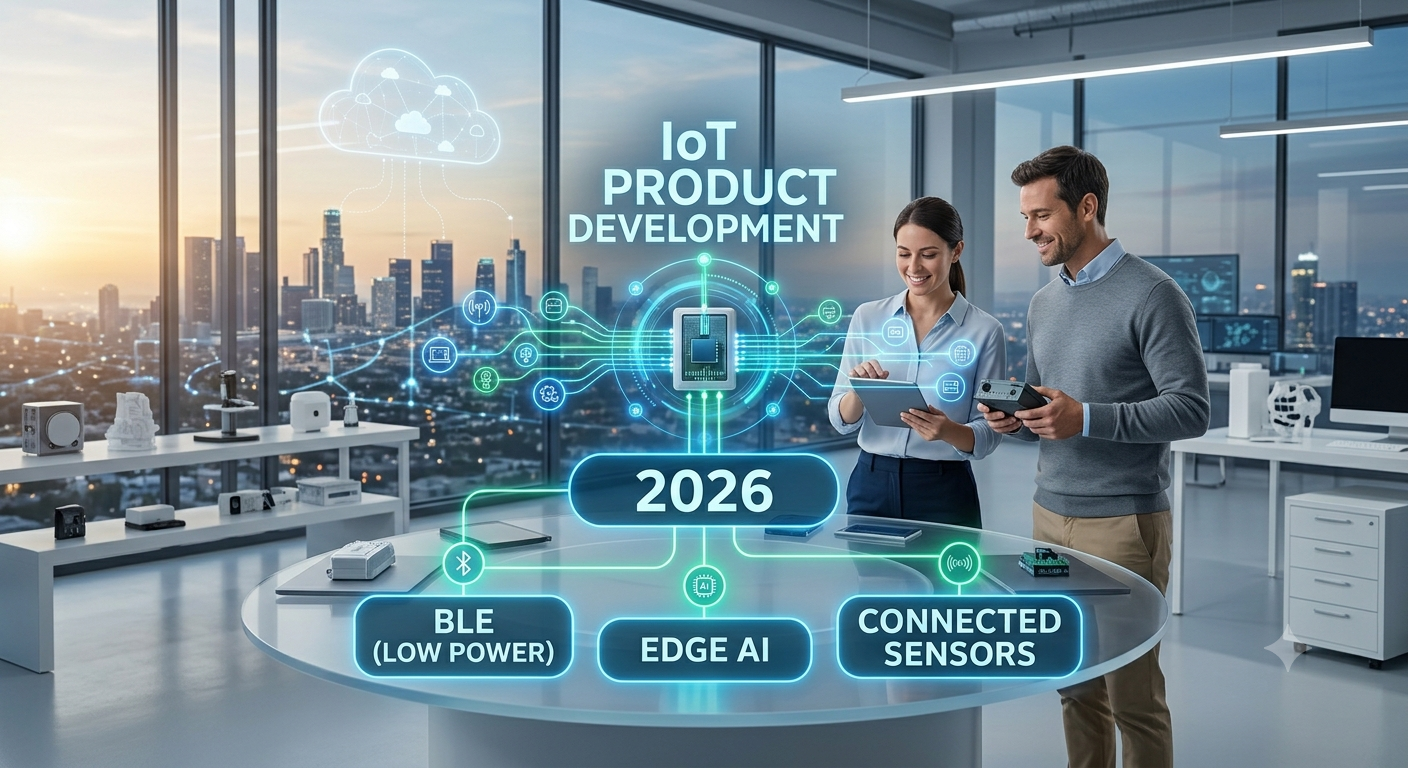
  • Smart IoT Product Development in 2026: How BLE, Edge AI, and Connected Sensors Are Transforming Businesses

    Smart IoT Product Development in 2026: How BLE, Edge AI, and Connected Sensors Are Transforming Businesses

    SEO Title: Smart IoT Product Development in 2026: BLE, AI & Connected Devices

    Meta Description: Discover how IoT and Bluetooth Low Energy development help businesses build smart connected products with real-time monitoring, automation, and efficient data management.

    Suggested URL Slug: /smart-iot-product-development-2026/

    Primary Keyword: IoT product development

    Secondary Keywords: IoT development services, BLE IoT solutions, Bluetooth Low Energy development, connected device development, IoT sensor integration, smart device development, industrial IoT solutions, IoT application development


    Introduction

    Connected technology is changing how businesses design products, monitor operations, and deliver customer experiences. From smart home devices and wearable technology to industrial sensors and asset-tracking systems, the Internet of Things (IoT) is helping organizations connect physical products with digital platforms.

    In 2026, businesses are looking beyond basic device connectivity. They want connected products that collect useful data, communicate efficiently, automate routine tasks, and support smarter decisions. Technologies such as Bluetooth Low Energy (BLE), edge computing, cloud platforms, and artificial intelligence (AI) are helping make these solutions possible.

    For companies planning a new connected product, choosing the right IoT architecture is essential. The right combination of sensors, firmware, wireless communication, mobile applications, and backend infrastructure can help create a product that is reliable, scalable, and ready for future improvements.

    What Is IoT Product Development?

    IoT product development is the process of designing and building connected devices that collect, transmit, process, and use data. An IoT solution typically combines hardware, embedded software, wireless connectivity, applications, and cloud-based services.

    A typical IoT ecosystem includes:

    • Sensors and connected hardware: Collect environmental, operational, or device information.
    • Embedded firmware: Controls device behavior and manages communication.
    • BLE or other wireless protocols: Transfer data between devices, smartphones, gateways, or networks.
    • Mobile and web applications: Allow users to configure devices and monitor information.
    • Cloud platforms and APIs: Store, process, and exchange data across systems.
    • Analytics and AI: Identify patterns, generate alerts, and support automation.

    A successful IoT development strategy connects these components into a complete system rather than treating the device as an isolated product.

    Why Bluetooth Low Energy Is Important for IoT Solutions

    Bluetooth Low Energy is widely used in connected products that need short-range wireless communication with limited power consumption. It is particularly useful for battery-operated sensors, wearables, proximity devices, and products that communicate with smartphones or nearby gateways.

    1. Lower Power Consumption

    Many IoT products operate in locations where frequent battery replacement is inconvenient or expensive. BLE supports low-power communication patterns that can help reduce energy consumption when devices are designed with appropriate advertising intervals, connection settings, and sleep modes.

    This makes BLE a practical option for applications such as environmental sensors, wearable devices, equipment monitors, and smart tags.

    2. Smartphone Connectivity

    BLE allows compatible connected devices to communicate directly with smartphones and tablets. This can simplify device setup, configuration, diagnostics, and data access without requiring a dedicated display or complex user interface on the hardware.

    For example, a manufacturer can build a BLE-enabled sensor that sends readings to a mobile application, where users can view measurements and configure device settings.

    3. Flexible Device Integration

    BLE can connect sensors, controllers, gateways, and applications within a larger IoT architecture. Depending on the product requirements, the mobile device or gateway can forward collected information to a cloud platform for remote access and analysis.

    4. New Opportunities for Location and Sensing

    BLE-based solutions can support proximity detection, asset visibility, and indoor location applications. Bluetooth direction-finding capabilities and newer distance-measurement features can support more advanced use cases when compatible hardware and suitable deployment conditions are available.

    Actual range, location accuracy, and battery life depend on the hardware, environment, radio design, and software configuration.

    Top IoT Development Trends Businesses Should Watch in 2026

    1. Edge AI for Faster Decisions

    Traditional IoT systems often send collected data to the cloud for processing. Edge computing allows some processing to happen directly on a device, gateway, or nearby computer.

    When combined with suitable AI models, edge processing can help identify unusual equipment behavior, classify sensor readings, and trigger responses without sending every raw measurement to the cloud.

    Business benefit: Faster responses, reduced unnecessary data transmission, and improved operation in environments with intermittent internet access.

    2. Predictive Maintenance With Connected Sensors

    Unexpected equipment failures can interrupt production and increase maintenance costs. IoT sensors can monitor parameters such as temperature, vibration, pressure, and operating hours.

    Analytics systems can use these measurements to identify unusual patterns and help maintenance teams investigate potential problems before a breakdown occurs.

    Predictive maintenance is not a guarantee that every failure will be detected. Its effectiveness depends on sensor quality, data availability, equipment conditions, and model validation.

    3. Smart Asset Tracking

    Businesses managing tools, inventory, equipment, or reusable containers need better visibility into where assets are located and how they are being used.

    BLE beacons and tags can transmit identification or sensor data to compatible receivers. Gateways and software platforms can then organize that information into searchable dashboards and alerts.

    Potential applications include:

    • Warehouse inventory visibility
    • Equipment and tool tracking
    • Retail inventory monitoring
    • Hospital equipment management
    • Logistics and supply-chain monitoring

    4. Connected Healthcare and Wearables

    IoT technology supports connected healthcare products that collect activity, environmental, or device-status information. BLE can help wearable devices and medical-adjacent products communicate with smartphones or dedicated gateways.

    Products intended for clinical use may also require specialized validation, privacy protections, regulatory compliance, and careful handling of health-related data.

    5. Smart Buildings and Energy Management

    Connected occupancy, temperature, lighting, and environmental sensors can help building operators understand how spaces are being used.

    When connected to suitable control systems, this information can support automated lighting, more informed energy management, and maintenance alerts. BLE can be useful for sensor connectivity and retrofit projects where minimizing new wiring is important.

    6. Low-Maintenance and Ambient IoT Devices

    Ambient IoT explores devices that obtain some or all of their operating energy from environmental sources, such as light, motion, or radio-frequency energy.

    This approach could enable new types of smart labels and low-maintenance sensors. However, battery-free operation is not suitable for every use case; available energy, transmission frequency, processing needs, and deployment conditions must be evaluated carefully.

    How to Choose the Right Connectivity for an IoT Product

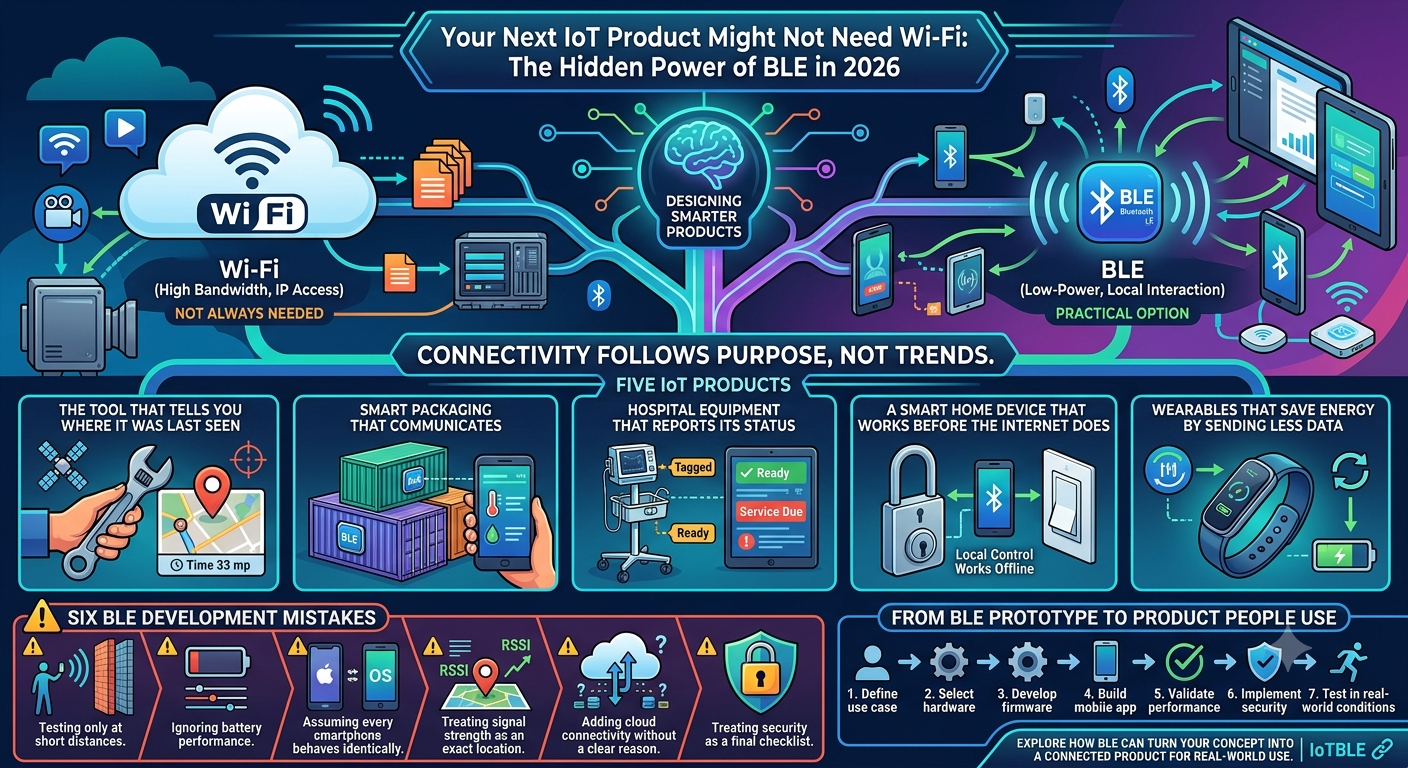
    BLE is powerful, but it is not the right choice for every connected device. The communication technology should match the product’s range, data volume, power budget, and network requirements.

    TechnologyBest suited forMain consideration
    Bluetooth Low EnergyWearables, sensors, smartphone-connected productsShort-range communication and low power
    Wi-FiConnected appliances, cameras, higher-bandwidth devicesHigher power requirements and network availability
    ThreadCompatible smart-home devices and mesh networksRequires a suitable Thread ecosystem
    LoRaWANLong-range, low-data-rate sensor networksLow throughput and gateway/network planning
    Cellular IoTRemote devices requiring wide-area connectivityCoverage, subscription costs, and power budget

    Some products combine multiple technologies. For example, a BLE sensor may communicate with a gateway that uses Wi-Fi or cellular connectivity to send data to a cloud platform.

    The best architecture depends on real-world operating conditions—not simply on which protocol is most popular.

    Key Challenges in IoT Product Development

    Building a working prototype is only one part of launching a successful connected product. Businesses must also consider reliability, security, integration, and long-term support.

    Device Security and Data Privacy

    IoT products should use appropriate authentication, encrypted communication where supported, secure key management, and controlled access to device settings and data.

    Security must be considered across the complete system, including firmware, mobile applications, APIs, gateways, and cloud infrastructure.

    Battery-Life Optimization

    Battery performance depends on more than the wireless protocol. Firmware efficiency, sensor sampling frequency, radio activity, processor usage, battery chemistry, and environmental conditions all affect actual runtime.

    Developers should measure power consumption on representative hardware under realistic operating conditions.

    Cross-Platform Compatibility

    When a product connects to Android and iOS applications, teams must account for operating-system differences, background communication restrictions, permissions, pairing behavior, and reconnection scenarios.

    Testing across supported devices and operating-system versions helps reduce connectivity problems after launch.

    Scalability and Integration

    An IoT solution may begin with a small prototype but eventually need to support thousands of devices. The architecture should consider device provisioning, firmware updates, monitoring, API performance, data retention, and cloud costs from the beginning.

    A Practical IoT Product Development Process

    A structured development process helps businesses reduce technical risk and make informed investment decisions.

    Step 1: Define the use case. Identify the problem, intended users, operating environment, and measurable business outcomes.

    Step 2: Select the hardware and connectivity. Evaluate sensors, microcontrollers, BLE modules, gateways, power requirements, and communication range.

    Step 3: Develop firmware and device logic. Implement sensing, data handling, connectivity, error recovery, and power management.

    Step 4: Build the application and backend. Create the mobile or web interface, APIs, device management tools, and cloud infrastructure where required.

    Step 5: Test the complete system. Validate connectivity, battery performance, security, reliability, usability, and operation under expected environmental conditions.

    Step 6: Prepare for deployment and maintenance. Plan secure provisioning, monitoring, firmware updates, troubleshooting, and future feature releases.

    How IoTBLE Development Services Can Help

    Businesses developing connected products often need expertise across several technical disciplines. IoT and BLE development can involve embedded firmware, wireless communication, mobile application development, cloud integration, APIs, and data analytics.

    A capable development partner can help define requirements, evaluate connectivity options, build prototypes, integrate software components, and test the product before deployment.

    For companies developing a new smart device or upgrading an existing product, a well-planned IoT product development strategy can help turn a technical concept into a practical, maintainable connected solution.

    At IoTBLE, focus on communicating the specific capabilities your team offers—such as BLE integration, connected-device software, mobile applications, sensor integration, or cloud connectivity—so prospective customers can understand how your services fit their project.

    Frequently Asked Questions

    1. What is BLE in IoT?

    BLE, or Bluetooth Low Energy, is a wireless communication technology designed to support low-power data exchange. It is commonly used in sensors, wearables, smart tags, and connected products that communicate with smartphones or nearby gateways.

    2. What are the benefits of IoT product development?

    IoT product development can help businesses monitor assets, collect operational data, automate processes, improve visibility, and build new digital services around connected products.

    3. Can BLE devices connect directly to the cloud?

    BLE devices generally communicate with a nearby smartphone, gateway, or other compatible receiver. That intermediary can forward data to the cloud. Some products combine BLE with additional connectivity technologies to meet their specific requirements.

    4. Is BLE suitable for industrial IoT?

    BLE can be suitable for industrial sensors, asset tracking, equipment monitoring, and selected control applications. Engineers should evaluate interference, coverage, reliability, latency, environmental conditions, and safety requirements before selecting it.

    5. How much does IoT product development cost?

    Costs depend on hardware complexity, firmware requirements, mobile and cloud functionality, integrations, testing, security, and production scale. A defined scope and technical feasibility assessment help establish a more realistic estimate.

    6. What is the difference between IoT and BLE?

    IoT refers to the broader ecosystem of connected devices, software, networks, and data services. BLE is one wireless technology that can be used to connect components within an IoT solution.

    Conclusion

    IoT product development is evolving beyond basic connectivity toward intelligent, secure, and energy-conscious connected experiences. BLE remains a useful option for products requiring low-power communication, smartphone compatibility, sensor integration, and proximity-based functionality.

    By combining the right connectivity technology with reliable firmware, intuitive applications, secure data handling, and scalable infrastructure, businesses can develop connected products that address real operational needs.

    Planning a connected product? Explore how IoT and BLE development can support your product requirements, from early feasibility and prototyping to software integration and deployment.


  • Digital Twins and BLE IoT in 2026: Turning Real-World Devices Into Intelligent Digital Systems

    Digital Twins and BLE IoT in 2026: Turning Real-World Devices Into Intelligent Digital Systems

    Introduction

    What if a business could monitor a physical product, understand its current condition, and identify potential problems through a digital representation of that product?

    This is the idea behind digital twins. By combining sensor data, Bluetooth Low Energy (BLE), IoT platforms, and analytics, businesses can create digital views of physical assets and use them to make more informed decisions.

    In 2026, connected product development is moving beyond simply collecting sensor readings. Businesses increasingly need solutions that transform device data into useful information, support remote monitoring, and improve operational visibility.

    BLE IoT technology can play an important role in this process, especially when products require low-power wireless communication between sensors, smartphones, and gateways.

    For manufacturers, product designers, and technology companies, understanding this combination can open new opportunities for building intelligent connected solutions.

    What Is a Digital Twin in BLE IoT?

    A digital twin is a digital representation of a physical asset, process, or system that is updated using relevant information from the real world.

    In a BLE IoT implementation, sensors can collect data from a physical device and transmit it to a compatible receiver. A smartphone, gateway, or embedded system can then forward the data to a platform that updates the digital representation.

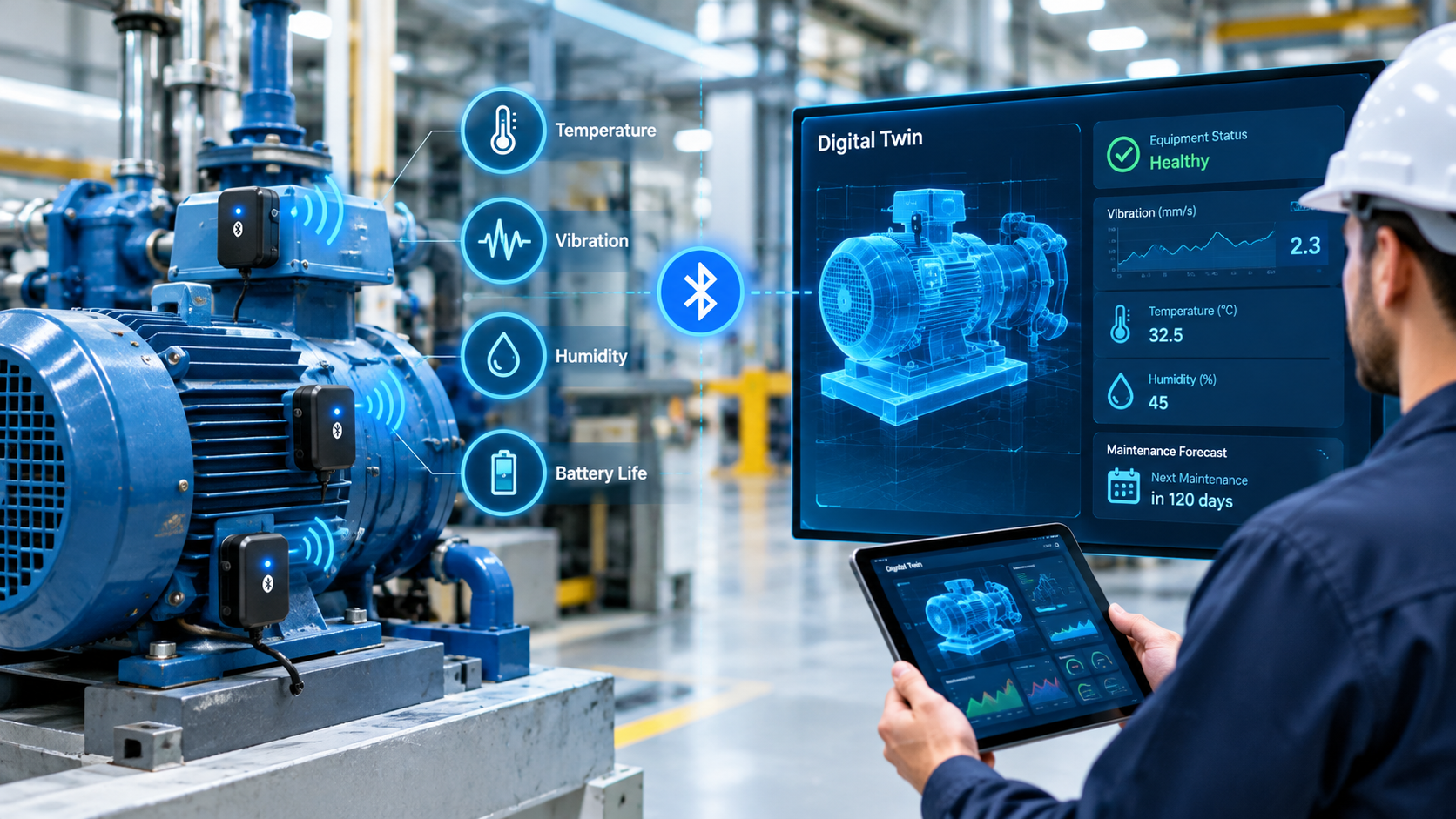
    For example, a digital twin for an industrial motor might display its temperature, operating status, vibration measurements, and maintenance history.

    A typical system may include:

    • Physical equipment: The machine, product, or asset being monitored.
    • BLE sensors: Components that measure and transmit relevant data.
    • Connectivity layer: A smartphone, gateway, or other compatible receiver.
    • IoT platform: Software that stores, processes, and organizes incoming data.
    • Digital twin interface: A dashboard displaying the asset’s current and historical condition.
    • Analytics engine: Rules or predictive models that identify trends and potential issues.

    A digital twin does not automatically predict every failure or mirror every physical behavior. Its usefulness depends on sensor quality, data availability, model accuracy, and the way the system is designed.

    Why BLE Is Useful for Digital Twin Applications

    Bluetooth Low Energy is designed for wireless communication with relatively low power consumption, making it useful for many battery-powered sensors and connected devices.

    Its advantages include the following.

    1. Lower-Power Sensor Connectivity

    Battery-powered devices often need to operate for extended periods without frequent maintenance.

    BLE can support periodic sensor readings and short data exchanges, helping developers optimize power consumption through suitable advertising intervals, connection settings, and sleep modes.

    Actual battery life depends on hardware, firmware, transmission frequency, and operating conditions.

    2. Smartphone-Based Device Access

    Many smartphones support BLE, allowing a mobile application to discover compatible devices, read measurements, configure settings, and display device status.

    This can simplify product onboarding and local monitoring without requiring a dedicated receiver for every use case.

    3. Flexible IoT Architecture

    BLE can operate as part of a larger system that includes cloud services, analytics platforms, and enterprise software.

    For example, a gateway can collect readings from multiple nearby sensors and transmit selected information to a remote digital twin platform.

    4. Cost-Conscious Product Design

    For suitable applications, BLE-enabled hardware can provide a practical connectivity option for connected products.

    However, the overall project cost depends on sensor selection, hardware design, certification, application development, backend infrastructure, and production volume.

    6 Real-World Applications of Digital Twins and BLE IoT

    1. Manufacturing Equipment Monitoring

    Manufacturers can use sensors to collect temperature, vibration, and operating information from machinery.

    The corresponding digital twin can present current readings alongside historical measurements, maintenance records, and equipment status.

    Maintenance teams can use this information to investigate abnormal patterns and prioritize inspections.

    Example: A production facility monitors several motors through BLE sensors and a nearby gateway. When vibration measurements exceed a configured threshold, the system flags the equipment for inspection.

    2. Smart Buildings and Facility Management

    Building operators need visibility into environmental conditions, equipment status, and energy-related performance.

    BLE sensors can collect temperature, humidity, and occupancy-related information where suitable. A digital twin of the building can organize these readings by room, floor, or equipment zone.

    When integrated with appropriate building management systems, this information can help facility teams identify inefficient operating conditions and coordinate maintenance.

    3. Healthcare Equipment Management

    Hospitals and healthcare facilities use many devices that require monitoring, maintenance, and inventory management.

    BLE connectivity can support compatible equipment-status sensors and asset tracking systems.

    A digital representation of an asset can show its reported condition, location information when supported by the deployment, service history, and maintenance schedule.

    Healthcare implementations must account for privacy, cybersecurity, applicable regulatory requirements, and the limitations of any monitoring technology.

    4. Warehouse and Logistics Operations

    Warehouses often manage large numbers of tools, containers, and reusable assets.

    BLE tags and receivers can help collect asset-identification and proximity information. An IoT platform can use these observations to maintain a digital inventory view.

    This can improve asset visibility and reduce time spent searching for equipment.

    Location accuracy depends on receiver placement, signal conditions, and the positioning technology used. A standard BLE beacon does not guarantee precise indoor coordinates.

    5. Smart Agriculture

    Agricultural operators can use connected sensors to monitor conditions in greenhouses, storage areas, and other controlled environments.

    Measurements such as temperature, humidity, and soil moisture can be incorporated into a digital representation of a growing area or storage facility.

    A gateway can forward readings to a remote dashboard, helping users review environmental trends and respond when readings move outside configured ranges.

    For remote outdoor locations, BLE should be evaluated against alternative communication technologies based on range, infrastructure, and power requirements.

    6. Consumer Products and Connected Appliances

    Connected consumer products can use BLE to communicate with mobile applications and share operational information.

    A digital twin can provide users or support teams with a structured view of device configuration, usage information, and maintenance events.

    For product manufacturers, this architecture can support troubleshooting, service planning, and better visibility into connected product performance.

    How to Build a BLE IoT Digital Twin Solution

    Developing a useful digital twin requires careful planning across hardware, software, and data integration.

    Step 1: Identify the Asset and Business Goal

    Start by defining the problem the solution should address.

    Does the business need equipment monitoring, inventory visibility, maintenance planning, environmental tracking, or product diagnostics?

    The answer determines which measurements must be collected and how frequently they should be updated.

    Step 2: Select Suitable Sensors and BLE Hardware

    Choose sensors based on measurement accuracy, operating environment, power consumption, and expected service life.

    The BLE module or microcontroller must support the required communication behavior and provide sufficient processing capability for the intended application.

    Step 3: Design the Firmware and Data Model

    Firmware should handle sensor readings, communication, error conditions, and power management.

    Developers can use Bluetooth GATT services and characteristics to organize device data. The application should also define how measurements, timestamps, device identifiers, and status information are represented.

    Step 4: Develop the Gateway or Mobile Application

    If the device needs remote monitoring, a smartphone or gateway may collect the BLE data and forward it to the IoT platform.

    The appropriate architecture depends on whether the solution requires local access, continuous operation, multiple-device support, or unattended data collection.

    Step 5: Build the Digital Twin Platform

    The platform should connect incoming data to the correct asset and present useful information through dashboards, reports, and alerts.

    Depending on the use case, it may also include asset history, maintenance schedules, device configuration, and integration with enterprise systems.

    Step 6: Add Analytics and Predictive Capabilities

    Once sufficient reliable data is available, analytics can identify patterns and unusual readings.

    Predictive maintenance requires suitable historical data, validated models, and ongoing evaluation. A basic threshold alert should not be presented as a guaranteed prediction of equipment failure.

    Step 7: Test Security and Real-World Performance

    Test the complete solution under realistic operating conditions, including wireless interference, connection interruptions, sensor errors, and gateway outages.

    Use appropriate authentication, access controls, secure data transmission, and protected firmware update mechanisms.

    Testing should also confirm that digital twin information remains consistent with the latest valid device data.

    BLE vs. Wi-Fi vs. Cellular for Digital Twin Connectivity

    FactorBLEWi-FiCellular
    Typical roleLocal sensor connectivityLocal network and IP connectivityWide-area connectivity
    Power considerationsOften suitable for low-power sensorsCan require more powerDepends on radio technology and transmission behavior
    InfrastructureSmartphone or compatible receiverWi-Fi network or access pointCellular coverage and service
    Data transferSmall to moderate data exchangesSuitable for high data volumesSuitable for remote data transmission
    Common applicationsWearables, tags, sensorsGateways, cameras, connected appliancesRemote assets and mobile equipment

    These technologies are not necessarily competitors. A connected product may use BLE to collect sensor readings and Wi-Fi or cellular connectivity to deliver information to its digital twin platform.

    Common Challenges in BLE IoT Digital Twin Development

    Data Accuracy and Reliability

    Incorrect sensor readings can make a digital twin misleading. Sensor calibration, data validation, timestamps, and fault handling are essential.

    Connectivity Gaps

    BLE communication is intended for suitable local wireless links, not unlimited geographic coverage. Remote monitoring may require gateways and another network connection.

    Battery Optimization

    Frequent transmissions and continuous sensor sampling can shorten battery life. Developers need to balance update frequency against power consumption and business requirements.

    Integration Complexity

    Digital twins often combine information from sensors, applications, databases, and enterprise systems. Consistent device identifiers and well-defined data formats help simplify integration.

    Security and Device Management

    Connected devices need appropriate access controls, secure configuration, and a reliable process for firmware updates and lifecycle management.

    Scaling Beyond the Prototype

    A solution that works with a few sensors may require a different operational approach when deployed across hundreds of assets. Device provisioning, observability, data retention, and support processes should be planned early.

    The Future of BLE IoT and Digital Twins

    Several developments are shaping connected product engineering.

    Edge computing: Processing data closer to the source can reduce unnecessary data transfers and support faster local responses.

    AI-assisted analytics: Suitable models can help identify unusual sensor patterns, estimate equipment condition, and prioritize maintenance tasks.

    Improved asset visibility: BLE-based identification and positioning solutions can help organizations understand where assets are observed and how they move through a facility.

    Interoperable platforms: Better integration between device data, cloud services, and business applications can make connected solutions more useful across departments.

    Lifecycle monitoring: Manufacturers can build systems that support products from deployment through maintenance and eventual replacement.

    These capabilities are not automatic benefits of BLE itself. They require suitable hardware, software, data architecture, and testing.

    Why Choose an Experienced BLE IoT Development Partner?

    Building a digital twin requires more than connecting a sensor to a mobile application.

    A development team may need to coordinate embedded firmware, BLE communication, mobile software, gateway integration, cloud infrastructure, data visualization, and analytics.

    An experienced partner can help evaluate requirements, select a suitable architecture, create a prototype, and prepare the solution for deploymen

  • Beyond Connectivity: How BLE and IoT Are Creating Smarter Products in 2026

    Beyond Connectivity: How BLE and IoT Are Creating Smarter Products in 2026

    Introduction

    A connected product is no longer just a device that sends data to an application. Businesses increasingly need products that collect useful information, communicate efficiently, and help users make better decisions.

    From smart wearables and industrial sensors to warehouse tracking systems and intelligent building controls, Bluetooth Low Energy (BLE) is helping businesses build practical connected experiences.

    In 2026, the combination of BLE and the Internet of Things (IoT) is creating new opportunities for companies developing smart hardware, mobile applications, and connected enterprise systems.

    For product manufacturers and technology businesses, investing in the right BLE IoT development strategy can improve device efficiency, simplify connectivity, and create new opportunities for digital services.

    1. What Makes BLE Important for IoT Product Development?

    Bluetooth Low Energy is a wireless communication technology designed for applications that need to exchange data while managing power consumption carefully.

    Unlike connectivity approaches designed primarily for high-bandwidth communication, BLE is particularly useful for devices that transmit small amounts of data periodically or communicate with nearby smartphones, tablets, or gateways.

    Its capabilities make it suitable for a wide range of connected products.

    Key advantages include:

    • Energy-efficient communication: Appropriate design and power management can help battery-powered products operate longer between charges or battery replacements.
    • Smartphone compatibility: BLE allows supported devices to communicate directly with compatible mobile applications.
    • Compact product design: BLE-enabled chips and modules can support small connected devices.
    • Flexible integration: BLE can connect sensors and peripherals to applications, gateways, and larger IoT platforms.
    • Multiple use cases: BLE supports applications ranging from asset tracking to device configuration and environmental monitoring.

    Actual power consumption, range, and reliability depend on hardware, firmware, radio conditions, communication settings, and the deployment environment. These factors should be evaluated during product development.

    2. Five Industries Transforming Through BLE and IoT

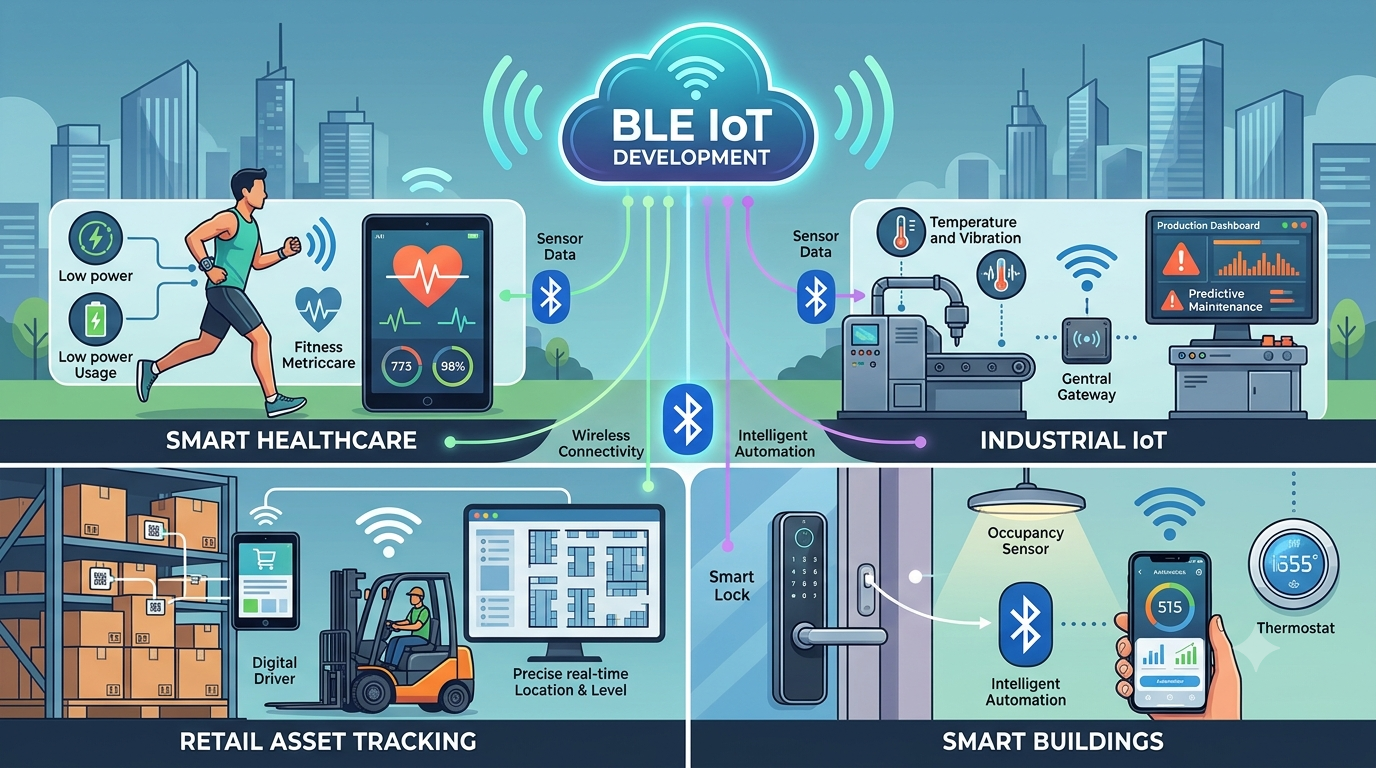
    Smart Healthcare and Wearable Devices

    Wearables and connected healthcare devices can use BLE to communicate with compatible smartphones or monitoring systems.

    Potential applications include fitness trackers, wellness devices, temperature sensors, and connected medical accessories.

    A typical system collects measurements from a sensor, transfers the data to a mobile application, and optionally sends approved information to a cloud platform.

    Product developers must carefully address data privacy, connection reliability, and any applicable medical-device requirements.

    Industrial IoT and Predictive Maintenance

    Factories and industrial facilities use sensors to monitor equipment conditions and operational performance.

    BLE-enabled sensors can transmit information such as temperature, vibration, or environmental readings to nearby gateways or supported devices.

    When integrated with analytics software, this information can help maintenance teams identify unusual patterns and investigate equipment problems earlier.

    The result can be improved operational visibility and better-informed maintenance planning.

    Retail and Warehouse Asset Tracking

    Businesses often lose time locating equipment, managing inventory, or identifying where reusable assets are being used.

    BLE beacons and tags can help systems detect nearby assets and estimate their location within a suitably designed infrastructure.

    For example, a warehouse solution may combine BLE tags, strategically placed receivers, a gateway, and inventory software to provide asset visibility.

    Developers should select the tracking approach based on required accuracy, facility layout, interference, and budget.

    Smart Homes and Intelligent Buildings

    BLE can support smart locks, wireless switches, occupancy sensors, environmental sensors, and device commissioning.

    Connected building applications can use sensor data to support lighting automation, access management, and environmental monitoring.

    Where multiple devices need to communicate across a larger facility, the architecture may combine BLE with gateways, cloud platforms, or other networking technologies.

    Agriculture and Environmental Monitoring

    Agricultural and environmental applications can use connected sensors to monitor soil conditions, temperature, humidity, and other relevant measurements.

    BLE may be appropriate for nearby sensors that communicate with a smartphone or gateway. Remote farms or wide outdoor deployments may require additional connectivity technologies.

    By collecting useful measurements and presenting them in a clear dashboard, IoT applications can help operators make more informed decisions about resources and maintenance.

    3. How a BLE IoT Solution Works

    A reliable connected product requires more than a Bluetooth chip. Hardware, embedded software, mobile applications, connectivity, and data processing must work together.

    A typical BLE IoT architecture includes the following components:

    1. Sensor or connected device

    The hardware collects measurements or performs an action. Examples include temperature sensors, smart locks, industrial equipment, and wearable devices.

    2. BLE firmware

    Embedded firmware manages Bluetooth advertising, connections, data exchange, device states, and power consumption.

    3. Mobile application or gateway

    A compatible mobile app or dedicated gateway receives data from the BLE device. The gateway can forward information to an internet-connected platform when required.

    4. Cloud or backend platform

    The backend stores and processes information, manages authorized users, and connects device data with business systems.

    5. Dashboard and analytics

    Users view measurements, receive alerts, monitor device status, and interact with connected products.

    Not every product needs all five components. A standalone BLE accessory may work entirely through a mobile application, while a large industrial deployment may require gateways and a centralized backend.

    4. Battery Life: A Critical Factor in BLE Development

    One of the biggest challenges in connected product engineering is balancing functionality with energy consumption.

    A device that drains its battery too quickly can increase maintenance costs, frustrate customers, and make large deployments impractical.

    Effective Bluetooth Low Energy development requires power optimization throughout the design process.

    Optimize communication intervals

    The device should transmit data as frequently as its actual use case requires. Excessive communication can increase power consumption.

    Use appropriate sleep modes

    Battery-powered devices can spend much of their time in low-power states and wake when measurements or communication are required.

    Reduce unnecessary processing

    Efficient firmware, carefully scheduled sensor readings, and optimized data handling can reduce energy use.

    Measure real-world performance

    Power consumption should be measured using representative workloads, connection settings, battery characteristics, and operating conditions.

    Select hardware carefully

    The BLE chipset, sensors, power regulator, antenna, and other components all influence total device performance.

    Developers should validate expected battery life through testing rather than relying solely on theoretical estimates.

    5. Security Considerations for Connected BLE Products

    As IoT devices become part of business operations, security must be included from the earliest design stages.

    A vulnerable connected device may expose sensitive information or allow unauthorized users to interact with the product.

    Important security practices include:

    • Use appropriate BLE pairing and bonding mechanisms where required.
    • Apply authentication and authorization to sensitive operations.
    • Protect sensitive data during transmission and storage.
    • Secure firmware updates and verify update authenticity.
    • Avoid exposing unnecessary device information.
    • Implement appropriate access controls in mobile apps and backend systems.
    • Test reconnection behavior, pairing flows, and unauthorized access scenarios.

    BLE security should be considered alongside application security, cloud security, and the physical security of the device.

    A secure design must account for the complete product rather than Bluetooth communication alone.

    6. BLE vs. Wi-Fi vs. Cellular: Which Technology Should You Choose?

    The right communication technology depends on how much data a device needs to transfer, how far it must communicate, its power constraints, and whether it needs direct internet access.

    RequirementBLEWi-FiCellular
    Low-power sensor communicationOften suitableDepends on implementationDepends on technology and usage
    High-bandwidth dataGenerally limitedOften suitableDepends on network and service
    Direct smartphone interactionStrong use caseSupportedRequires separate connectivity
    Wide-area connectivityUsually needs a phone or gatewayRequires network coverageDesigned for wide-area networks
    Typical applicationsWearables, beacons, nearby sensorsCameras, connected appliancesRemote trackers, distributed assets

    These technologies are not always competitors. Many connected products combine them.

    For example, a sensor may communicate with a mobile app using BLE while the app uses Wi-Fi or cellular connectivity to upload data to the cloud.

    Similarly, a gateway may collect BLE sensor readings and forward them through an internet connection.

    The best architecture balances cost, performance, battery life, coverage, and the intended user experience.

    7. How to Choose the Right BLE IoT Development Partner

    Choosing an experienced development team can help reduce integration problems and improve the reliability of a connected product.

    Before selecting a BLE IoT development company, businesses should evaluate several factors.

    Embedded systems expertise: Can the team develop and test firmware for the intended hardware platform?

    Mobile application development: Does the team understand BLE scanning, pairing, permissions, connection management, and background-operation limitations on Android and iOS?

    IoT integration experience: Can the proposed solution connect devices with gateways, backend systems, APIs, and dashboards?

    Power optimization: Does the development process include current measurement and battery-life validation?

    Security and testing: Are firmware, device communication, mobile applications, and cloud components tested together?

    Long-term maintainability: Can the product support future firmware updates, additional devices, and evolving customer requirements?

    A good development partner considers the complete product lifecycle, from early prototypes through deployment and maintenance.

    8. Why BLE IoT Development Needs a Complete Product Strategy

    A connected product may work perfectly in a laboratory but encounter problems after deployment.

    Metal structures, radio interference, different smartphone operating systems, battery variations, and inconsistent network availability can all affect real-world performance.

    A complete development strategy should therefore include:

    1. Requirements gathering and use-case definition.
    2. Hardware and communication architecture selection.
    3. Embedded firmware and BLE protocol implementation.
    4. Mobile application and backend development, where needed.
    5. Security, interoperability, and performance testing.
    6. Pilot deployment in realistic operating conditions.
    7. Monitoring, maintenance, and future product improvements.

    This structured approach helps identify technical risks before they become expensive production problems.

    9. How IoTBLE Can Support Your Connected Product Journey

    Businesses developing smart devices need a practical approach to connectivity, embedded software, and application integration.

    IoTBLE focuses on the BLE and IoT development space, making it relevant to organizations exploring connected products and wireless device applications.

    Depending on the project’s scope, a BLE IoT solution may involve:

    • BLE-enabled mobile applications.
    • Connected sensor and hardware integration.
    • IoT data collection and monitoring.
    • Device configuration and communication.
    • Cloud connectivity and application integration.
    • Power optimization and product testing.

    The exact development requirements should be determined by the device specifications, target users, deployment environment, and expected product lifecycle.

    Whether a business is building a new connected product or upgrading an existing device, careful architecture and testing can help turn an initial concept into a dependable solution.

    Conclusion

    BLE and IoT are helping businesses build connected products that are more practical, energy-conscious, and useful in everyday operations.

    From industrial sensors and wearable devices to smart buildings and asset tracking, the combination creates opportunities to collect data, improve visibility, and automate selected workflows.

    However, successful deployment requires more than wireless connectivity. Developers must consider battery life, hardware compatibility, firmware reliability, security, mobile application behavior, and the complete system architecture.

    By investing in the right BLE IoT development strategy, businesses can create connected products designed for real-world conditions and future growth.

    Planning a BLE-enabled product? Explore the requirements for your hardware, firmware, mobile application, and IoT platform to identify the right development approach.

    Frequently Asked Questions

    1. What is BLE IoT development?

    BLE IoT development involves building connected products that use Bluetooth Low Energy to exchange information between devices, sensors, smartphones, gateways, or other systems.

    2. What products can be developed using BLE?

    BLE can support wearables, smart locks, environmental sensors, asset tags, industrial monitoring devices, retail solutions, and many other products that require nearby wireless communication.

    3. Does a BLE device need an internet connection?

    No. A BLE device can communicate directly with a compatible nearby smartphone or another BLE device without internet access. Internet connectivity is needed only when the application requires remote access, cloud processing, or online data synchronization.

    4. How can developers improve BLE battery life?

    Developers can optimize advertising and connection intervals, use low-power sleep modes, reduce unnecessary sensor readings, select suitable hardware, and measure power consumption under realistic operating conditions.

    5. Can BLE connect with cloud-based IoT platforms?

    Yes. A smartphone or gateway can receive BLE data and forward it to a cloud platform through an internet connection. The exact architecture depends on the product requirements.

    6. Is BLE suitable for industrial IoT?

    BLE can be suitable for industrial sensing, nearby asset monitoring, device configuration, and selected automation applications. Range, interference, reliability, environmental conditions, and safety requirements should be evaluated for each deployment.

    7. What is the difference between BLE and Bluetooth Classic?

    BLE is designed for energy-efficient communication and many low-power connected-device applications. Bluetooth Classic is commonly used for applications such as continuous audio streaming. The appropriate option depends on the product’s data, latency, power, and interoperability requirements.


  • The Invisible Infrastructure of Smart Products: How IoT and BLE Are Powering Connected Experiences in 2026

    The Invisible Infrastructure of Smart Products: How IoT and BLE Are Powering Connected Experiences in 2026

    Introduction

    The next generation of smart products will not be defined only by their hardware. Their real value will come from how effectively they communicate, share information, and respond to changing conditions.

    From connected industrial equipment to smart consumer devices, businesses are combining the Internet of Things (IoT) with Bluetooth Low Energy (BLE) to create products that are more efficient, responsive, and easier to manage.

    Imagine a sensor that detects a change in equipment temperature, transmits the reading to a nearby gateway, and triggers an alert in a monitoring application. This simple workflow can help a maintenance team identify a potential issue before it disrupts operations.

    That is the practical opportunity behind IoT product development, BLE integration, and connected device engineering.

    In 2026, companies developing smart products need more than wireless connectivity. They need a complete technology ecosystem that connects hardware, firmware, mobile applications, cloud infrastructure, and business intelligence.

    What Makes IoT and BLE a Powerful Combination?

    The Internet of Things connects physical objects to digital systems, allowing devices to collect and exchange information. Bluetooth Low Energy provides a wireless communication option for compatible devices that need efficient, short-range data exchange.

    When combined, these technologies can support connected products across industries.

    A typical IoT and BLE solution may include:

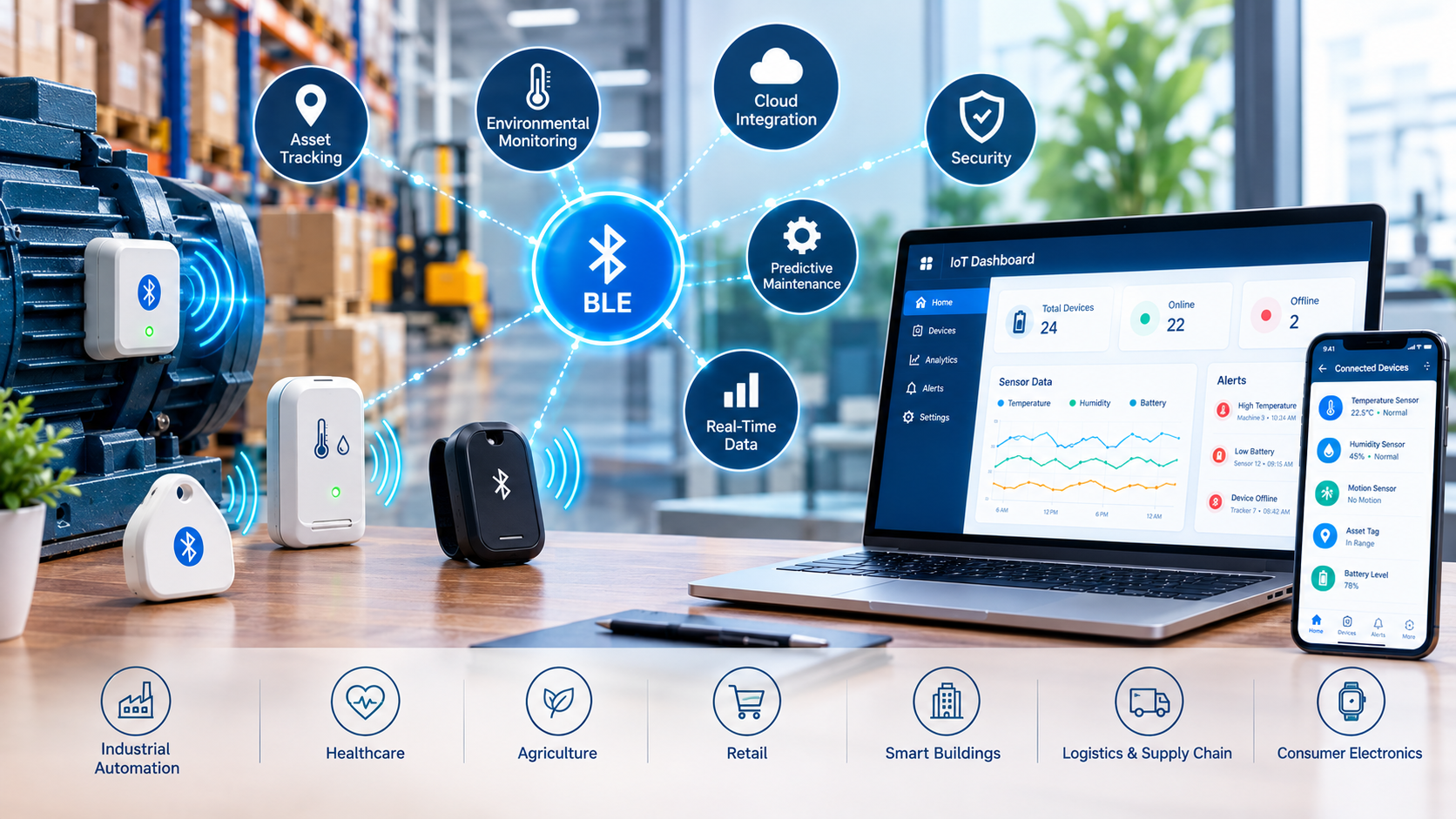
    • Smart sensors: Capture measurements such as temperature, motion, humidity, and vibration.
    • BLE connectivity: Transfers data between compatible devices and nearby receivers.
    • Embedded firmware: Controls device behavior, communication, and power management.
    • Mobile applications: Allow users to configure devices and view information.
    • IoT gateways: Forward information from local devices to remote systems.
    • Cloud platforms: Store, process, and analyze device data.
    • Monitoring dashboards: Present device status, trends, and alerts.

    Not every project requires every component. The right architecture depends on the product’s communication range, battery requirements, data volume, security needs, and operating environment.

    7 Innovative Applications of IoT and BLE in 2026

    1. Intelligent Asset Monitoring

    Businesses often lose time locating tools, equipment, and inventory across warehouses, factories, and commercial facilities.

    BLE beacons and compatible asset tags can help identify nearby assets and monitor their presence in designated areas.

    An IoT asset tracking platform can combine device signals with gateway data to provide operational visibility.

    Potential applications include:

    • Equipment location and proximity monitoring.
    • Asset utilization reporting.
    • Movement alerts between designated zones.
    • Inventory visibility.
    • Maintenance workflow integration.

    The achievable location accuracy depends on the deployment design. BLE signals alone do not guarantee precise indoor positioning.

    2. Smart Agriculture and Environmental Sensing

    Agricultural businesses need reliable information about growing conditions, water availability, and environmental changes.

    Connected sensors can collect soil moisture, temperature, humidity, and other measurements. BLE can transfer readings locally to a compatible gateway or mobile device, while an IoT platform can organize the data for analysis.

    For example, a farm monitoring system could notify an operator when soil moisture falls below a configured threshold.

    A well-designed solution can help farmers make more informed irrigation decisions, although the results depend on sensor quality, placement, connectivity, and local conditions.

    3. Industrial Equipment Health Monitoring

    Unexpected equipment failures can increase maintenance costs and interrupt production.

    IoT sensors can monitor operating conditions such as temperature and vibration. BLE-enabled devices may transmit selected measurements to nearby receivers for processing and analysis.

    The monitoring application can then flag abnormal readings and help maintenance teams prioritize inspections.

    Industrial implementations should consider radio interference, metal enclosures, environmental conditions, device durability, and the consequences of delayed or missing data.

    4. Connected Healthcare and Wearable Devices

    Wearable technology and compatible medical monitoring products use wireless connectivity to exchange information with mobile applications and other systems.

    BLE can support communication between sensors and smartphones, while additional software can present readings, device status, and notifications.

    Depending on the product, development may involve embedded firmware, mobile app development, secure data transfer, cloud integration, and device management.

    Healthcare applications require careful attention to privacy, accuracy, reliability, and applicable medical-device regulations. A general-purpose wearable should not be assumed to provide clinically validated measurements.

    5. Smart Buildings and Energy Management

    Commercial buildings contain lighting systems, environmental sensors, occupancy devices, and equipment that may benefit from better monitoring.

    IoT and BLE solutions can support selected building automation tasks, including wireless sensor configuration, room-level environmental monitoring, and equipment identification.

    Connected dashboards can help facility managers view readings and identify unusual conditions.

    For larger deployments, developers should evaluate device density, gateway placement, interoperability, and integration with existing building management systems.

    6. Smart Retail and Customer Experiences

    Retail businesses can use connected sensors and BLE beacons to support proximity-based experiences and operational analytics.

    For example, a store application could provide location-aware information when a customer with the appropriate application and permissions enters a monitored area.

    IoT solutions can also support equipment monitoring, environmental sensing, and inventory visibility.

    Businesses should design these experiences with privacy and consent in mind. BLE infrastructure does not automatically identify individual shoppers or guarantee that every nearby smartphone will detect a beacon.

    7. Connected Consumer Electronics

    Smart locks, fitness accessories, connected appliances, and other consumer products often rely on communication between hardware and mobile applications.

    BLE can simplify initial setup, local control, configuration, and status monitoring.

    However, a successful connected product requires more than pairing. It should also handle connection failures, firmware compatibility, device recovery, and security updates.

    Developers must consider the complete user experience, from first-time setup to long-term maintenance.

    IoT and BLE Development: The Technology Stack Explained

    A reliable connected product combines multiple engineering disciplines.

    Technology layerPrimary purpose
    Hardware and sensorsCapture physical measurements and interact with the environment
    Embedded firmwareControl device operation and communication
    BLE communicationExchange data with compatible nearby devices
    Mobile applicationConfigure, control, and monitor devices
    IoT gatewayConnect local devices to broader networks
    Cloud backendStore information and manage connected devices
    Analytics dashboardPresent trends, alerts, and operational insights
    Security infrastructureProtect devices, data, and authorized access

    Choosing technologies independently can create integration problems. The hardware, firmware, connectivity architecture, and application software should be designed together.

    BLE vs. Wi-Fi for IoT Products

    Choosing a wireless protocol is one of the earliest technical decisions in connected product development.

    FactorBluetooth Low EnergyWi-Fi
    Power consumptionDesigned for low-energy operationOften requires more power
    Typical roleNearby device communicationNetwork connectivity and higher data throughput
    Internet accessUsually requires a phone or gateway intermediaryCan connect directly through a suitable network
    Common applicationsWearables, sensors, beaconsCameras, connected appliances, high-data devices
    Design prioritiesBattery life and local connectivityBandwidth and network integration

    Neither technology is universally superior. BLE can be suitable for battery-powered sensors, while Wi-Fi may be preferable when devices need higher throughput or direct network access.

    Some IoT architectures use BLE for local communication and Wi-Fi or cellular connectivity for backhaul.

    Five Challenges in IoT and BLE Product Development

    1. Battery Life Optimization

    A connected device may need to operate for months or years without a battery replacement.

    Power consumption depends on advertising intervals, connection parameters, sensor sampling, transmission frequency, processing workload, and hardware selection.

    Engineers should measure actual current consumption and validate battery-life estimates under realistic operating conditions.

    2. Reliable Wireless Communication

    Wireless performance can change because of distance, physical obstructions, interference, antenna design, and the number of active devices.

    Testing should reflect the intended deployment environment rather than relying exclusively on laboratory results.

    3. Device Security

    Connected products can introduce risks if devices accept unauthorized connections or use insecure firmware updates.

    Security planning should include appropriate authentication, protected communication, secure provisioning, access control, and a process for managing vulnerabilities throughout the product lifecycle.

    4. Cross-Platform Compatibility

    Products that communicate with smartphones must account for differences in operating systems, hardware, permissions, and background execution behavior.

    Compatibility testing should cover pairing, reconnection, data transfer, error handling, and supported device configurations.

    5. Scaling from Prototype to Production

    A prototype may work well with a handful of devices but encounter challenges when deployed across hundreds or thousands of units.

    Production-ready IoT platforms need reliable device registration, monitoring, firmware version management, data handling, and operational support.

    Planning for scalability early can reduce costly redesigns later.

    How to Develop an IoT and BLE Product Successfully

    A structured development process helps businesses move from concept to a reliable connected product.

    Step 1: Define the use case.

    Determine what the product should measure, control, communicate, or automate.

    Step 2: Select hardware and connectivity.

    Choose suitable sensors, BLE chipsets, antennas, batteries, and gateway options.

    Step 3: Develop embedded firmware.

    Implement device logic, communication services, power management, and recovery behavior.

    Step 4: Build the mobile or web application.

    Create interfaces for device configuration, monitoring, and user interaction.

    Step 5: Integrate cloud infrastructure.

    Add device management, data storage, analytics, and notifications where required.

    Step 6: Test performance and security.

    Evaluate connectivity, battery life, environmental conditions, device compatibility, and security controls.

    Step 7: Prepare for deployment and maintenance.

    Establish monitoring, firmware updates, technical support, and a process for resolving production issues.

    This end-to-end approach helps ensure that connectivity, hardware, and software work together as a coherent product.

    Why Choose IoTBLE for Connected Device Development?

    Businesses creating smart products need a development approach that connects physical hardware with dependable software.

    An experienced IoT and BLE development partner can support projects involving Bluetooth Low Energy integration, sensor connectivity, embedded firmware, mobile application development, IoT gateways, cloud integration, and device monitoring platforms.

    When evaluating a development partner, businesses should review experience with relevant hardware, wireless communication requirements, integration challenges, security testing, and long-term maintenance.

    The objective is to create a connected product that solves a real business problem while meeting its requirements for power consumption, reliability, usability, and cost.

    Frequently Asked Questions

    What is IoT BLE development?

    IoT BLE development involves creating connected products that use Bluetooth Low Energy to exchange data between compatible sensors, embedded devices, mobile applications, gateways, and software platforms.

    Can BLE devices connect to the internet?

    BLE devices generally communicate with nearby compatible devices rather than directly accessing the internet. A smartphone or gateway can forward their information to an internet-connected platform.

    Which industries benefit from IoT and BLE solutions?

    Manufacturing, healthcare, agriculture, retail, logistics, building management, and consumer electronics can benefit from appropriately designed connected-device solutions.

    How much does IoT product development cost?

    Costs vary according to hardware complexity, firmware development, mobile applications, cloud infrastructure, testing, certifications, and production requirements. A clearly defined scope helps establish a realistic estimate.

    Is BLE suitable for battery-powered IoT devices?

    Yes. BLE is designed for low-energy wireless communication and can be suitable for battery-powered sensors and accessories. Actual battery life depends on hardware, configuration, workload, and operating conditions.

    What is the difference between BLE and an IoT platform?

    BLE provides wireless communication between compatible devices. An IoT platform typically manages connected devices, processes data, stores information, generates alerts, and provides monitoring or analytics capabilities.

    Conclusion

    The combination of IoT and Bluetooth Low Energy is helping businesses create smarter products, improve operational visibility, and connect physical devices with digital services.

    From asset tracking and environmental sensing to industrial monitoring and consumer electronics, the opportunities extend across industries. However, successful implementation depends on thoughtful hardware selection, efficient firmware, reliable connectivity, secure data handling, and well-integrated software.

    Businesses planning their next connected product should treat IoT development as an end-to-end engineering challenge rather than simply adding wireless connectivity.

    Building a connected product in 2026? Explore IoT and BLE development with IoTBLE and identify the right combination of hardware, connectivity, and software for your project.


    SEO Metadata

    SEO Title: IoT and BLE Development in 2026: Connected Product Solutions

    Meta Description: Discover IoT and BLE development solutions for smart sensors, asset tracking, industrial monitoring, connected devices, and Bluetooth Low Energy integration.

    Suggested URL Slug: /blogs/iot-ble-development-connected-products-2026/

    Primary Keyword: IoT BLE development

    Secondary Keywords:

    • IoT product development
    • Bluetooth Low Energy integration
    • BLE development services
    • Connected device development
    • IoT software development
    • BLE firmware development
    • Smart sensor development
    • IoT mobile app development
    • Industrial IoT solutions
    • Bluetooth IoT connectivity

    Suggested Internal Links:

    • IoT Product Development
    • BLE Development Services
    • Bluetooth Application Development
    • Embedded Software Development
    • IoT Mobile App Development

    Suggested Image Alt Text: IoT and BLE connected sensors communicating with a smart device monitoring platform

    Recommended Schema: BlogPosting, BreadcrumbList, and Organization. Implement FAQPage structured data only where appropriate for the website and current search engine guidelines.

  • Beyond Device Connectivity: How BLE-to-Cloud Integration Is Transforming IoT Product Development in 2026

    Beyond Device Connectivity: How BLE-to-Cloud Integration Is Transforming IoT Product Development in 2026

    Introduction

    Connecting a device to a smartphone is only the beginning of a successful Internet of Things (IoT) product. The real challenge is creating a reliable system in which devices collect data, applications interpret it, and cloud platforms make that information useful.

    In 2026, businesses developing connected products need more than wireless communication. They need secure device pairing, efficient data transmission, dependable firmware, mobile application connectivity, and scalable cloud infrastructure.

    This is where IoT product development, Bluetooth Low Energy (BLE) integration, and cloud-connected software work together.

    IoTBLE helps businesses explore connected product solutions that combine BLE device communication, IoT system integration, sensor networks, gateways, and cloud connectivity. The objective is to turn individual devices into useful, manageable, and scalable connected systems.

    1. Why BLE-to-Cloud Integration Matters for IoT Products

    Bluetooth Low Energy is designed for wireless communication with relatively low power consumption, making it suitable for many battery-powered connected devices.

    However, BLE devices generally do not connect directly to cloud services on their own. A smartphone, dedicated gateway, or another suitable intermediary typically bridges the device to an internet-connected platform.

    A complete BLE-to-cloud architecture may include:

    • BLE-enabled hardware and embedded firmware.
    • Secure device discovery, pairing, and communication.
    • A mobile application or IoT gateway.
    • Backend APIs and cloud infrastructure.
    • Data storage, monitoring dashboards, and alerts.
    • Device management and firmware update mechanisms.

    When these components work together, businesses can develop connected products that provide useful information and support remote monitoring.

    2. IoT Product Development Beyond the Prototype

    A working prototype demonstrates that an idea is technically possible. A production-ready IoT product must also work reliably under real-world conditions.

    Professional IoT product development services consider hardware compatibility, connectivity, power consumption, firmware behavior, software integration, and long-term maintenance.

    The development process typically includes:

    Requirements and feasibility: Define the product’s purpose, target users, hardware, connectivity needs, and expected operating conditions.

    System architecture: Determine how devices, mobile applications, gateways, APIs, and cloud services will communicate.

    Prototype development: Validate critical functionality using representative hardware and software.

    Integration and testing: Test device communication, data handling, connectivity recovery, and security controls.

    Deployment and maintenance: Monitor production performance, address issues, and plan updates.

    This approach helps identify technical risks early and reduces the likelihood of expensive integration problems later.

    3. BLE Device Development for Low-Power Connected Products

    BLE is useful when a product needs to exchange relatively small amounts of data with nearby devices while managing power consumption.

    Examples include smart wearables, environmental sensors, access-control devices, connected consumer products, and industrial monitoring equipment.

    A well-designed BLE device development project may involve:

    • BLE peripheral and central implementations.
    • Custom Generic Attribute Profile (GATT) services and characteristics.
    • Device discovery and connection management.
    • Secure pairing and bonding.
    • Embedded firmware integration.
    • Signal and power optimization.
    • Mobile application communication.
    • Compatibility and interoperability testing.

    The correct implementation depends on the hardware, Bluetooth specification, communication requirements, and expected operating environment.

    4. Smart Sensor Networks for Real-Time Monitoring

    Sensor networks allow businesses to collect information from multiple devices and use it to understand operational conditions.

    For example, industrial sensors may monitor temperature, humidity, vibration, or equipment status. A gateway can aggregate sensor data and forward it to a cloud platform for visualization and analysis.

    Smart sensor network development can help organizations:

    • Monitor environmental conditions.
    • Identify abnormal readings.
    • Track equipment operating conditions.
    • Generate alerts when thresholds are exceeded.
    • Analyze historical sensor data.
    • Improve visibility across distributed locations.

    Reliable sensor networks require appropriate sampling intervals, data validation, connectivity planning, and a strategy for handling missing or delayed measurements.

    Real-time monitoring also depends on the system architecture and connection quality; not every IoT deployment requires instantaneous cloud updates.

    5. IoT Gateway and Cloud Connectivity

    A gateway acts as a bridge between connected devices and broader networks or cloud services.

    In a BLE-based system, a gateway can receive data from nearby BLE devices and forward it through an internet connection. Depending on the design, a compatible smartphone may also perform this bridging role.

    IoT gateway development and cloud connectivity solutions can include:

    • Device-to-gateway communication.
    • Secure API integration.
    • Data ingestion and processing.
    • Cloud-based device registration.
    • Remote monitoring dashboards.
    • Device status and event notifications.
    • Connectivity recovery and error handling.

    A suitable gateway architecture can also support local processing when internet access is unavailable or immediate responses are required.

    Businesses should select their cloud architecture according to expected device volume, data frequency, security requirements, operating costs, and integration needs.

    6. Secure Device Provisioning and BLE Communication

    Device provisioning is the process of securely registering and configuring a device so it can operate within an application or IoT ecosystem.

    Poor provisioning can create onboarding difficulties, unauthorized access risks, and device-management problems.

    A robust provisioning workflow should consider:

    1. Device identity and authentication.
    2. Secure pairing and bonding where appropriate.
    3. User or organization ownership.
    4. Protected configuration and credentials.
    5. Authorization for device commands.
    6. Recovery and device-transfer procedures.

    BLE security mechanisms should be selected according to the threat model and supported hardware. Applications should not treat a successful Bluetooth connection as proof that a device or user is authorized.

    For cloud-connected products, security must extend beyond BLE communication to APIs, firmware, cloud accounts, data storage, and administrative interfaces.

    7. Over-the-Air Firmware Updates for Connected Devices

    Connected products often need firmware updates to improve functionality, address vulnerabilities, or correct device behavior.

    Over-the-air (OTA) firmware updates can reduce the need to access every device physically, particularly when products are deployed across multiple locations.

    A reliable OTA process should include:

    • Firmware authenticity and integrity verification.
    • Secure update authorization.
    • Compatibility checks.
    • Adequate power and connectivity checks.
    • Progress reporting and failure handling.
    • Recovery or rollback mechanisms where supported.
    • Post-update validation.

    For BLE-enabled devices, firmware transfer speed and reliability depend on device capabilities, connection parameters, packet handling, and the update design.

    Planning OTA functionality early can make long-term product maintenance easier and safer.

    8. Industries Benefiting from BLE and IoT Integration

    Healthcare and wearable technology

    Connected devices can transmit measurements to mobile applications for display and further processing. Products handling sensitive health information require appropriate privacy, security, and validation practices.

    Manufacturing and industrial monitoring

    Sensor-based systems can provide visibility into equipment conditions, environmental measurements, and selected operational events.

    Smart buildings

    BLE sensors and compatible gateways can support environmental monitoring, occupancy-related applications, and connected building systems.

    Logistics and asset tracking

    Connected sensors and beacon technologies can assist with asset visibility and proximity detection. Accuracy depends on the chosen positioning technology and deployment conditions.

    Consumer electronics

    Mobile applications can help users configure, monitor, and control compatible connected products.

    Each industry has different requirements for connectivity, reliability, security, and data handling, so solutions should be designed around the actual use case.

    9. How IoTBLE Supports Connected Product Development

    IoTBLE focuses on BLE and IoT development capabilities for businesses planning connected products and integrated device ecosystems.

    Depending on project requirements, relevant capabilities include:

    • BLE device communication and integration.
    • IoT application development.
    • Custom GATT service implementation.
    • Secure device provisioning and pairing.
    • Smart sensor network development.
    • IoT gateway and cloud connectivity.
    • Embedded firmware integration.
    • OTA firmware update workflows.
    • Mobile application connectivity.
    • Monitoring dashboards and data integration.

    Combining these elements into a coordinated architecture helps businesses plan beyond initial connectivity and consider the entire product lifecycle.

    If you are developing a new connected device or upgrading an existing IoT platform, define the required hardware, communication protocols, data flow, security controls, and user experience before selecting the final architecture.

    10. How to Choose the Right IoT Development Partner

    Choosing an IoT development company requires evaluating the complete technology stack rather than focusing on a single component.

    Before beginning a project, consider the following questions:

    • Does the team understand BLE protocols and device behavior?
    • Can it integrate embedded firmware with mobile and cloud software?
    • Does it have experience with device provisioning and connectivity troubleshooting?
    • Can it implement suitable security controls?
    • Does its testing process cover real hardware and operating conditions?
    • Can the architecture support future features and additional devices?
    • Is maintenance and firmware update support available?

    A development partner should be able to explain the technical trade-offs, identify project risks, and establish a practical implementation plan.

    Conclusion

    The future of connected products depends on more than adding wireless connectivity to hardware. Successful IoT solutions require coordinated device engineering, reliable BLE communication, secure provisioning, cloud integration, and ongoing maintenance.

    From BLE development services to IoT gateway development, sensor networks, and cloud-connected applications, a well-planned architecture can help businesses build connected products that are easier to manage, maintain, and expand.

    IoTBLE supports businesses exploring BLE and IoT development opportunities with an emphasis on device connectivity, system integration, and connected product requirements.

    Planning a BLE or IoT product? Visit IoTBLE to discuss your project requirements and explore a suitable connected-device development approach.

    Frequently Asked Questions

    1. What is BLE-to-cloud integration?

    BLE-to-cloud integration connects Bluetooth Low Energy devices to cloud platforms through an intermediary, such as a smartphone or dedicated gateway, allowing data to be transmitted, stored, and processed.

    2. What are IoT product development services?

    IoT product development services can include system architecture, embedded software, device connectivity, mobile applications, cloud integration, testing, and ongoing product support.

    3. What is the role of an IoT gateway?

    An IoT gateway connects devices or local networks with other systems and cloud platforms. It can bridge protocols, forward data, and perform selected local processing.

    4. Why is BLE useful for IoT devices?

    BLE is useful for many short-range applications because it supports wireless communication with relatively low power consumption. Its suitability depends on range, throughput, latency, hardware, and application requirements.

    5. What is OTA firmware updating?

    OTA firmware updating allows compatible devices to receive and install firmware updates remotely, subject to appropriate security, compatibility, and recovery mechanisms.

    6. How can businesses secure BLE and IoT devices?

    Businesses should use suitable device authentication, secure pairing, protected APIs, access controls, signed firmware updates, and ongoing security testing throughout the product lifecycle.


    SEO keyword strategy

    Primary keyword

    • IoT product development

    Secondary keywords

    • BLE IoT development
    • BLE development services
    • IoT development company
    • IoT system integration
    • BLE device development
    • IoT gateway development
    • IoT cloud connectivity
    • Smart sensor network development
    • BLE-to-cloud integration
    • IoT application development

    Long-tail keywords

    • Custom BLE and IoT product development services
    • Bluetooth Low Energy integration for IoT devices
    • IoT gateway and cloud integration solutions
    • Secure BLE device provisioning and pairing
    • Over-the-air firmware updates for IoT devices
    • Connected device development for industrial monitoring

    Suggested internal links

    • BLE Device Development
    • IoT System Integration
    • Smart Sensor Networks
    • Gateway and Cloud Connectivity
    • BLE Application Development

    Link each phrase to the corresponding IoTBLE service page when that page exists. Avoid adding links to nonexistent URLs.

  • The Invisible Internet: How BLE Beacons and IoT Are Changing Indoor Navigation in 2026

    The Invisible Internet: How BLE Beacons and IoT Are Changing Indoor Navigation in 2026

    Introduction: What If Buildings Could Guide You?

    Imagine entering a hospital and finding your department without asking for directions. A warehouse worker locates a specific product in seconds. A shopper receives helpful navigation inside a large shopping center without relying on GPS.

    These experiences are becoming possible through indoor positioning technologies, including Bluetooth Low Energy (BLE) beacons and the Internet of Things (IoT).

    GPS works well outdoors, but its accuracy can be limited inside buildings because satellite signals struggle to penetrate walls and roofs. BLE-based systems offer another approach by using nearby wireless signals to estimate device proximity or location.

    In 2026, businesses are exploring these technologies to improve navigation, asset visibility, operational efficiency, and customer experiences.

    What Are BLE Beacons and How Do They Work?

    BLE beacons are small wireless transmitters that periodically broadcast Bluetooth signals. Compatible smartphones, gateways, or other devices can detect these signals and use them for different applications.

    A typical BLE indoor navigation system includes:

    • BLE beacons: Broadcast identifiable wireless signals.
    • Mobile applications: Detect beacon signals and provide directions or contextual information.
    • IoT gateways: Collect information from nearby devices when required.
    • Location software: Estimates proximity or position using signal measurements and system configuration.
    • Management dashboards: Help businesses monitor devices, locations, and system activity.

    For example, a hospital may install beacons in corridors and waiting areas. Its mobile application can use detected signals to identify nearby zones and guide visitors toward their destinations.

    The accuracy depends on beacon placement, building layout, radio interference, device capabilities, and the positioning method used.

    Five Industries Exploring BLE Indoor Navigation

    1. Hospitals and Healthcare Facilities

    Large hospitals often contain multiple departments, diagnostic laboratories, pharmacies, and specialist clinics.

    BLE-based indoor navigation can help visitors find departments, elevators, reception desks, and waiting areas.

    Potential benefits include:

    • Easier navigation for patients and visitors.
    • Location-aware information through mobile applications.
    • Better orientation in large medical facilities.
    • Support for locating tagged equipment when the system is designed for asset tracking.

    Healthcare implementations should protect personal information and avoid assuming that proximity data alone establishes a person’s precise location.

    2. Warehouses and Distribution Centers

    Finding inventory and equipment in a large warehouse can consume valuable time.

    BLE tags and receivers can support asset visibility by helping organizations detect tagged items in particular zones or estimate their location.

    When integrated with warehouse management software, these systems can help staff find tools, track equipment movement, and improve inventory workflows.

    For applications requiring centimeter-level accuracy, BLE alone may not be sufficient without specialized positioning techniques or complementary technologies.

    3. Shopping Malls and Retail Stores

    Retailers can use BLE beacons to support indoor maps, location-aware offers, and store discovery.

    For example, a shopping center application could help visitors find a particular store or display relevant information when they approach a designated area.

    Businesses should prioritize useful, permission-based notifications instead of sending excessive promotional messages.

    4. Airports and Transportation Hubs

    Airports, railway stations, and convention centers can be difficult to navigate because of their size and complex layouts.

    BLE-based systems can support indoor maps, wayfinding, and location-aware guidance to gates, platforms, service counters, and facilities.

    Reliable navigation requires careful deployment, frequent map updates, and testing across different mobile devices.

    5. Smart Offices and Commercial Buildings

    Connected buildings can use BLE to support room discovery, occupancy-related applications, and location-aware building services.

    Combined with suitable IoT sensors and building management platforms, these systems can provide additional insights into space utilization and operational patterns.

    Any monitoring solution should be designed with appropriate transparency, access controls, and privacy protections.

    BLE vs. GPS: Which Is Better for Indoor Navigation?

    GPS and BLE serve different purposes, and many location solutions use multiple technologies.

    FeatureBLE BeaconsGPS
    Best environmentIndoor and nearby-device applicationsOutdoor positioning
    InfrastructureUsually requires deployed beacons or compatible transmittersGenerally uses satellite signals
    Indoor performanceCan work indoors with proper deploymentOften limited inside buildings
    Typical applicationsIndoor wayfinding, proximity, asset visibilityRoad navigation, outdoor tracking
    AccuracyDepends on configuration and positioning methodDepends on signal conditions and receiver

    BLE is not automatically more accurate in every building. The right choice depends on the environment, required accuracy, infrastructure cost, and user experience.

    How AI Can Make BLE and IoT Navigation Smarter

    BLE provides wireless signals, while IoT systems organize and process information from connected devices. AI and analytics can add another layer of intelligence.

    Potential applications include:

    Navigation optimization: Analyze aggregated movement patterns to identify confusing routes or heavily congested areas.

    Predictive maintenance: Use device-health data to identify beacons or gateways that may need attention.

    Crowd-flow insights: Help facility managers understand general traffic patterns using appropriately aggregated data.

    Context-aware assistance: Combine location estimates with maps and user-selected destinations to provide more relevant directions.

    AI cannot eliminate inaccurate signals or poor infrastructure. Reliable outcomes still depend on suitable hardware, quality data, and well-tested positioning logic.

    Common Challenges in BLE Indoor Positioning

    Although BLE can be cost-effective and flexible, successful deployment requires careful planning.

    Signal Interference

    Walls, metal structures, people, and other radio sources can affect Bluetooth signal strength. Site surveys and real-world testing help determine appropriate beacon placement.

    Location Accuracy

    A beacon detection may indicate that a device is nearby without identifying its exact position. More advanced methods, calibration, or additional sensors may be needed for precise navigation.

    Battery Life and Maintenance

    Battery-powered beacons require a maintenance plan based on transmission intervals, hardware specifications, and expected operating conditions.

    Device Compatibility

    Mobile operating systems have Bluetooth permissions and background-operation restrictions. Applications must account for these behaviors and obtain the necessary user permissions.

    Privacy and Security

    Organizations should consider secure system administration, appropriate data retention, transparent location-data practices, and access controls.

    How to Develop a BLE Indoor Navigation Solution

    Businesses planning a BLE navigation product can follow a structured development process.

    1. Define the objective: Decide whether the priority is wayfinding, asset tracking, proximity notifications, or another use case.
    2. Survey the environment: Assess the building layout, walls, interference, and required coverage.
    3. Select the hardware: Choose appropriate beacons, gateways, and receivers.
    4. Choose a positioning method: Determine whether proximity zones, signal-strength estimates, or more advanced techniques meet the accuracy requirements.
    5. Develop the application: Build indoor maps, route guidance, search, and accessible navigation features.
    6. Integrate IoT services: Connect the system to relevant dashboards, databases, or business applications.
    7. Test and optimize: Validate performance in busy and quiet conditions, across supported devices.
    8. Plan maintenance: Establish procedures for battery replacement, map updates, monitoring, and software improvements.

    A pilot deployment in one floor or department can help businesses measure accuracy and usability before expanding across an entire facility.

    The Future of BLE and Indoor Location Technology

    Indoor positioning is evolving alongside connected devices, digital mapping, edge computing, and smart-building platforms.

    BLE can provide a practical foundation for proximity-based services, while additional sensors and positioning methods can improve location estimates where necessary.

    The strongest implementations will focus on solving specific problems: helping people find their destinations, reducing time spent searching for equipment, and giving facility managers useful operational information.

    Instead of adding beacons simply because the technology is available, businesses should begin with a clear goal and measurable outcomes.

    Conclusion

    BLE beacons and IoT are creating new possibilities for indoor navigation across healthcare, retail, logistics, transportation, and commercial buildings.

    By combining wireless hardware, mobile applications, positioning software, and connected platforms, organizations can build indoor experiences that are more informative and convenient.

    For companies exploring connected product development, the opportunity lies in designing a solution that balances location accuracy, affordability, reliability, and privacy.

    IoTBLE insight: The future of indoor navigation isn’t just about knowing where you are. It’s about helping you decide where to go next.

    Frequently Asked Questions

    What is BLE indoor positioning?

    BLE indoor positioning uses Bluetooth Low Energy signals from beacons or devices to estimate proximity or location within a building.

    Can BLE be used for indoor navigation without GPS?

    Yes. A properly designed BLE-based system can support indoor navigation without relying on GPS, although it may use maps, gateways, or other positioning technologies.

    How accurate is BLE indoor positioning?

    Accuracy varies significantly with hardware, beacon placement, environmental conditions, and the positioning technique. Proximity detection is generally simpler than precise coordinate-based tracking.

    Do BLE beacons need Wi-Fi?

    BLE beacons can broadcast Bluetooth signals without Wi-Fi. However, applications may require internet access or gateways for map downloads, remote monitoring, and cloud integration.

    What businesses can benefit from BLE IoT solutions?

    Hospitals, warehouses, retailers, airports, offices, museums, and other large facilities can benefit when indoor navigation or location awareness addresses a genuine operational need.


    SEO title: BLE Indoor Navigation in 2026: Beacons, IoT and Smart Buildings

    Meta description: Discover how BLE beacons and IoT enable indoor navigation, asset tracking, smart buildings, and location-aware applications in 2026.

    Primary keyword: BLE indoor navigation

    Secondary keywords: BLE beacon technology, BLE IoT solutions, indoor positioning system, Bluetooth indoor navigation, IoT asset tracking, BLE beacon development, smart building technology.

    Suggested URL slug: /blogs/ble-indoor-navigation-iot-2026/

  • The Internet of Things Is Getting Smarter: How BLE and Edge AI Are Transforming Connected Devices in 2026

    The Internet of Things Is Getting Smarter: How BLE and Edge AI Are Transforming Connected Devices in 2026

    Introduction: What If Your IoT Devices Could Think Locally?

    Imagine a factory sensor that detects an unusual machine vibration and immediately alerts a technician. A smart building that adjusts its environment based on occupancy. A wearable device that identifies an unusual pattern without continuously sending raw data to the cloud.

    These applications represent an important direction for the Internet of Things (IoT): combining efficient wireless connectivity with intelligent processing.

    Bluetooth Low Energy (BLE) enables compatible devices to communicate while supporting power-conscious designs. Edge AI allows suitable devices or nearby computing systems to analyze information closer to where it is collected.

    Together, these technologies can help businesses build connected products that respond more quickly, reduce unnecessary data transfers, and support smarter automation.

    In 2026, the opportunity is not simply to connect more devices. It is to make connected systems more useful, responsive, and efficient.

    What Is BLE-Powered Edge AI?

    BLE-powered edge AI combines Bluetooth Low Energy communication with artificial intelligence processing performed on a device, gateway, smartphone, or other nearby computing system.

    A typical architecture includes four components:

    • Sensors and connected devices: Collect temperature, movement, vibration, location-related signals, or other measurements.
    • BLE connectivity: Transfers selected data between compatible devices and receivers.
    • Edge processing: Analyzes information locally using rules, lightweight machine-learning models, or other algorithms.
    • Applications and cloud platforms: Display results, manage devices, generate reports, and coordinate wider operations when required.

    Not every BLE device needs to run an AI model itself. A small battery-powered sensor might transmit measurements to a nearby gateway that performs the analysis.

    This distinction matters because processing requirements, battery capacity, memory, and hardware capabilities vary considerably across IoT products.

    Why This Technology Combination Matters in 2026

    Traditional IoT architectures often send collected information to remote servers for processing. That approach remains useful, but it is not always ideal when applications need rapid responses, intermittent connectivity, or reduced data transmission.

    Combining BLE with edge processing can address several practical challenges.

    1. Faster Responses

    Local processing can reduce dependence on round trips to a remote cloud service.

    For example, a gateway monitoring industrial equipment could detect a predefined vibration threshold and trigger an immediate local alert.

    The actual response time depends on the hardware, communication interval, processing workload, and application design.

    2. More Efficient Data Transfers

    Instead of transmitting every raw measurement continuously, a device or gateway can process readings and send summaries, events, or anomalies.

    This can reduce network traffic and cloud processing requirements when the application permits selective reporting.

    3. Better Support for Intermittent Connectivity

    Some industrial sites, remote facilities, and mobile environments experience unreliable internet access.

    Local processing allows certain monitoring and automation functions to continue while cloud connectivity is unavailable. Data can be synchronized later if the system has suitable storage and recovery mechanisms.

    4. Greater Control Over Sensitive Data

    Processing information locally can reduce the amount of raw data sent to external services.

    However, edge processing does not automatically guarantee privacy. Device security, access controls, encryption, data retention, and software updates remain essential.

    Five Real-World Applications of BLE and Edge Intelligence

    1. Predictive Maintenance for Industrial Equipment

    Unexpected equipment failure can interrupt production and increase maintenance costs.

    BLE-enabled sensors can collect measurements such as vibration and temperature. A nearby gateway can analyze the data to identify abnormal patterns and notify maintenance personnel.

    Example: A factory monitors selected motors and flags unusual vibration patterns for inspection before a problem causes a major disruption.

    This approach can support condition monitoring, although reliable predictive maintenance requires appropriate sensors, sufficient data, and validated detection models.

    2. Smart Buildings That Respond to Occupancy

    Commercial buildings can use compatible BLE sensors and occupancy-related systems to understand how rooms and facilities are being used.

    Edge processing can help coordinate lighting, ventilation, or room-level automation according to predefined rules and sensor inputs.

    Example: A meeting room automation system uses occupancy information to manage lighting and report underused spaces.

    The system must be designed around privacy expectations, sensor accuracy, and the building’s existing control infrastructure.

    3. Intelligent Asset Tracking

    Warehouses, hospitals, and manufacturing facilities often need better visibility into tools, equipment, and reusable inventory.

    BLE tags or beacons can transmit identifiers that compatible receivers detect. Gateways can process sightings and provide information about an asset’s last detected area.

    Edge analytics can help identify unexpected movement or assets that have not appeared at required checkpoints.

    BLE beacon detection does not necessarily provide precise positioning. Accuracy depends on receiver placement, environmental conditions, signal characteristics, and the positioning method.

    4. Wearables and Personal Devices

    Wearable products can combine BLE connectivity with local processing to monitor activity, recognize selected patterns, or transfer measurements to a smartphone.

    A device might process some information locally and send only relevant summaries to a mobile application.

    For health-related applications, accuracy, clinical validation, data protection, and applicable regulatory requirements must be considered separately from wireless connectivity.

    5. Smart Retail and Connected Products

    Retailers can use BLE-connected sensors and devices for electronic shelf labels, equipment monitoring, inventory workflows, and proximity-based experiences.

    Edge systems can process local events and communicate selected updates to a central platform.

    For example, a gateway may collect data from multiple connected devices and flag missing inventory updates before synchronizing with a retail management system.

    The result is a more responsive system without requiring every device to maintain its own direct cloud connection.

    BLE vs. Wi-Fi vs. Zigbee: Which Is Right for Your IoT Product?

    Choosing a connectivity technology depends on the product’s requirements rather than a single universal winner.

    RequirementBLEWi-FiZigbee
    Typical strengthsLow-power peripheral connectivityHigher-bandwidth networkingLow-power mesh networking
    Common applicationsWearables, sensors, beaconsCameras, appliances, gatewaysSmart lighting, building controls
    Device communicationDirect connections and supported broadcast modesInfrastructure-based networkingMesh-based networking
    Internet accessOften through a phone or gatewayCan connect through a routerTypically through a compatible gateway
    Key considerationRange and connection behaviorPower consumption and network capacityMesh design and interoperability

    BLE, Wi-Fi, and Zigbee have different capabilities and trade-offs. A connected product may even combine them—for example, BLE for sensor communication and Wi-Fi for gateway-to-cloud connectivity.

    The Technical Challenges Developers Must Solve

    Combining BLE with intelligent processing creates opportunities, but successful products require careful engineering.

    Battery management: Advertising intervals, connection parameters, processing frequency, and peripheral selection affect power consumption.

    Wireless reliability: Interference, physical obstructions, device density, and receiver placement can affect communication.

    Edge hardware limitations: Smaller devices may lack the memory, processing power, or energy budget needed for complex AI models.

    Data quality: Inaccurate sensors, missing measurements, and inconsistent sampling can reduce the usefulness of analytics.

    Security: Secure pairing, authentication, encryption, firmware updates, and access management must be considered throughout the product lifecycle.

    Device management: Commercial deployments need reliable provisioning, diagnostics, updates, monitoring, and recovery procedures.

    The best architecture balances intelligence, battery life, responsiveness, connectivity, and development cost.

    How to Build a BLE and Edge AI IoT Product

    A practical development process starts with the use case and works toward the right combination of hardware and software.

    Step 1: Define the Problem

    Determine what the device must measure, what decisions need to be made, and how the solution will improve an existing workflow.

    Step 2: Select the Hardware

    Choose sensors, a BLE-capable microcontroller, power components, and suitable edge hardware based on performance and environmental requirements.

    Step 3: Develop Firmware

    Implement sensor acquisition, wireless communication, power management, error handling, and secure device behavior.

    Step 4: Design the Data Processing Layer

    Decide whether analysis should run on the device, a smartphone, a gateway, or the cloud. Use the simplest approach that meets the product’s requirements.

    Step 5: Develop the Application

    Build the mobile or web interface for device setup, monitoring, notifications, reporting, and configuration.

    Step 6: Test in Real Conditions

    Evaluate communication range, battery life, processing accuracy, security, recovery from network interruptions, and performance at the expected device scale.

    Step 7: Prepare for Deployment

    Plan firmware updates, device provisioning, analytics, customer support, and long-term maintenance before rolling out the product.

    How IoTBLE Fits Into the Connected Technology Landscape

    The next generation of connected products will depend on more than wireless communication alone. Hardware, firmware, mobile applications, gateways, analytics, and cloud services must work together reliably.

    For businesses exploring BLE and IoT development, the starting point should be a clearly defined operational or customer problem.

    Whether the goal is smarter asset monitoring, a connected wearable, industrial sensing, or an energy-conscious device, selecting the right architecture early can help avoid unnecessary complexity later.

    IoTBLE focuses on the intersection of Bluetooth Low Energy and connected-device technology, where practical integration decisions help turn prototypes into usable products.

    Frequently Asked Questions

    Can BLE work with edge AI?

    Yes. BLE can transfer sensor data to a compatible smartphone, gateway, or processing device that runs AI models or other analytics locally. Some capable devices can also perform limited inference directly.

    Does BLE IoT require cloud connectivity?

    No. Many BLE applications can operate locally. Cloud connectivity is needed only for features such as remote access, centralized analytics, or internet-based synchronization.

    Can edge AI improve IoT battery life?

    It can, depending on the design. Local processing may reduce wireless data transfers, but AI computation also consumes energy. Battery life must be evaluated for the complete device and workload.

    Is BLE suitable for industrial IoT?

    BLE can be suitable for sensor monitoring, asset identification, configuration, and selected industrial workflows. Suitability depends on range, interference, environmental conditions, reliability requirements, and the wider system architecture.

    What is the difference between BLE and IoT?

    BLE is a wireless communication technology. IoT describes a broader ecosystem of connected physical devices, software, and data services. BLE is one of several connectivity options used in IoT systems.

    Conclusion: The Future of IoT Is Connected and Context-Aware

    The next step in IoT development is not simply adding connectivity to physical products. It is building systems that collect useful information, process it intelligently, and respond in ways that improve real-world operations.

    BLE offers a practical communication option for many low-power devices, while edge intelligence can help applications respond locally and manage data more efficiently.

    For businesses developing connected products in 2026, the opportunity lies in combining these capabilities with sound hardware design, secure firmware, reliable applications, and realistic testing.

    Exploring your next connected-device project? Visit IoTBLE to learn more about BLE and IoT technology and the possibilities for smarter connected products.

  • Your Next IoT Product Might Not Need Wi-Fi: The Hidden Power of Bluetooth Low Energy in 2026

    Your Next IoT Product Might Not Need Wi-Fi: The Hidden Power of Bluetooth Low Energy in 2026

    Imagine a warehouse where every valuable tool can be located, a hospital where equipment can report its status, or a factory where sensors detect problems before a machine stops working.

    Now imagine achieving these capabilities without connecting every device directly to Wi-Fi.

    That is where Bluetooth Low Energy (BLE) becomes interesting.

    As businesses rethink how connected products should communicate, BLE is emerging as a practical option for applications that need low-power wireless connectivity, local device interaction, and efficient data exchange. In 2026, the real opportunity is not simply connecting more devices. It is designing smarter products that use the right connection for the right job.

    The Big IoT Question: Does Every Device Need Wi-Fi?

    Wi-Fi is useful when devices need substantial bandwidth or direct access to an IP network. However, not every IoT product needs to transmit large amounts of data continuously.

    Consider a temperature sensor that records a reading every few minutes. A connected access tag that broadcasts its presence. A wearable device that synchronizes information with a smartphone.

    For these products, continuous Wi-Fi connectivity may introduce unnecessary power consumption, configuration complexity, or hardware requirements.

    BLE offers another approach: devices can communicate locally with compatible smartphones, gateways, or other supported systems, depending on the product architecture.

    The lesson for IoT product developers is simple: connectivity should follow the product’s purpose, not the latest technology trend.

    Five IoT Products That Become More Interesting With BLE

    1. The Tool That Tells You Where It Was Last Seen

    Imagine a maintenance company managing hundreds of specialized tools across multiple locations.

    A BLE tag attached to each tool can broadcast a signal that compatible scanners or gateways detect. A tracking application can then display the last detected location or zone, along with timestamps.

    This can help teams reduce time spent searching for equipment.

    The development challenge: Designing useful tracking logic, gateway placement, battery-efficient advertising, and clear location-confidence indicators.

    BLE proximity does not automatically provide precise GPS-like positioning. The actual accuracy depends on the hardware, environment, and positioning method.

    2. Smart Packaging That Communicates

    What if reusable shipping containers could help businesses monitor their handling conditions?

    A BLE-enabled sensor could record temperature or other environmental measurements and share them with a nearby smartphone or gateway.

    Businesses could use this approach to improve visibility into storage and transportation conditions.

    The development challenge: Battery life, sensor calibration, data integrity, environmental durability, and deciding when readings should be stored locally or transmitted.

    3. Hospital Equipment That Reports Its Status

    Hospitals and clinics manage many mobile assets, from diagnostic equipment to portable monitoring devices.

    BLE tags and receiving infrastructure can help authorized staff identify nearby equipment and improve asset visibility.

    A connected system could also support maintenance reminders or equipment availability workflows.

    The development challenge: Reliable coverage, secure device identity, integration with existing hospital systems, and careful handling of sensitive operational data.

    4. A Smart Home Device That Works Before the Internet Does

    A smart device should not always become unusable simply because the internet connection fails.

    A BLE-enabled product can support local setup, configuration, and direct interaction with a compatible phone. Depending on its design, essential local functions may continue even when cloud services are unavailable.

    The development challenge: Defining which features must work offline, preserving device settings, handling reconnections, and securely synchronizing data when connectivity returns.

    5. Wearables That Save Energy by Sending Less Data

    A wearable sensor does not necessarily need to transmit every raw measurement continuously.

    Depending on the application, firmware can process or summarize selected measurements and send only the information required by the connected application.

    This can reduce unnecessary communication and may improve energy efficiency.

    The development challenge: Balancing measurement frequency, data accuracy, latency, battery life, and the limitations of the device’s processor.

    The Real Innovation Is Not BLE Alone

    A successful connected product usually combines multiple technologies rather than relying on one wireless protocol.

    For example, a BLE-enabled industrial sensor might use:

    • BLE for local communication and configuration.
    • Embedded firmware for sensor readings, power management, and device behavior.
    • A mobile application for setup, diagnostics, and nearby-device interaction.
    • A gateway to relay information when remote access is required.
    • Cloud software for device management, historical data, and reporting.
    • AI or analytics when the collected data can support useful predictions or anomaly detection.

    Not every product needs all six components. The correct architecture depends on its users, operating environment, data requirements, and budget.

    Six BLE Development Mistakes That Can Ruin a Good IoT Product

    A promising prototype can still fail when deployed in the real world.

    Mistake 1: Testing only at short distances. Real buildings contain walls, metal surfaces, interference, and changing environmental conditions.

    Mistake 2: Ignoring battery performance. Advertising intervals, connection settings, sensor activity, and firmware behavior all influence power consumption.

    Mistake 3: Assuming every smartphone behaves identically. Operating-system restrictions, background execution, permissions, and Bluetooth implementations can affect application behavior.

    Mistake 4: Treating signal strength as an exact location. RSSI-based proximity estimates can fluctuate and require suitable calibration and interpretation.

    Mistake 5: Adding cloud connectivity without a clear reason. Remote access is valuable for some products, but local-only solutions may be simpler and more economical for others.

    Mistake 6: Treating security as a final checklist. Device authentication, pairing security, firmware updates, and protection of sensitive information should be considered from the beginning.

    From BLE Prototype to a Product People Can Actually Use

    Building a BLE demonstration is only the first step. Commercial product development requires attention to the complete user experience.

    A practical development process includes:

    1. Define the product’s core use case and connectivity requirements.
    2. Select suitable BLE hardware, sensors, and power architecture.
    3. Develop firmware and the required GATT services and characteristics.
    4. Build and test the mobile application on supported devices.
    5. Validate range, interference handling, reconnection, and battery performance.
    6. Implement suitable security controls and device-update mechanisms.
    7. Test the product in realistic operating conditions before deployment.

    For manufacturers and startups, this process helps identify technical limitations before they become expensive production problems.

    Is BLE the Right Choice for Your Next IoT Product?

    BLE is worth evaluating when your product needs low-power local communication, smartphone connectivity, nearby-device discovery, or sensor-data exchange.

    It may not be the best primary technology when the application requires high-bandwidth streaming, long-distance communication without gateways, or continuous direct internet access.

    The strongest product architecture may combine BLE with Wi-Fi, cellular connectivity, or another suitable technology.

    The objective is not to use the most technologies. It is to build a product that solves the problem reliably.

    Build Beyond the Prototype With IoTBLE

    A connected product becomes valuable when its hardware, firmware, connectivity, and software work together in real operating conditions.

    IoTBLE can position its development services around helping businesses explore BLE-enabled product concepts, connected-device applications, firmware integration, and end-to-end IoT architectures.

    Whether you are developing an asset tracker, a smart sensor, a wearable, or an industrial monitoring solution, start by identifying the problem your device needs to solve.

    Then choose the technology that makes that solution practical.

    Have an IoT product idea? Explore how BLE development can help turn your concept into a connected product built for real-world use.

    Frequently Asked Questions

    Can an IoT device work without Wi-Fi?

    Yes. Depending on its requirements, a device can use BLE for local communication or another connectivity technology. Remote access may require a gateway or an additional network connection.

    How far can Bluetooth Low Energy communicate?

    Range varies with hardware, antenna design, transmit power, receiver sensitivity, obstacles, and interference. The practical range must be tested in the intended environment.

    Can BLE devices send data to the cloud?

    Yes. A smartphone or gateway can receive BLE data and forward it to cloud services when the application requires remote monitoring or centralized data management.

    Is BLE suitable for industrial IoT?

    It can be suitable for sensor monitoring, configuration, asset visibility, and other applications where its range, reliability, and throughput meet operational requirements.

    What is the difference between a BLE prototype and a production-ready product?

    A prototype demonstrates core functionality. A production-ready product additionally requires robust firmware, realistic connectivity testing, security, power optimization, manufacturing preparation, and ongoing support.

  • IoT BLE: The Complete Guide to Bluetooth Low Energy for IoT Devices

    IoT BLE: The Complete Guide to Bluetooth Low Energy for IoT Devices

    IoT BLE means using Bluetooth Low Energy (BLE) as the wireless link between Internet of Things devices, phones, and gateways. It is the default choice when a device must run for months or years on a coin-cell battery and only needs to send small bursts of data.

    BLE uses roughly 10 to 100 times less power than classic Bluetooth, which is why it sits inside fitness trackers, asset tags, smart locks, medical sensors, and industrial monitors. A 2025 peer-reviewed review in Sensors calls BLE a key enabler of low-power, low-cost IoT connectivity and notes the arrival of Bluetooth 6.0.

    This guide explains how IoT BLE works, how it compares with Wi-Fi and Zigbee, where it is used, what changed in BLE 5.x and 6.0, and how to build a BLE IoT product from prototype to production.

    In this guide:

    • How BLE works in IoT
    • Why choose BLE: benefits and comparison
    • Real-world BLE IoT applications
    • BLE 5.x, 6.0, mesh, and security
    • How to build a BLE IoT product
    • FAQ

    How Does BLE Work in IoT?

    BLE devices spend most of their time asleep and wake briefly to advertise or exchange small packets of data. That duty cycle is the source of the long battery life.

    BLE operates in the 2.4 GHz band and was introduced with Bluetooth 4.0. Every IoT BLE link has two roles:

    • Peripheral (advertiser): the sensor, tag, or wearable that broadcasts its presence.
    • Central (initiator): the phone, gateway, or hub that scans, connects, and reads data.

    Once connected, data is organised with GATT (Generic Attribute Profile). A device exposes services, each holding characteristics such as temperature, battery level, or a control command. A central reads, writes, or subscribes to notifications on those characteristics.

    There is also a connectionless mode. Beacons and sensors can broadcast data in advertising packets so many devices can receive it without pairing, which suits asset tracking and proximity use cases.

    A typical IoT BLE architecture has three layers: the BLE device with its sensors, a gateway or smartphone app that bridges to Wi-Fi, cellular, or Ethernet, and a cloud platform that stores and analyses the data.

    Why Choose BLE for IoT? Benefits and BLE vs Wi-Fi vs Zigbee

    BLE wins when battery life, cost, and direct smartphone connectivity matter more than raw bandwidth. Its main benefits for IoT products:

    • Ultra-low power: coin-cell devices can last months to years.
    • Built into every smartphone: no extra gateway is needed for an app-controlled device.
    • Low cost: inexpensive chips and modules, plus a mature global ecosystem.
    • Flexible topologies: point-to-point, broadcast, and mesh networking.
    • Fast, secure pairing: standardised encryption and a large developer community.

    The table compares typical characteristics of the three most common short-range IoT options. Figures are approximate and vary by chip, environment, and configuration.

    FeatureBLEWi-FiZigbee
    Power useVery lowHighLow
    Typical data rateUp to 1–2 Mbps (PHY)Tens to hundreds of Mbps250 kbps
    Typical range10–100 m, longer with Coded PHY30–100 m10–100 m
    Direct phone connectionYesYesNo (needs hub)
    Mesh supportYes (Bluetooth Mesh)LimitedYes
    Best forWearables, sensors, tags, locksCameras, streaming, high-bandwidth devicesSmart-home lighting and sensors

    Bottom line: choose BLE for small, battery-powered devices that talk to phones or gateways; choose Wi-Fi for high-bandwidth devices on mains power.

    Top IoT BLE Applications and Use Cases

    BLE IoT applications cluster around devices that are small, battery-powered, and near a phone or gateway.

    • Smart home: door locks, thermostats, lighting, and sensors that pair with a phone app in seconds.
    • Healthcare and wearables: glucose monitors, pulse oximeters, ECG patches, and fitness bands streaming readings to an app.
    • Asset tracking and indoor positioning: BLE tags and beacons locate tools, pallets, and staff in warehouses, hospitals, and retail stores.
    • Industrial IoT: wireless condition-monitoring sensors for vibration, temperature, and pressure where cabling is costly.
    • Smart agriculture and cold chain: soil and temperature loggers read with a phone, then synced to the cloud.
    • Retail and smart buildings: proximity marketing, occupancy sensing, and BLE mesh lighting control.
    • Audio: LE Audio brings low-power, multi-stream audio and broadcast to earbuds and public venues.

    In each case the pattern is the same: a low-power BLE node, a phone or gateway as the bridge, and a cloud dashboard on top.

    BLE 5.x, BLE 6.0, Mesh, and Security: What Has Changed

    Each Bluetooth release since 5.0 has made IoT BLE longer-range, more precise, or more efficient.

    VersionYearWhat it adds for IoT
    BLE 6.02024Channel Sounding for secure, centimetre-level distance measurement
    BLE 5.42023Periodic Advertising with Responses for large electronic shelf label and sensor networks
    BLE 5.32021Better connection updates and power efficiency
    BLE 5.22019LE Audio foundations and enhanced attribute protocol
    BLE 5.12019Direction finding (AoA/AoD) for accurate indoor positioning
    BLE 5.020162x speed, long-range Coded PHY, and 8x advertising capacity

    Release years are approximate; check the Bluetooth SIG for exact dates.

    BLE mesh lets many nodes relay messages across a building, which suits lighting control, sensor grids, and asset tracking at scale.

    BLE security is a design requirement, not an add-on. For production IoT BLE devices:

    • Use LE Secure Connections with authenticated pairing instead of “Just Works” where the device handles sensitive data.
    • Encrypt characteristics that carry personal or control data.
    • Sign and verify firmware, and support secure OTA (over-the-air) updates.
    • Randomise device addresses to limit tracking, and rate-limit connection attempts.

    How to Build an IoT BLE Product: 7 Steps

    A BLE IoT product goes from idea to shipping through seven steps, and the hardware and power decisions come first.

    1. Define the data and power budget. Decide what you measure, how often you send it, and the battery life you need. These numbers drive every later choice.
    2. Pick the BLE chip or module. Compare Nordic, Silicon Labs, Espressif, Texas Instruments, and similar families on BLE version, radio sensitivity, flash size, and certification status. A pre-certified module saves time.
    3. Design the GATT profile. Define services and characteristics, use standard profiles where they exist, and keep custom characteristics small and documented.
    4. Write firmware for low power. Sleep as much as possible, use long connection intervals, and batch data into fewer transmissions.
    5. Build the app or gateway. Handle scanning, reconnection, background operation, and permissions on iOS and Android, then forward data to the cloud over Wi-Fi or cellular.
    6. Secure it. Add authenticated pairing, encrypted characteristics, signed firmware, and a tested OTA update path.
    7. Test and certify. Run range, interference, battery, and multi-phone tests, then complete Bluetooth SIG qualification and regional radio approvals before launch.

    Common pitfalls: ignoring phone-to-phone differences in BLE behaviour, skipping OTA updates, and underestimating the battery cost of frequent advertising.

    IoT BLE FAQ

    What is IoT BLE?

    IoT BLE is the use of Bluetooth Low Energy to connect IoT devices such as sensors, wearables, and tags to phones, gateways, and the cloud, with very low power consumption.

    How far does BLE reach in IoT applications?

    Typical range is 10 to 100 metres. BLE 5 and later support a long-range Coded PHY that extends this in open space, while walls and interference reduce it.

    Is BLE better than Wi-Fi for IoT?

    BLE is better for small, battery-powered devices that send little data. Wi-Fi is better for high-bandwidth or mains-powered devices such as cameras.

    Is BLE secure enough for IoT?

    Yes, when it is implemented correctly: use LE Secure Connections, encrypted characteristics, signed firmware, and secure OTA updates. Weak pairing and unencrypted data are the usual causes of problems.

    How long can a BLE IoT device run on a battery?

    With a well-tuned duty cycle, coin-cell devices can run for months to years. The result depends on advertising interval, connection settings, and transmit power.

    Does BLE support mesh networking?

    Yes. Bluetooth Mesh lets nodes relay messages across large buildings and is widely used for lighting and sensor networks.

    What is the difference between BLE and Bluetooth Classic?

    Classic Bluetooth suits continuous streaming such as audio, while BLE is built for short, infrequent data exchanges at far lower power.

    Conclusion: Start Your IoT BLE Project

    IoT BLE is the most practical wireless choice for low-power devices that need to talk to phones, gateways, and the cloud. With BLE 5.x range and capacity, mesh networking, and BLE 6.0 distance measurement, it now covers everything from wearables to warehouse tracking.

    Start with your power budget and data needs, choose a pre-certified module, design a clean GATT profile, and build security and OTA updates in from day one.