PCI Developers Navbar

Tag: developement

  • IoT in 2026: How AI, Edge Computing, and Smart Connectivity Are Transforming Connected Devices

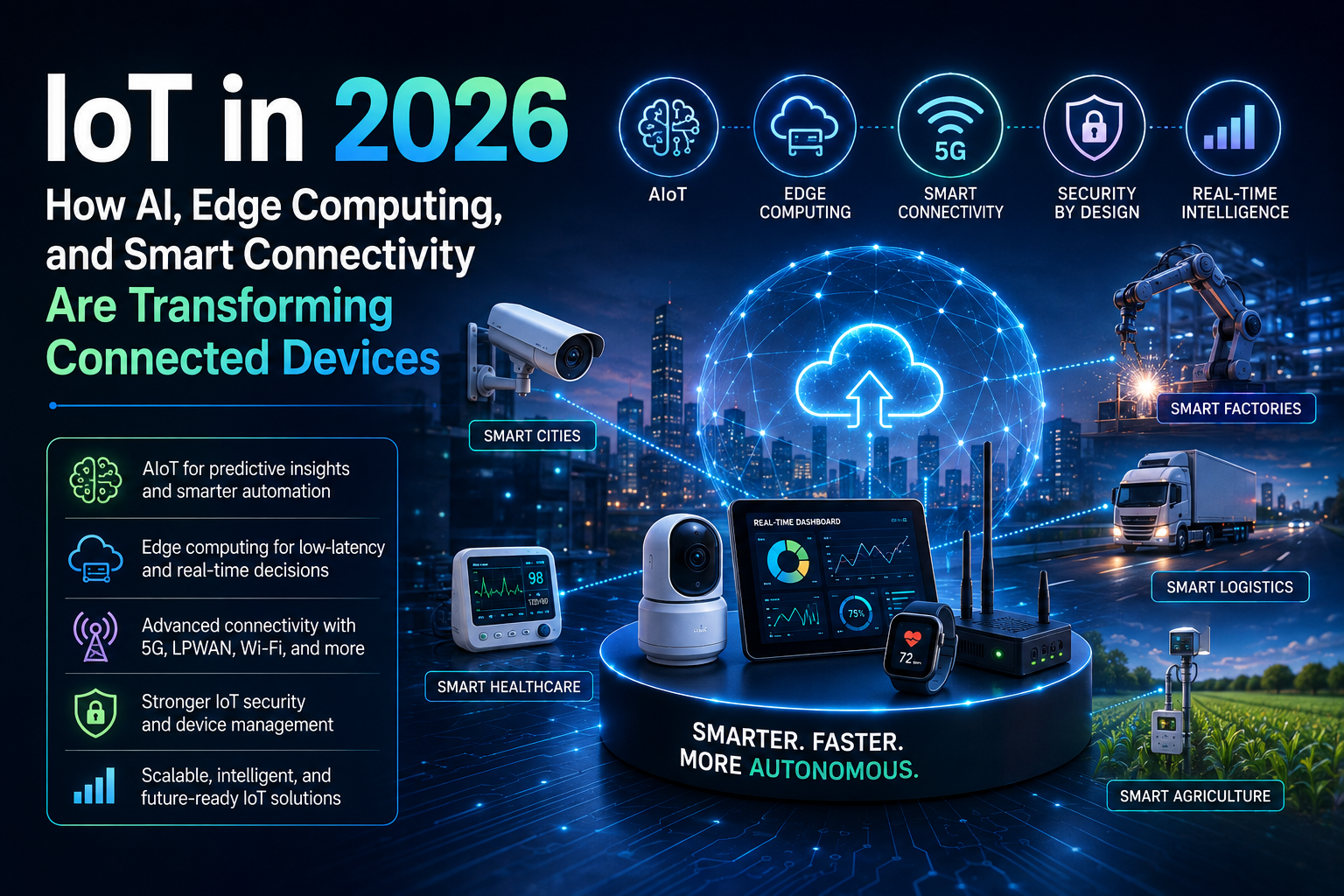
    IoT in 2026: How AI, Edge Computing, and Smart Connectivity Are Transforming Connected Devices

    The Internet of Things (IoT) is entering a new phase in 2026. Connected devices are no longer limited to collecting data and sending it to the cloud. With AI, edge computing, advanced connectivity, and stronger cybersecurity, IoT systems are becoming smarter, faster, and more autonomous.

    For businesses, this means IoT is shifting from simple monitoring to real-time decision-making, predictive maintenance, automation, and intelligent operations.

    What Is IoT?

    The Internet of Things connects physical devices such as sensors, machines, wearables, vehicles, appliances, and industrial equipment to software platforms and networks.

    These devices can collect information, communicate with other systems, and trigger actions automatically.

    A modern IoT ecosystem typically includes:

    • Smart sensors and connected devices
    • Embedded software and firmware
    • Bluetooth, Wi-Fi, 5G, LPWAN, or other connectivity
    • Edge computing infrastructure
    • Cloud platforms
    • Mobile and web applications
    • AI and machine learning
    • IoT security and device management

    The real value comes from connecting these components into a system that can turn raw device data into useful business decisions.

    1. AIoT Is Making IoT More Intelligent

    One of the biggest developments in 2026 is the convergence of Artificial Intelligence and IoT, often called AIoT.

    Traditional IoT answers questions such as:

    What is happening?

    AI-powered IoT can go further:

    Why is it happening, what is likely to happen next, and what should the system do?

    For example, an industrial sensor may detect unusual vibration in a machine. Instead of simply sending an alert, an AI-powered system can analyze the pattern and identify a potential equipment failure before it happens.

    This enables:

    • Predictive maintenance
    • Anomaly detection
    • Intelligent automation
    • Energy optimization
    • Demand forecasting
    • Real-time decision-making

    AIoT is therefore transforming connected devices from passive data collectors into intelligent systems.

    2. Edge Computing Brings Intelligence Closer to Devices

    Cloud computing remains important, but businesses increasingly need IoT systems that can make decisions without sending every piece of data to a remote server.

    That’s where edge computing comes in.

    Instead of this:

    Device → Cloud → Decision

    modern IoT architectures can use:

    Device → Edge → Decision → Cloud

    Processing data closer to the source can reduce latency, lower unnecessary data transfers, and allow systems to continue operating when internet connectivity is unreliable. This is especially valuable for manufacturing, healthcare, energy, transportation, and other time-sensitive applications.

    3. IoT Security Is Becoming a Core Requirement

    More connected devices also mean a larger attack surface.

    An IoT ecosystem can include thousands of devices, gateways, applications, APIs, and cloud services. A weakness in one component can potentially create security risks across the wider system.

    Modern IoT development therefore needs security throughout the device lifecycle, including:

    • Secure device authentication
    • Encrypted communication
    • Secure firmware
    • Access control
    • Device monitoring
    • Regular software updates
    • Data privacy
    • Network segmentation
    • Vulnerability management

    NIST’s 2026 IoT cybersecurity work highlights the continuing need to develop security requirements and risk-management approaches as IoT technology evolves.

    The ITU has also outlined AIoT threats across hardware, system, data, network, and application layers, showing why security needs to be considered across the entire architecture rather than added at the end.

    4. 5G and Advanced Connectivity Are Expanding IoT

    Connectivity is the foundation of every IoT system.

    Different applications require different communication technologies. Depending on the use case, developers may combine:

    • Bluetooth Low Energy
    • Wi-Fi
    • 5G
    • NB-IoT
    • LTE-M
    • LoRaWAN
    • Private cellular networks

    5G is particularly useful for applications requiring reliable connectivity, higher bandwidth, and low latency.

    This can support use cases such as connected vehicles, smart factories, industrial automation, remote monitoring, and large-scale infrastructure.

    5. Smart Devices Are Becoming More Autonomous

    The next generation of IoT devices will increasingly be capable of making decisions locally.

    Consider a smart security camera.

    A traditional camera might continuously send video to the cloud.

    A smarter edge-enabled camera could identify an unusual event locally and send only relevant information to the central platform.

    This approach can reduce unnecessary data transmission while improving response times and privacy.

    The same concept can be applied to:

    • Industrial cameras
    • Smart wearables
    • Agricultural sensors
    • Fleet tracking devices
    • Healthcare monitoring systems
    • Smart home equipment
    • Retail systems

    6. IoT Is Transforming Industries

    IoT is no longer limited to smart homes.

    Manufacturing

    Connected machines can monitor temperature, vibration, pressure, and performance to support predictive maintenance and reduce unexpected downtime.

    Healthcare

    Connected medical devices and wearables can support continuous monitoring and generate alerts when abnormal patterns are detected.

    Agriculture

    IoT sensors can monitor soil moisture, temperature, humidity, and environmental conditions to help optimize irrigation and resource usage.

    Logistics

    Connected tracking devices can provide visibility into vehicles, shipments, temperature-sensitive products, and supply chains.

    Smart Cities

    IoT can support intelligent traffic systems, smart lighting, environmental monitoring, waste management, and infrastructure monitoring.

    Energy

    Connected meters and sensors can help organizations monitor consumption, detect abnormalities, and optimize energy usage.

    7. The Future of IoT Is Not Just More Devices

    The biggest change in IoT isn’t simply the number of connected devices.

    It’s what those devices can understand and do.

    A sensor that only reports temperature provides information.

    A sensor combined with edge computing and AI can identify an abnormal temperature pattern, predict a potential problem, and trigger an automated response.

    That is the transition from connected IoT to intelligent IoT.

    What Businesses Should Consider Before Building an IoT Solution

    Companies planning an IoT project should think beyond hardware.

    A successful IoT solution requires a complete technology strategy covering:

    1. Device and sensor selection
    2. Embedded software
    3. Connectivity
    4. Mobile or web applications
    5. Cloud and edge architecture
    6. Data processing
    7. AI and analytics
    8. Security
    9. Device management
    10. Scalability

    Choosing the right architecture at the beginning can make it much easier to scale an IoT product from a prototype into a production-ready solution.

    Conclusion

    IoT in 2026 is becoming smarter, more distributed, and more autonomous.

    AI is turning device data into actionable intelligence. Edge computing is moving processing closer to the source. Advanced connectivity is supporting increasingly distributed deployments, while cybersecurity is becoming a fundamental part of IoT architecture.

    For businesses, the opportunity is no longer simply to connect a device.

    The opportunity is to build an intelligent ecosystem where devices sense, software understands, AI predicts, and systems act.

    That is what will define the next generation of IoT.

    SEO Keywords

    Primary keywords: IoT development, IoT solutions, IoT development company, Internet of Things, IoT technology 2026

    Secondary keywords: AIoT, AI-powered IoT, edge computing, IoT security, smart devices, IoT applications, industrial IoT, IoT software development, IoT solutions for business, connected devices, IoT application development

    Long-tail keywords: custom IoT development services, AI-powered IoT solutions, IoT development for businesses, edge AI IoT solutions, secure IoT application development, industrial IoT development services
  • When IoT Gets Too Smart: 10 Funny Things Every Connected Device Developer Knows

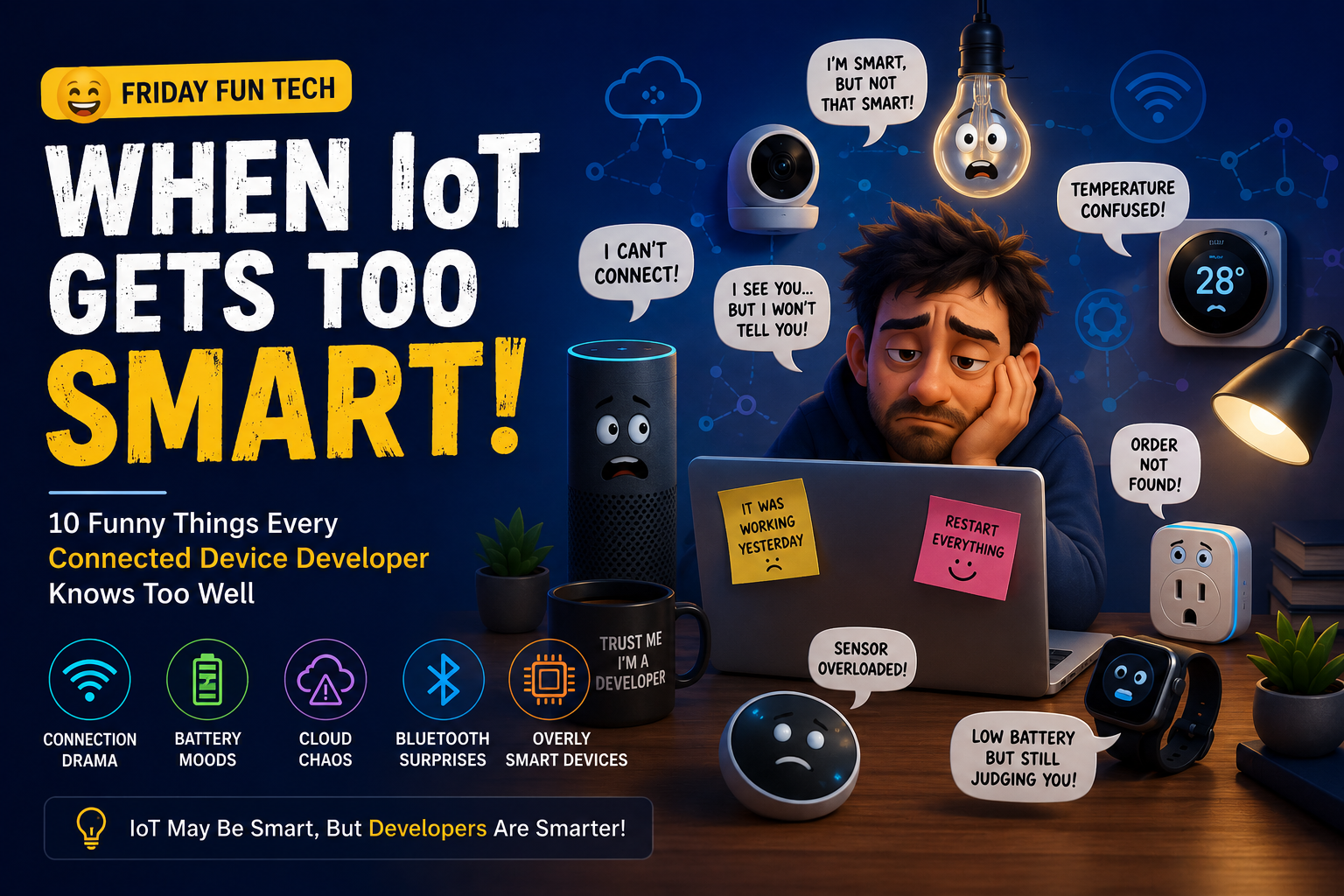
    When IoT Gets Too Smart: 10 Funny Things Every Connected Device Developer Knows

    It’s Friday.

    The week is almost over.

    Your laptop has 37 browser tabs open.

    Your coffee has become a dependency.

    And somewhere in the office, an IoT device has decided that “connected” is more of a suggestion than a guarantee. 😄

    Welcome to the wonderful world of the Internet of Things—where everyday objects are getting smarter, while developers are occasionally wondering whether the objects are becoming smarter than their developers.

    Let’s look at some of the funniest situations that happen when businesses start connecting everything to everything.


    1. The Smart Device That Isn’t Feeling Very Smart

    You buy a smart device.

    You connect it to Wi-Fi.

    You download the application.

    You create an account.

    You verify your email.

    You accept 14 permissions.

    You restart the device.

    And finally…

    “Device not found.”

    At this point, the device isn’t smart.

    It’s just emotionally unavailable.

    Reliable IoT development requires careful device discovery, connectivity management, error handling, and recovery mechanisms.

    Because users shouldn’t need a computer science degree to turn on a smart light.


    2. “It’s Connected!”

    The IoT developer:

    “The device is connected.”

    The mobile app:

    “Connecting…”

    The cloud:

    “Waiting…”

    The user:

    “Nothing is happening.”

    The developer:

    “Can you restart Bluetooth?”

    The user:

    “I already did.”

    Developer:

    “…Can you restart it again?”

    This is why real-world IoT systems need robust connection management, reconnection logic, device state synchronization, and proper diagnostics.

    A green Bluetooth icon isn’t necessarily the end of the story.

    Sometimes it’s just the beginning.


    3. The Smart Fridge Knows Everything Except What You Want

    Modern IoT can monitor temperature, energy usage, door activity, and other conditions.

    Imagine a refrigerator that can tell you:

    “Temperature: 4°C.”

    “Door open for 32 seconds.”

    “Energy consumption increased 7%.”

    And then you ask:

    “Do we have milk?”

    Silence.

    Congratulations.

    You’ve built a highly intelligent refrigerator that still requires human intelligence.

    This illustrates an important IoT principle:

    Collecting data isn’t the same as creating useful intelligence.

    The real value comes from turning device data into meaningful information and actions.


    4. Bluetooth Works Perfectly…

    …until you actually need it.

    BLE is excellent for connecting nearby devices while keeping power consumption low.

    But developers know the reality:

    Developer environment: Perfect.

    Testing device: Perfect.

    Second testing device: Mostly perfect.

    Customer’s phone: “Interesting.”

    BLE applications need to account for:

    • Device discovery
    • Pairing
    • Connection drops
    • Reconnection
    • Background operation
    • OS differences
    • Firmware compatibility
    • Battery optimization
    • Data synchronization

    Because your application doesn’t get to choose which smartphone the customer bought.


    5. The IoT Device Has 1% Battery and a Big Personality

    Battery-powered IoT devices have one simple job:

    Stay alive.

    But every sensor reading, wireless transmission, and background operation consumes energy.

    Developers therefore need to carefully balance:

    Performance ↔ Connectivity ↔ Battery Life

    Sometimes the smartest thing an IoT device can do is simply…

    go to sleep.

    And honestly, after a long Friday, developers can relate.


    6. The Sensor That Reports Everything

    IoT devices can generate enormous amounts of data.

    Temperature.

    Humidity.

    Movement.

    Location.

    Battery level.

    Signal strength.

    Device status.

    Error codes.

    And eventually someone asks:

    “Why are we storing all of this?”

    Good question.

    IoT architecture should define what data needs to be collected, how frequently it should be collected, where it should be stored, and what business purpose it serves.

    Because a million data points nobody uses are still…

    a million data points nobody uses.


    7. When the Cloud Becomes the Family Group Chat

    An IoT ecosystem may have:

    Device → BLE/Wi-Fi → Mobile App → API → Cloud → Database → Analytics

    Every component has something to say.

    The device says:

    “Here’s some data.”

    The app says:

    “I received it.”

    The API says:

    “I’m processing it.”

    The cloud says:

    “Stored.”

    The analytics engine says:

    “Interesting pattern.”

    And the developer says:

    “Why did the device send that data 47 times?”

    That’s why scalable IoT architecture, monitoring, logging, and event management are essential.


    8. The Smart Lock That Makes You Feel Less Smart

    Smart locks are a great IoT use case.

    Your smartphone can communicate with the lock.

    The application can manage access.

    The system can track activity.

    Everything is wonderfully connected.

    Until you stand outside your own house saying:

    “Why isn’t my phone connecting?”

    Suddenly, the traditional key looks like a technological masterpiece.

    IoT products should always consider failure scenarios.

    What happens when:

    • Bluetooth is unavailable?
    • The battery is low?
    • The phone is offline?
    • The device loses connectivity?
    • The cloud service is unavailable?

    Smart products need sensible fallback mechanisms.


    9. “Can We Add AI?”

    This is becoming one of the most popular questions in IoT projects.

    “We have an IoT device. Can we add AI?”

    Of course.

    But first:

    What should the AI actually do?

    AI can add significant value when it is used for:

    • Predictive maintenance
    • Anomaly detection
    • Demand forecasting
    • Intelligent automation
    • Pattern recognition
    • Energy optimization
    • Personalized experiences

    The goal shouldn’t be:

    IoT + AI = Cool

    The goal should be:

    IoT Data + AI → Useful Business Decision

    Otherwise, you’re just giving your sensor a very expensive brain.


    10. The Friday IoT Deployment

    And finally…

    The sentence every experienced developer fears:

    “Let’s deploy it today. It’s Friday.”

    Suddenly:

    • The device doesn’t reconnect.
    • The firmware update fails.
    • The API returns an unexpected response.
    • The mobile app crashes.
    • The dashboard shows 14,000 devices offline.

    And someone asks:

    “Can we fix it before Monday?”

    The entire development team:

    “…”

    For IoT systems, deployment should include proper testing, monitoring, rollback procedures, firmware management, and staged releases.

    Because Friday should be about finishing the week—not becoming part of the incident report.


    The Funny Problems Are Actually Important

    Behind the jokes are some serious IoT development challenges.

    A successful IoT ecosystem needs to consider:

    Connectivity

    Devices must communicate reliably.

    Power Management

    Battery-powered devices need efficient communication strategies.

    Scalability

    The architecture must support growth from hundreds to thousands or millions of devices.

    Security

    Devices, applications, APIs, and cloud systems all need protection.

    Data Management

    Businesses need to determine what information should be collected and how it should be used.

    Device Management

    Organizations need ways to monitor, configure, update, and troubleshoot connected devices.

    User Experience

    The technology should make life easier—not create another troubleshooting manual.


    What a Good IoT Ecosystem Looks Like

    A mature IoT solution can connect:

    Sensors & Devices

    BLE / Wi-Fi / Cellular

    Mobile or Gateway Application

    Secure APIs

    Cloud Platform

    Data Analytics & AI

    Business Applications

    Automated Actions

    The technology may be complex behind the scenes.

    But for the user, it should feel simple.

    That’s the real definition of smart technology.


    Where IoT Is Making a Difference

    IoT isn’t limited to smart homes.

    Connected technology is being used across:

    • Healthcare
    • Manufacturing
    • Logistics
    • Retail
    • Agriculture
    • Automotive
    • Fitness
    • Smart buildings
    • Asset tracking
    • Industrial monitoring
    • Consumer electronics

    The use case changes, but the basic idea remains the same:

    Connect physical things to digital intelligence.


    The IoT Rule for Friday

    Here’s a simple rule for every IoT project:

    If the device needs a 47-page manual to explain how to connect it, it probably isn’t smart enough yet. 😄

    Good IoT products hide complexity.

    The user shouldn’t need to know about:

    • BLE characteristics
    • MQTT messages
    • API endpoints
    • Cloud instances
    • Database schemas
    • Firmware versions

    They should simply see:

    “Connected.”

    And preferably…

    Actually connected.


    Final Thoughts

    IoT is transforming ordinary products into connected digital experiences.

    But making something connected isn’t the same as making it useful.

    Successful IoT development requires a combination of:

    Hardware + BLE + Mobile + Cloud + APIs + Data + Security + AI

    When these technologies are designed together, businesses can create products that monitor, communicate, analyze, and respond intelligently.

    And if your IoT device starts talking back to you on a Friday afternoon…

    Don’t panic.

    Just check the logs.

    Then check Bluetooth.

    Then restart the device.

    And if that doesn’t work…

    It’s probably Wi-Fi. 😂

    SEO Title

    Funny IoT Technology Problems: 10 Things Every IoT Developer Knows

    Meta Description

    Explore the funny side of IoT development, from Bluetooth connection problems and smart devices to cloud systems, AI, battery life, and Friday deployments.

    Primary Keywords

    IoT development, IoT solutions, IoT development company, IoT applications

    Secondary Keywords

    IoT device development, BLE IoT development, connected device development, IoT software development, smart device development, IoT mobile app development, Bluetooth IoT, industrial IoT, IoT cloud solutions, IoT technology

  • When Everyday Objects Start Thinking: The New Era of BLE and IoT Applications

    When Everyday Objects Start Thinking: The New Era of BLE and IoT Applications

    The Internet of Things was once described as a future where everything would be connected.

    That future has already arrived.

    Today, a wearable can communicate with a smartphone. A machine can report its own condition. A smart lock can recognize a nearby device. A healthcare sensor can continuously collect information. A business can monitor equipment without having an employee physically inspect it.

    But the interesting part isn’t simply that these devices are connected.

    It’s what businesses can do with the data after the connection happens.

    This is where BLE and IoT development are creating a new generation of intelligent products.


    BLE Is Becoming the Bridge Between Physical Products and Apps

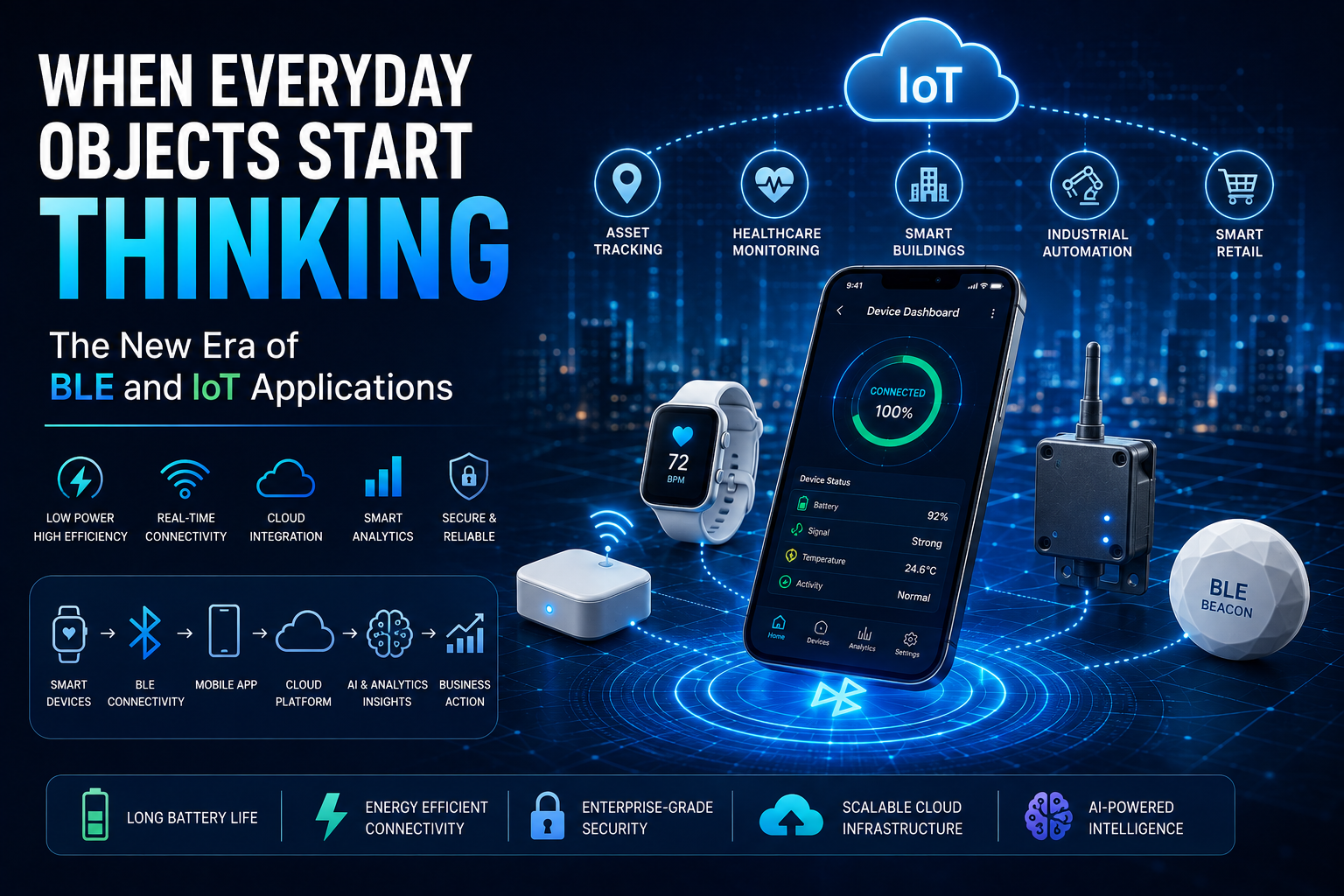
    Bluetooth Low Energy (BLE) is particularly useful for applications that need nearby wireless communication without continuously consuming large amounts of power.

    A typical BLE ecosystem can look like:

    Smart Device → BLE → Smartphone → Cloud → Analytics → Business Action

    This relatively simple architecture can support surprisingly sophisticated products.

    BLE can be used for:

    • Wearable devices
    • Fitness trackers
    • Smart locks
    • Healthcare equipment
    • Asset tracking
    • Industrial sensors
    • Smart retail systems
    • Proximity applications
    • Beacon-based experiences
    • Connected consumer electronics

    The smartphone often acts as the bridge between the physical device and the larger IoT ecosystem.


    The Real Value of IoT Isn’t the Device

    A connected sensor by itself doesn’t create much business value.

    The real value comes from the information generated by that sensor.

    Consider an industrial machine.

    A traditional machine simply performs its job.

    A connected machine can provide information about:

    • Temperature
    • Usage
    • Operating conditions
    • Performance
    • Errors
    • Maintenance requirements

    Now imagine software analyzing that information continuously.

    The business can potentially identify problems earlier, improve maintenance planning, reduce downtime, and make better operational decisions.

    This is the shift from:

    Connected Device → Intelligent Business System


    BLE + IoT + AI: The Combination Businesses Should Watch

    The next major opportunity is not BLE alone or IoT alone.

    It is the combination of:

    BLE + IoT + AI + Cloud + Mobile

    Each technology performs a different role.

    BLE

    Connects nearby devices.

    IoT

    Moves device information into a broader connected ecosystem.

    Cloud

    Provides scalable storage, APIs, processing, and infrastructure.

    AI

    Turns large amounts of data into insights and predictions.

    Mobile Apps

    Give users an accessible interface for interacting with connected products.

    Together, these technologies can create products that don’t simply collect information—they can help businesses understand and act on it.


    From Reactive Products to Predictive Products

    Traditional products usually respond after something happens.

    A connected product can provide information before a problem becomes obvious.

    For example, instead of waiting for equipment to fail, a connected monitoring system could detect unusual operating behavior.

    Instead of asking a customer to manually enter information, a wearable could automatically send relevant data to an application.

    Instead of manually checking whether an asset is available, a tracking system could provide its status digitally.

    This creates a major change in product design:

    Old model: Detect → Respond

    Connected model: Monitor → Analyze → Predict → Respond


    Why Mobile Apps Are Critical to IoT

    IoT products often need a simple interface through which users can control or monitor connected devices.

    That’s where mobile applications become important.

    A mobile app can allow users to:

    • Pair BLE devices
    • Configure devices
    • View real-time information
    • Receive notifications
    • Monitor historical data
    • Change device settings
    • View analytics
    • Manage multiple connected devices

    For many consumer IoT products, the mobile application effectively becomes the remote control for the physical world.


    The Hidden Challenge: BLE Development Isn’t Just Bluetooth Pairing

    Building a reliable BLE application requires more than establishing a connection.

    Developers may need to deal with:

    • Device discovery
    • Pairing
    • Services and characteristics
    • Data packets
    • Connection drops
    • Background communication
    • Reconnection logic
    • Firmware compatibility
    • Android and iOS differences
    • Power consumption
    • Data synchronization

    A product may work perfectly in a controlled development environment and behave differently when hundreds or thousands of real users start connecting devices in different environments.

    That is why BLE architecture and testing should be considered from the beginning.


    IoT Security Cannot Be an Afterthought

    More connected devices also mean more potential entry points.

    IoT products should therefore consider security across the entire ecosystem.

    That includes:

    Device → BLE Connection → Mobile App → API → Cloud → Database

    Important areas include:

    • Secure authentication
    • Encrypted communication
    • Secure APIs
    • Device authorization
    • Access control
    • Secure firmware updates
    • Cloud security
    • Data protection
    • Monitoring and logging

    A connected product is only as strong as its weakest component.


    The Future of IoT Will Be Less Visible

    One of the biggest changes coming to IoT is that users may not even notice the technology.

    Imagine walking into a building and having your preferred settings automatically applied.

    Imagine a machine notifying the maintenance team before a major failure.

    Imagine a healthcare device continuously sharing information with an application.

    Imagine a retail environment understanding customer movement without requiring manual interaction.

    The technology becomes invisible.

    The experience becomes the product.


    What Businesses Should Ask Before Building an IoT Product

    Before starting development, businesses should answer several important questions.

    What problem are we solving?

    Connectivity alone isn’t a business strategy.

    What data does the device need to collect?

    Collecting unnecessary information increases complexity.

    How will the device communicate?

    BLE, Wi-Fi, cellular, or a combination may be appropriate depending on the use case.

    Where will the data go?

    The cloud architecture needs to be planned early.

    Who will use the information?

    Customers, employees, administrators, machines, or automated systems may require different interfaces.

    What happens when connectivity fails?

    Real-world devices won’t always have perfect connectivity.

    How will the ecosystem scale?

    An architecture designed for 100 devices may behave very differently with 100,000 devices.


    Why IoT Products Need More Than Hardware

    Successful connected products are built through the combination of multiple disciplines.

    A complete solution may require:

    • Hardware integration
    • BLE development
    • Mobile application development
    • Backend development
    • IoT architecture
    • Cloud infrastructure
    • APIs
    • Data analytics
    • AI integration
    • Security
    • Device management

    This is why businesses should think about the entire product ecosystem, rather than developing hardware and software as completely separate projects.


    Building the Next Generation of Connected Products

    IoTBLE focuses on the intersection of Bluetooth Low Energy, IoT, mobile applications, connected devices, and intelligent software.

    For businesses developing connected products, the objective should be more than simply making a device communicate with a phone.

    The bigger opportunity is to build an ecosystem where:

    Devices generate data → Applications connect users → Cloud systems process information → AI creates intelligence → Businesses take action.

    That is where connected technology becomes genuinely valuable.


    Final Thoughts

    The future of IoT isn’t about putting a sensor into everything.

    It’s about creating meaningful connections between devices, applications, people, and data.

    BLE provides an efficient way for nearby devices to communicate.

    IoT creates the larger connected ecosystem.

    Cloud platforms provide the infrastructure.

    AI transforms data into intelligence.

    And mobile applications make that intelligence accessible.

    The businesses that understand how these technologies work together can move beyond building individual connected devices and start creating intelligent digital products that continuously learn, communicate, and improve.

    The next generation of products won’t just be connected. They’ll be context-aware.

    SEO Title

    BLE and IoT Applications: How Connected Products Are Becoming Intelligent

    Meta Description

    Discover how BLE, IoT, AI, cloud, and mobile applications are transforming connected products and creating intelligent IoT ecosystems for modern businesses.

    Primary Keywords

    BLE IoT applications, BLE IoT development, IoT application development, BLE app development

    Secondary Keywords

    Bluetooth Low Energy IoT, BLE development company, IoT development company, connected device development, IoT mobile app development, BLE mobile app, smart device development, IoT solutions, connected products, IoT software development

  • How IoT and BLE Are Transforming Connected Devices in 2026

    How IoT and BLE Are Transforming Connected Devices in 2026

    Connected devices are becoming an important part of modern businesses and everyday life. From smart healthcare devices and asset trackers to industrial sensors and connected retail systems, organizations are increasingly looking for reliable ways to connect physical devices with mobile and cloud applications.

    Two technologies are particularly important in this transformation: Internet of Things (IoT) and Bluetooth Low Energy (BLE).

    IoT enables devices to collect and exchange data, while BLE provides efficient wireless communication between nearby devices. When combined, they can create connected solutions that are reliable, scalable, and energy-efficient.

    In 2026, businesses are increasingly using IoT and BLE solutions to improve automation, monitoring, asset management, customer experiences, and operational efficiency.

    What Is IoT?

    The Internet of Things refers to a network of physical devices that can collect, transmit, and exchange data.

    IoT devices can include:

    • Sensors
    • Wearables
    • Smart appliances
    • Industrial machines
    • Healthcare equipment
    • Tracking devices
    • Smart meters
    • Connected vehicles

    These devices collect real-world information and transfer it to software platforms for monitoring and analysis.

    For businesses, IoT can provide greater visibility into operations and enable automated decision-making.

    What Is Bluetooth Low Energy?

    Bluetooth Low Energy, commonly known as BLE, is a wireless communication technology designed for low-power connectivity.

    BLE is particularly useful for devices that need to operate for long periods using small batteries.

    BLE can connect devices such as:

    • Smart sensors
    • Fitness trackers
    • Medical devices
    • Beacons
    • Smart locks
    • Wearables
    • Asset trackers
    • Industrial equipment

    Mobile applications can communicate with BLE devices and exchange data without requiring traditional wired connections.

    Why Combine IoT and BLE?

    BLE and IoT solve different parts of the connectivity problem.

    BLE is excellent for short-range, low-power device communication, while IoT platforms can provide cloud connectivity, data storage, analytics, and centralized management.

    A typical architecture may look like:

    BLE Device → Smartphone/Gateway → Internet → Cloud Platform → IoT Dashboard

    This architecture allows businesses to collect information from nearby BLE devices and make that information available through cloud-based applications.

    Key Benefits of IoT and BLE Integration

    1. Low Power Consumption

    BLE is designed for low-energy communication, making it suitable for battery-powered sensors and wearable devices.

    Longer battery life can reduce maintenance requirements and improve the usability of connected products.

    2. Real-Time Data Collection

    BLE-enabled devices can continuously collect information and send it to a mobile application or gateway.

    Businesses can use this data to monitor equipment, assets, environments, or users.

    3. Cost-Effective Connectivity

    BLE hardware is widely available and can provide an economical connectivity option for many IoT applications.

    4. Easy Mobile Integration

    Modern smartphones support BLE, allowing businesses to develop mobile applications that communicate directly with compatible devices.

    5. Scalable IoT Ecosystems

    BLE can serve as the local connectivity layer while cloud platforms handle large-scale data processing and device management.

    Major IoT and BLE Applications in 2026

    Healthcare

    BLE and IoT are increasingly useful for connected healthcare devices.

    Applications can collect information from:

    • Health monitoring devices
    • Wearable sensors
    • Patient monitoring equipment
    • Medical accessories
    • Fitness devices

    Healthcare applications can then transmit this information to authorized platforms for monitoring and analysis.

    Smart Retail

    Retail businesses can use BLE beacons and connected sensors to improve customer engagement and store operations.

    Potential applications include:

    • Indoor proximity solutions
    • Product tracking
    • Customer engagement
    • Inventory monitoring
    • Smart checkout systems
    • Location-based notifications

    Asset Tracking

    Businesses with large numbers of physical assets can use BLE tags and IoT gateways to monitor asset locations.

    This can help organizations reduce asset loss and improve operational visibility.

    Industrial IoT

    Factories can use connected sensors to monitor machines, environmental conditions, and production processes.

    BLE can provide local connectivity, while IoT platforms can collect and analyze the data.

    Smart Buildings

    IoT and BLE can support smart building applications such as:

    • Access control
    • Occupancy monitoring
    • Smart lighting
    • Temperature monitoring
    • Energy management
    • Indoor positioning

    Wearable Technology

    BLE remains an important technology for wearable devices.

    Smartwatches, fitness trackers, healthcare wearables, and other connected products can use BLE to communicate with smartphones and other devices.

    BLE Beacons and IoT

    BLE beacons are small devices that periodically transmit wireless signals.

    When a compatible smartphone or gateway detects the signal, an application can determine proximity or trigger specific actions.

    Businesses can use beacon technology for:

    • Indoor navigation
    • Proximity marketing
    • Asset monitoring
    • Customer engagement
    • Employee tracking
    • Location-based services

    When beacon data is connected to an IoT platform, organizations can combine proximity information with other business data.

    The Role of Mobile Applications

    Mobile applications often act as an important bridge between BLE devices and cloud-based IoT systems.

    A mobile application can:

    1. Discover nearby BLE devices.
    2. Establish a secure connection.
    3. Read device characteristics.
    4. Send commands to the device.
    5. Process collected data.
    6. Upload information to the cloud.
    7. Display real-time information to users.

    This makes BLE app development an important part of many connected-device ecosystems.

    IoT + BLE + AI

    The combination of IoT, BLE, and Artificial Intelligence can take connected applications even further.

    BLE devices can collect local data.

    IoT platforms can store and organize the data.

    AI can analyze the information and identify patterns.

    For example, an industrial system could collect machine data through connected sensors and use AI-based analytics to identify unusual behavior before a major equipment failure occurs.

    This can support:

    • Predictive maintenance
    • Anomaly detection
    • Smart automation
    • Demand forecasting
    • Operational optimization
    • Personalized experiences

    Security Considerations

    Security should be considered from the beginning of every IoT and BLE project.

    Important areas include:

    • Device authentication
    • Secure BLE communication
    • Data encryption
    • API security
    • Cloud security
    • User authentication
    • Access control
    • Secure firmware updates
    • Device lifecycle management

    Businesses should also consider industry-specific privacy and compliance requirements when handling sensitive data.

    Challenges in IoT and BLE Development

    Although the technologies provide significant benefits, developing connected solutions can be complex.

    Common challenges include:

    Device Compatibility

    Different hardware manufacturers may implement BLE functionality differently.

    Connectivity Issues

    Applications need to handle connection drops, interference, and changing device availability.

    Battery Optimization

    Poorly designed communication patterns can reduce battery life.

    Data Management

    Large IoT deployments can generate significant amounts of data that require reliable storage and processing.

    Security

    Connected devices create additional attack surfaces that must be protected.

    Scalability

    The architecture should be able to support increasing numbers of devices and users.

    How to Build a Successful IoT and BLE Application

    A successful project generally starts with a clear understanding of the business requirement.

    Step 1: Define the Use Case

    Identify the problem the connected solution needs to solve.

    Step 2: Select the Hardware

    Choose sensors, BLE modules, gateways, or other connected devices based on the requirements.

    Step 3: Design the BLE Architecture

    Define how devices will advertise, connect, exchange data, and recover from connection failures.

    Step 4: Develop the Mobile or Web Application

    Build the interface that users will use to monitor and control the connected system.

    Step 5: Build the IoT Backend

    Create APIs, databases, cloud infrastructure, and device-management functionality.

    Step 6: Add Analytics and AI

    Use analytics or AI where it provides measurable value.

    Step 7: Test Security and Scalability

    Test the complete ecosystem across different devices, operating systems, network conditions, and usage scenarios.

    Why Choose an Experienced IoT and BLE Development Partner?

    IoT development is more than simply connecting a Bluetooth device to an application.

    A complete solution may involve:

    • Hardware communication
    • BLE integration
    • Mobile application development
    • Cloud infrastructure
    • APIs
    • Databases
    • IoT platforms
    • Security
    • Analytics
    • Device management

    An experienced development team can help businesses design the complete technology ecosystem rather than focusing on only one component.

    How IOTBLE Can Help

    IOTBLE focuses on connected technology solutions involving IoT, BLE, Bluetooth, mobile applications, and smart connected devices.

    Businesses can leverage IoT and BLE development expertise to build solutions for healthcare, retail, industrial applications, asset tracking, wearables, smart environments, and other connected-device use cases.

    The objective is to create connected applications that are reliable, secure, scalable, and aligned with business requirements.

    Future of IoT and BLE

    The future of connected technology will increasingly involve devices that can communicate automatically and generate actionable information.

    BLE will continue to be valuable for low-power, short-range communication, while IoT platforms will provide the infrastructure needed to manage connected devices at scale.

    The integration of BLE + IoT + AI + Cloud can create intelligent systems capable of collecting data, analyzing it, and supporting automated decisions.

    Conclusion

    IoT and BLE are becoming essential technologies for businesses developing connected products and smart applications in 2026.

    BLE provides efficient device-to-device and device-to-mobile communication, while IoT platforms enable cloud connectivity, centralized management, analytics, and scalability.

    When combined with mobile applications, cloud infrastructure, and AI, these technologies can help businesses build powerful connected ecosystems.

    Whether you are developing a wearable, healthcare device, smart retail solution, industrial monitoring platform, or asset-tracking system, choosing the right IoT and BLE architecture can have a significant impact on the success of your product.

    Ready to build your connected product? Explore IoT and BLE development solutions with IOTBLE and turn your connected-device idea into a scalable digital solution.

    Suggested SEO Keywords

    Primary Keywords:
    IoT development, BLE development, IoT BLE solutions, BLE IoT development, IoT application development

    Secondary Keywords:
    BLE app development, Bluetooth Low Energy development, IoT application development company, BLE integration, IoT solutions, connected device development, Bluetooth IoT solutions, IoT mobile app development

    Suggested Meta Title:
    IoT & BLE Development: Building Smarter Connected Devices in 2026

    Suggested Meta Description:
    Discover how IoT and BLE are transforming connected devices in 2026. Learn about applications, benefits, architecture, security, and IoT BLE development.

  • IoT in 2026: How Connected Technologies Are Transforming Modern Businesses

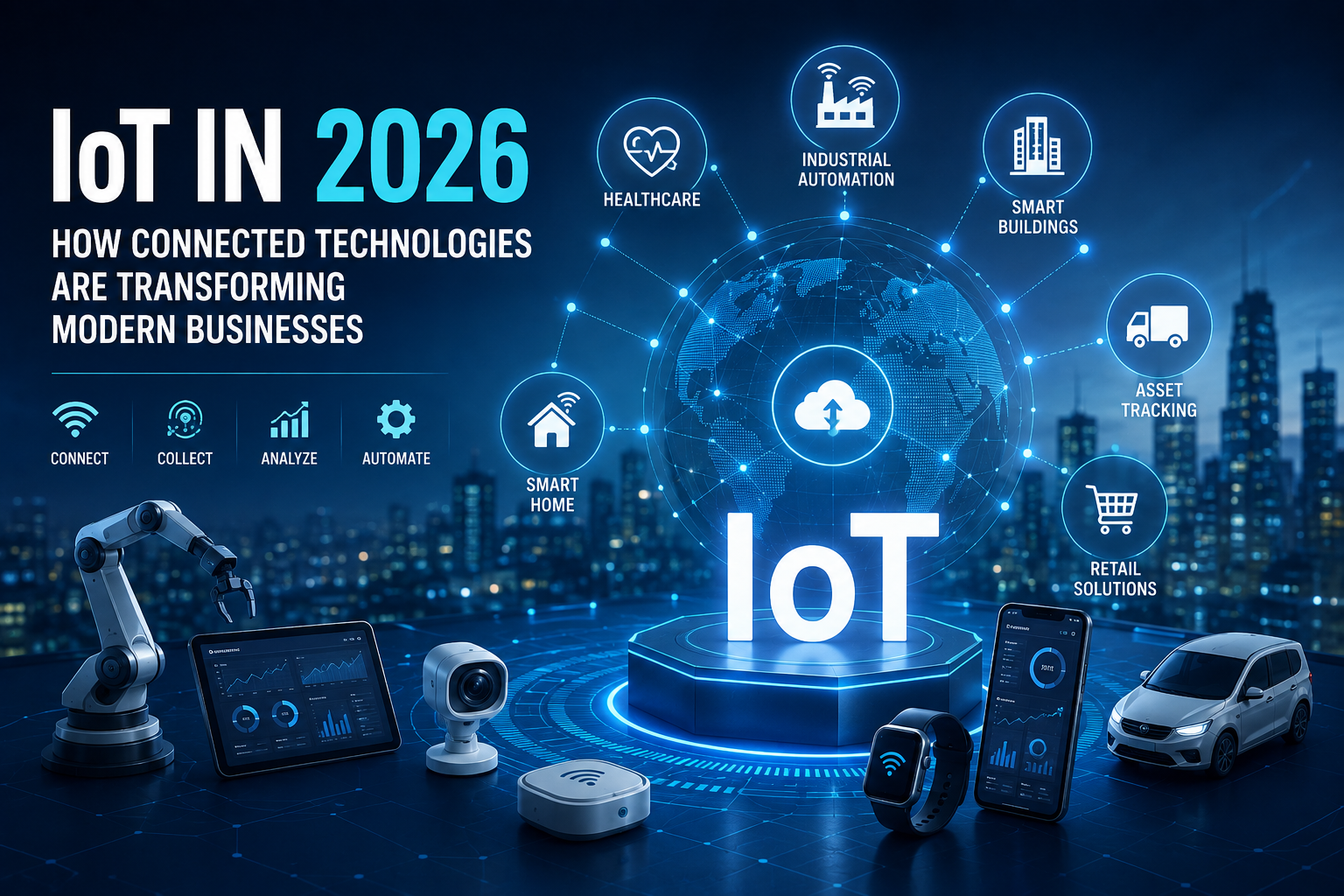
    IoT in 2026: How Connected Technologies Are Transforming Modern Businesses

    The Internet of Things (IoT) is becoming a major driver of digital transformation in 2026. Businesses across industries are connecting devices, sensors, machines, applications, and cloud platforms to collect data and automate everyday operations.

    From smart homes and healthcare to industrial automation and asset tracking, IoT is helping organizations make faster decisions, improve efficiency, and deliver smarter connected experiences.

    What Is IoT?

    The Internet of Things refers to a network of physical devices that can collect, exchange, and process data through connected technologies.

    An IoT ecosystem may include:

    • Sensors and connected devices
    • Mobile applications
    • IoT gateways
    • Cloud platforms
    • APIs
    • Analytics dashboards
    • Artificial intelligence and machine learning systems

    These components work together to collect real-world information and turn it into actionable business insights.

    Why IoT Is Important in 2026

    IoT has moved beyond simple device connectivity. Modern IoT solutions increasingly combine connected devices with cloud computing, artificial intelligence, automation, and real-time analytics.

    Businesses are using IoT to:

    • Monitor equipment remotely
    • Automate repetitive processes
    • Track assets and inventory
    • Improve operational efficiency
    • Reduce unnecessary costs
    • Analyze real-time data
    • Improve customer experiences
    • Support predictive maintenance

    Major IoT Applications in 2026

    1. Industrial IoT

    Industrial IoT is helping manufacturers and industrial organizations connect machinery, sensors, and production systems.

    Sensors can monitor equipment conditions such as temperature, vibration, pressure, and energy consumption.

    This information can help companies identify potential equipment problems before they result in costly downtime.

    2. Smart Healthcare

    IoT-enabled healthcare devices can collect and transmit important information from connected medical and wearable devices.

    Applications include:

    • Remote patient monitoring
    • Wearable health devices
    • Medical equipment monitoring
    • Temperature monitoring
    • Hospital asset tracking

    IoT can improve visibility and help healthcare organizations manage connected equipment more efficiently.

    3. Smart Buildings

    Smart buildings use connected sensors and systems to monitor and control different aspects of a facility.

    Examples include:

    • Smart lighting
    • Access control
    • Temperature monitoring
    • Occupancy detection
    • Energy management
    • Indoor positioning

    These systems can help organizations create more efficient and connected working environments.

    4. Asset Tracking

    IoT technology is increasingly being used to track equipment, vehicles, inventory, and other valuable assets.

    Connected tags, sensors, gateways, and cloud platforms can provide businesses with better visibility into asset location and status.

    5. Retail IoT

    Retail businesses can use IoT to improve inventory management, customer engagement, store operations, and equipment monitoring.

    Connected devices can provide real-time information that helps retailers make better operational decisions.

    The Role of BLE in IoT

    Bluetooth Low Energy (BLE) is an important connectivity technology for many IoT applications.

    BLE is particularly useful for battery-powered devices because it is designed for low-power wireless communication.

    BLE IoT solutions can be used for:

    • Asset tracking
    • Wearables
    • Indoor positioning
    • Smart access systems
    • Healthcare devices
    • Retail applications
    • Industrial sensors

    A smartphone or gateway can collect information from BLE devices and transmit the data to an IoT platform or cloud application.

    IoT and Artificial Intelligence

    One of the biggest developments in modern IoT is the combination of connected devices with artificial intelligence.

    IoT devices generate large amounts of data. AI and machine learning can analyze this information to identify patterns and support automated decision-making.

    For example, an industrial IoT system can analyze equipment sensor data and identify unusual behavior that may indicate an upcoming failure.

    This combination of IoT + AI can help businesses move from reactive operations toward predictive and automated systems.

    IoT Cloud Platforms and APIs

    A scalable IoT solution often requires a strong backend architecture.

    Cloud platforms can store and process data collected from thousands or millions of connected devices.

    APIs can connect:

    IoT Devices → Gateway/Mobile App → API → Cloud Platform → Dashboard

    This architecture allows businesses to monitor devices, manage data, create alerts, and integrate IoT systems with existing enterprise software.

    IoT Security Challenges

    As more devices become connected, security becomes increasingly important.

    IoT developers should consider:

    • Device authentication
    • Secure communication
    • Data encryption
    • API security
    • Access management
    • Secure firmware updates
    • Cloud security
    • Device lifecycle management

    Security should be integrated into the architecture from the beginning rather than added after development.

    Challenges of IoT Development

    Developing an IoT product involves more than connecting a sensor to the internet.

    Common challenges include:

    • Hardware and software integration
    • Device compatibility
    • Network reliability
    • Battery optimization
    • Data management
    • Cloud scalability
    • Security
    • Firmware updates
    • Mobile application integration
    • Large-scale device management

    A successful IoT solution requires coordination between hardware, firmware, mobile, backend, cloud, and analytics technologies.

    How Businesses Can Benefit from IoT

    Organizations can use IoT to create measurable improvements across their operations.

    Key benefits include:

    Improved Efficiency

    Automated data collection can reduce manual processes and improve operational workflows.

    Real-Time Monitoring

    Businesses can monitor devices, equipment, and assets from centralized dashboards.

    Predictive Maintenance

    Sensor data can help identify equipment issues before major failures occur.

    Better Decision-Making

    Real-time data gives organizations greater visibility into operations.

    New Business Opportunities

    Connected products can enable subscription services, remote monitoring, personalized experiences, and new digital revenue models.

    Why Choose IoTBLE for IoT Development?

    Developing a connected product requires expertise in IoT architecture, wireless communication, mobile applications, APIs, cloud platforms, and device integration.

    IoTBLE focuses on connected technology solutions that can help businesses transform ideas into scalable IoT applications.

    From BLE-connected devices and smart sensors to mobile applications and cloud-connected IoT platforms, a customized development approach can help businesses build solutions around their specific requirements.

    The Future of IoT

    The future of IoT will increasingly involve intelligent automation, edge computing, AI-powered analytics, advanced wireless connectivity, and increasingly connected devices.

    Instead of simply collecting data, next-generation IoT systems will be designed to understand data and take automated actions.

    This evolution will create opportunities across industries including manufacturing, healthcare, logistics, retail, smart buildings, transportation, and consumer electronics.

    Conclusion

    IoT is transforming the way businesses interact with physical devices and real-world data. In 2026, connected technologies are becoming more intelligent through the integration of BLE, cloud computing, AI, automation, and real-time analytics.

    For organizations planning to build connected products or modernize existing operations, a well-designed IoT architecture can provide the foundation for greater efficiency, visibility, and innovation.

    The businesses that combine reliable connectivity with secure software, scalable cloud infrastructure, and intelligent data processing will be better positioned to take advantage of the next generation of IoT.

  • BLE IoT Applications in 2026: How Bluetooth Low Energy Is Transforming Connected Devices

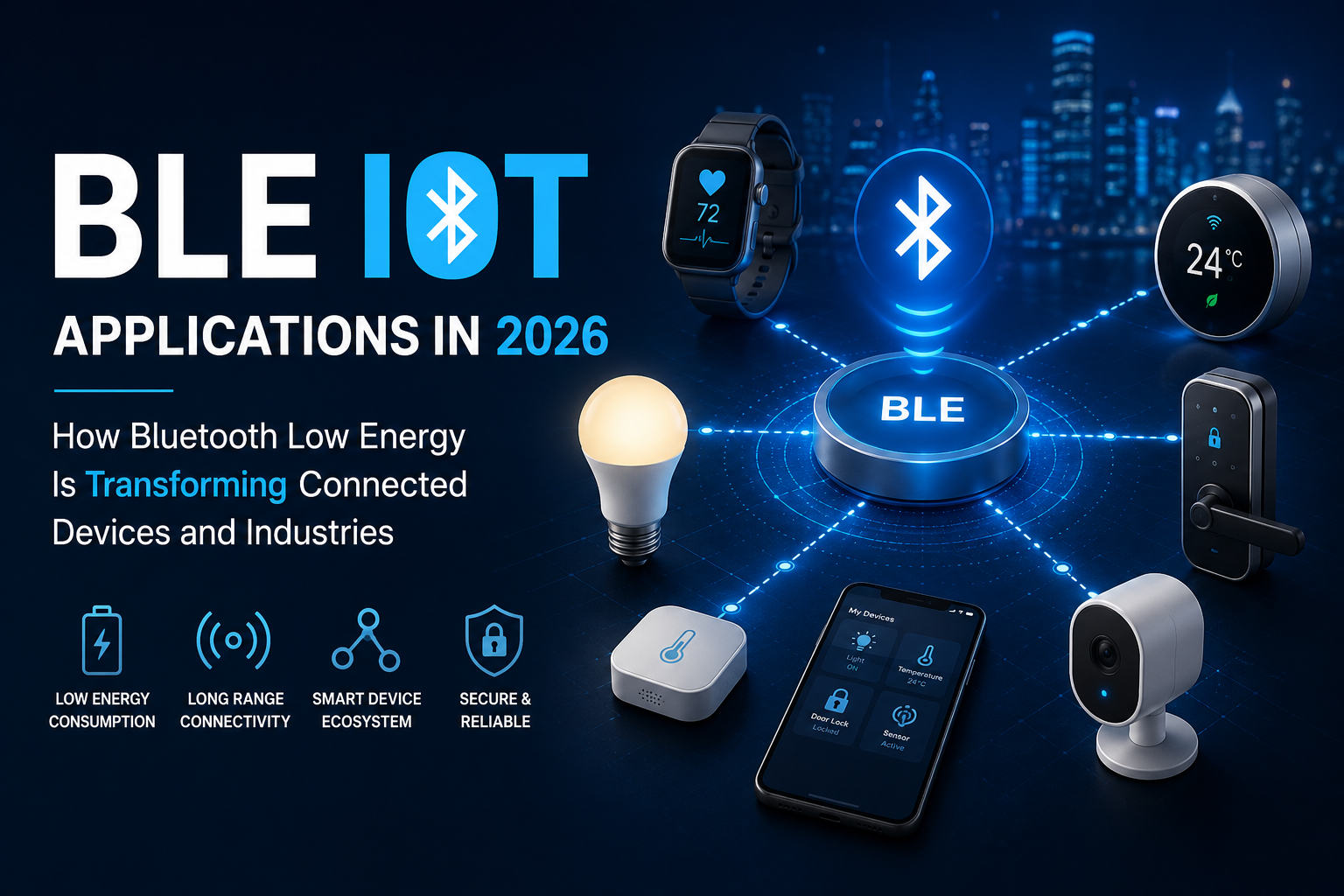
    BLE IoT Applications in 2026: How Bluetooth Low Energy Is Transforming Connected Devices

    Bluetooth Low Energy (BLE) has become one of the most practical technologies for building connected products that are affordable, energy-efficient, and easy to deploy. As IoT adoption continues to grow in 2026, BLE is playing an increasingly important role in connecting sensors, mobile applications, wearables, healthcare devices, smart buildings, and industrial equipment.

    For businesses looking to develop reliable IoT solutions, combining BLE with cloud platforms, mobile apps, edge computing, and AI can create powerful connected experiences.

    What Is BLE IoT?

    BLE IoT refers to the use of Bluetooth Low Energy technology to connect IoT devices, sensors, and applications. Unlike traditional Bluetooth, BLE is designed for low-power communication, making it particularly suitable for battery-operated devices.

    A typical BLE IoT ecosystem can include:

    • BLE-enabled sensors
    • Smartphones and tablets
    • IoT gateways
    • Cloud platforms
    • Mobile applications
    • Web dashboards
    • AI and analytics systems

    A BLE device collects information such as temperature, movement, location, pressure, or device status and communicates that data to a smartphone, gateway, or other connected system.

    Why BLE Is Important for IoT in 2026

    The growth of smart devices has increased the demand for wireless technologies that are efficient, reliable, and cost-effective.

    BLE offers several advantages:

    Low Power Consumption

    BLE devices can operate for long periods using small batteries. This makes BLE suitable for wearable devices, sensors, trackers, and remote monitoring systems.

    Cost Efficiency

    BLE hardware is generally affordable, allowing businesses to deploy large numbers of connected sensors without significantly increasing infrastructure costs.

    Smartphone Compatibility

    Modern smartphones support BLE, allowing mobile applications to communicate directly with compatible IoT devices without requiring specialized hardware in many use cases.

    Flexible Connectivity

    BLE can be used for short-range communication between sensors, mobile devices, gateways, and connected equipment.

    Scalable IoT Deployments

    Businesses can combine multiple BLE sensors with gateways and cloud platforms to create scalable IoT ecosystems.

    Major BLE IoT Applications in 2026

    1. Healthcare and Medical Devices

    BLE is increasingly useful in healthcare monitoring applications. Connected devices can transmit measurements to mobile applications or healthcare platforms.

    Potential applications include:

    • Patient monitoring
    • Fitness and wellness devices
    • Medical sensors
    • Medication tracking
    • Hospital asset monitoring
    • Remote health monitoring

    BLE can help reduce the need for wired connections while providing convenient access to device data.

    2. Smart Homes

    BLE is also becoming an important component of smart-home ecosystems.

    Connected BLE devices can include:

    • Smart locks
    • Motion sensors
    • Temperature sensors
    • Lighting controls
    • Door and window sensors
    • Energy-monitoring devices

    Mobile applications can communicate with these devices and provide users with real-time control and monitoring.

    3. Industrial IoT

    Industrial businesses can use BLE sensors to monitor equipment and operational conditions.

    For example, sensors can collect:

    • Temperature
    • Vibration
    • Pressure
    • Machine status
    • Equipment usage
    • Environmental conditions

    This information can be analyzed to identify abnormal conditions and support predictive maintenance strategies.

    4. Asset Tracking

    BLE beacons and tags can help businesses track equipment, inventory, tools, and other assets.

    A BLE-based tracking system can provide information about the approximate location of an asset and help businesses reduce asset loss and improve operational visibility.

    5. Retail and Customer Engagement

    Retailers can use BLE technology for proximity-based experiences.

    BLE beacons can support:

    • Indoor navigation
    • Product information
    • Customer engagement
    • Store analytics
    • Personalized notifications
    • Location-aware experiences

    When combined with mobile applications, BLE can create more interactive retail environments.

    6. Wearable Technology

    BLE is widely used in wearable devices because of its low energy requirements.

    Examples include:

    • Smartwatches
    • Fitness trackers
    • Sports sensors
    • Health-monitoring devices
    • Smart accessories

    BLE enables these devices to communicate with smartphones and other connected systems while conserving battery power.

    BLE IoT and Mobile Applications

    Mobile applications are often an important part of a BLE IoT solution.

    A typical application can:

    1. Scan for nearby BLE devices.
    2. Identify compatible devices.
    3. Establish a connection.
    4. Discover BLE services and characteristics.
    5. Read or receive sensor data.
    6. Send commands to the connected device.
    7. Display information to the user.
    8. Synchronize selected data with a cloud platform.

    This combination of BLE and mobile technology allows businesses to create connected products without requiring users to interact directly with complex hardware.

    BLE IoT and Cloud Connectivity

    BLE itself is generally designed for local wireless communication. Cloud connectivity can be added through a smartphone, gateway, or edge device.

    A common architecture looks like:

    BLE Sensor → Smartphone/Gateway → Internet → Cloud Platform → Web/Mobile Dashboard

    This architecture allows organizations to collect data from multiple devices and analyze it centrally.

    Cloud integration can provide:

    • Real-time monitoring
    • Historical data
    • Device management
    • Remote analytics
    • Alerts and notifications
    • Reporting
    • Data visualization

    The Role of AI in BLE IoT

    AI is becoming an important layer in modern IoT solutions.

    Instead of simply collecting sensor data, businesses can use AI to analyze that information and identify meaningful patterns.

    For example, AI can help detect:

    • Unusual equipment behavior
    • Potential device failures
    • Abnormal sensor readings
    • Usage patterns
    • Energy consumption trends

    The combination of BLE sensors, IoT platforms, and AI can turn raw device data into actionable business insights.

    BLE IoT Security Considerations

    Security should be considered from the beginning of every BLE IoT project.

    Important areas include:

    • Secure pairing
    • Authentication
    • Encryption
    • Device authorization
    • Secure firmware updates
    • Data protection
    • Access control
    • Secure cloud communication

    Developers should design the complete IoT ecosystem with security in mind rather than treating security as a final-stage feature.

    Challenges in BLE IoT Development

    Although BLE provides many benefits, IoT development can involve technical challenges.

    These may include:

    • Device compatibility
    • Connection stability
    • Background communication on mobile platforms
    • Power optimization
    • Large-scale device management
    • Firmware integration
    • Security requirements
    • Cloud synchronization
    • Cross-platform application development

    Choosing the right BLE architecture and development approach can significantly affect the reliability of the final product.

    Future of BLE IoT

    The future of BLE IoT is moving toward more intelligent, automated, and interconnected systems.

    Businesses are increasingly combining BLE with:

    • Edge computing
    • Artificial intelligence
    • Cloud platforms
    • Mobile applications
    • Real-time analytics
    • Smart sensors
    • Digital twins
    • Location-based technologies

    This evolution will allow IoT systems to move beyond basic monitoring toward automated decision-making and intelligent device management.

    How Businesses Can Build BLE IoT Solutions

    Developing a successful BLE IoT product requires more than simply connecting a Bluetooth device to an application.

    A complete solution may involve:

    Hardware → BLE Firmware → Mobile App → IoT Gateway → Cloud → Analytics → Admin Dashboard

    Working with an experienced BLE and IoT development team can help businesses manage these different components and build a solution tailored to their requirements.

    Conclusion

    BLE IoT is becoming an important technology for connected products in 2026. Its low power consumption, cost efficiency, smartphone compatibility, and flexibility make it suitable for applications across healthcare, industrial IoT, smart homes, retail, asset tracking, and wearable technology.

    When BLE is combined with mobile applications, cloud infrastructure, and AI, businesses can create intelligent IoT ecosystems that improve monitoring, automation, and operational efficiency.

    For companies planning to build a BLE-enabled IoT product, now is an excellent time to explore how connected devices can become part of their digital strategy.

    Suggested SEO Keywords: BLE IoT, BLE IoT development, Bluetooth Low Energy IoT, BLE IoT applications, IoT development, BLE development, Bluetooth IoT solutions, BLE mobile app development, IoT device connectivity

  • IoT BLE in 2026: How Bluetooth Low Energy Is Powering Smarter Connected Devices

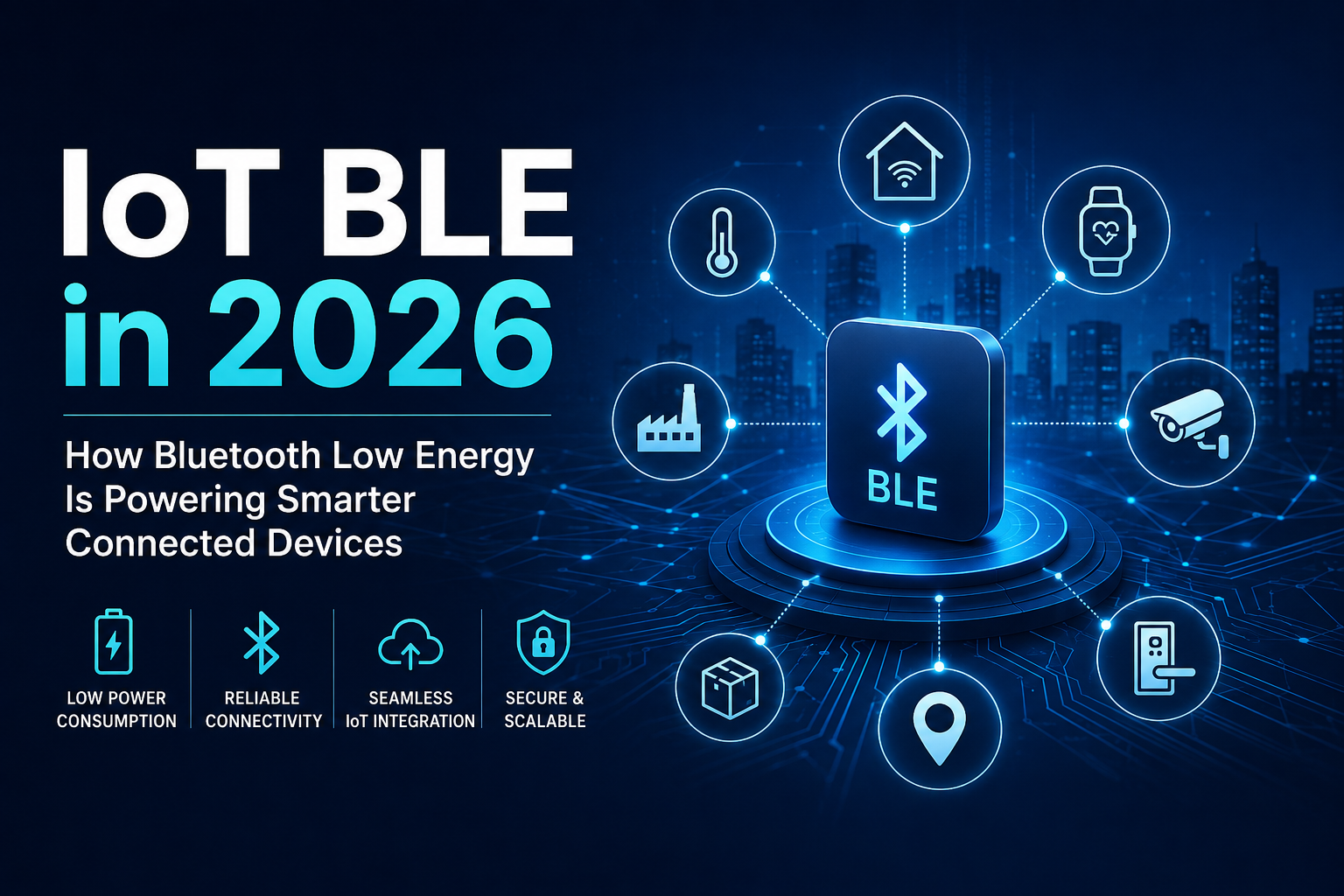
    IoT BLE in 2026: How Bluetooth Low Energy Is Powering Smarter Connected Devices

    The Internet of Things (IoT) is rapidly changing how businesses and consumers interact with connected devices. From smart homes and healthcare equipment to industrial monitoring and retail solutions, organizations need reliable, secure, and energy-efficient connectivity.

    One technology playing a major role in this transformation is Bluetooth Low Energy (BLE).

    In 2026, BLE is no longer limited to simple wireless accessories. Combined with IoT platforms, cloud services, mobile applications, sensors, and edge computing, BLE is becoming an important building block for modern connected solutions.

    What Is IoT BLE?

    IoT BLE refers to the integration of Bluetooth Low Energy technology with Internet of Things devices and systems.

    BLE enables sensors, machines, wearables, beacons, and other devices to communicate wirelessly while consuming relatively little power. IoT platforms can then collect, process, analyze, and visualize the data generated by these devices.

    A typical IoT BLE ecosystem may include:

    • BLE sensors
    • Smartphones or tablets
    • BLE gateways
    • IoT cloud platforms
    • Mobile applications
    • Web dashboards
    • Databases and analytics systems
    • AI-powered monitoring and automation

    This combination allows businesses to create connected solutions without depending on high-power wireless technologies for every device.

    Why BLE Is Important for IoT in 2026

    IoT deployments often involve hundreds or thousands of connected devices. Many of these devices operate on batteries and may need to work for months or years without frequent maintenance.

    BLE offers several advantages for these environments.

    1. Low Power Consumption

    BLE was designed for low-energy communication. This makes it suitable for battery-powered sensors, wearable devices, asset trackers, and monitoring equipment.

    Longer battery life can reduce maintenance requirements and operating costs for large IoT deployments.

    2. Cost-Effective Connectivity

    BLE hardware is widely available and can be integrated into many types of devices. This makes it practical for startups as well as enterprise IoT deployments.

    3. Smartphone Compatibility

    Modern smartphones and tablets generally support BLE, allowing mobile applications to communicate directly with compatible IoT devices.

    This can eliminate the need for dedicated hardware in certain use cases.

    4. Flexible IoT Architecture

    BLE devices can communicate with smartphones, gateways, embedded systems, and other compatible infrastructure.

    A BLE gateway can collect data from multiple nearby sensors and transfer that information to an IoT backend using Wi-Fi, Ethernet, cellular connectivity, or another network technology.

    How an IoT BLE System Works

    A basic IoT BLE architecture can be divided into several stages.

    Step 1: Sensors Collect Data

    BLE-enabled sensors measure information such as:

    • Temperature
    • Humidity
    • Motion
    • Location
    • Pressure
    • Proximity
    • Equipment status
    • Energy consumption

    Step 2: BLE Transfers the Data

    The sensor transmits information using Bluetooth Low Energy.

    Depending on the application, the data may be received by a smartphone, tablet, embedded controller, or BLE gateway.

    Step 3: Gateway or Mobile Device Processes Data

    A gateway or mobile application can process the BLE data and forward relevant information to an IoT platform.

    Step 4: Cloud Platform Stores and Analyzes Information

    The IoT backend can store sensor information and provide dashboards, alerts, analytics, and automation.

    Step 5: Businesses Take Action

    Organizations can use the collected data to monitor assets, identify problems, automate processes, and make better operational decisions.

    Major IoT BLE Applications

    BLE and IoT are being used across a wide range of industries.

    Smart Homes

    BLE sensors can monitor temperature, motion, doors, windows, lighting, and other household conditions.

    When integrated with an IoT platform, these sensors can contribute to automated smart-home experiences.

    Healthcare and Wearables

    BLE is widely used for connecting wearable and monitoring devices with smartphones and healthcare systems.

    Applications can include fitness tracking, patient monitoring, medical device connectivity, and wellness platforms.

    Industrial IoT

    Factories can use BLE sensors to monitor equipment conditions, temperature, vibration, and asset movement.

    Real-time data can help organizations identify maintenance requirements before equipment failures occur.

    Retail

    Retail businesses can use BLE beacons and sensors for proximity-based experiences, indoor navigation, customer engagement, and asset monitoring.

    BLE can also help retailers understand movement patterns within physical locations.

    Logistics and Asset Tracking

    BLE tags can be attached to equipment, containers, inventory, or other valuable assets.

    Gateways positioned throughout facilities can collect information from these tags and send it to centralized systems.

    Smart Buildings

    BLE-enabled sensors can support occupancy monitoring, environmental monitoring, access systems, and energy-management solutions.

    BLE Beacons and IoT

    BLE beacons are small wireless devices that periodically transmit signals that nearby compatible devices can detect.

    When integrated into an IoT ecosystem, beacons can support:

    • Indoor positioning
    • Asset tracking
    • Proximity marketing
    • Navigation
    • Location-based automation
    • Employee and equipment tracking
    • Smart-building applications

    Beacons are particularly useful when businesses need location-aware IoT experiences.

    BLE Mesh for Large IoT Deployments

    Traditional BLE communication is generally designed around direct connections or broadcasts. Bluetooth Mesh can extend the possibilities for larger networks of connected devices.

    Mesh networking allows compatible devices to participate in a network where information can move between nodes.

    This can be useful for applications such as:

    • Smart lighting
    • Building automation
    • Industrial monitoring
    • Large sensor networks
    • Commercial facilities

    For organizations deploying many connected devices across large physical spaces, BLE Mesh can provide another architectural option.

    IoT BLE and Edge Computing

    Edge computing is becoming increasingly important as IoT deployments generate larger amounts of data.

    Instead of sending every piece of sensor information directly to the cloud, edge devices can process some information locally.

    For example, an industrial BLE gateway could analyze sensor readings locally and send only important events to the cloud.

    This approach can help reduce:

    • Network traffic
    • Cloud processing requirements
    • Response times
    • Dependence on continuous cloud connectivity

    Security Considerations for IoT BLE

    Security should be considered from the beginning of an IoT BLE project.

    Developers should pay attention to:

    • BLE pairing and authentication
    • Encryption
    • Device identity
    • Secure firmware updates
    • Access control
    • API security
    • Cloud authentication
    • Data protection
    • Device lifecycle management

    A secure IoT architecture should protect the device, communication layer, gateway, application, and backend infrastructure.

    Challenges of IoT BLE Development

    Despite its advantages, BLE IoT development can involve several technical challenges.

    Device Compatibility

    Different BLE devices may implement profiles and characteristics differently. Developers need to understand the hardware specifications and communication protocols involved.

    Connection Management

    Mobile and embedded applications need to properly handle scanning, pairing, connections, disconnections, reconnection attempts, and background behavior.

    Large-Scale Deployment

    A solution that works with ten devices may require a different architecture when deployed across thousands of devices.

    Data Management

    IoT systems can generate large amounts of sensor data. Businesses need an efficient approach to storing, processing, and analyzing this information.

    Security

    Security must be addressed across the complete ecosystem rather than only at the BLE communication layer.

    The Future of IoT BLE

    The combination of BLE, IoT, edge computing, cloud platforms, and AI is creating new opportunities for connected-device development.

    Future IoT BLE solutions are likely to focus increasingly on:

    • Intelligent automation
    • Real-time monitoring
    • Predictive maintenance
    • Indoor positioning
    • Smart healthcare
    • Connected retail
    • Industrial asset tracking
    • Energy optimization
    • AI-powered analytics

    As organizations continue to digitize physical environments, BLE can provide an efficient connectivity layer between sensors and intelligent IoT applications.

    Conclusion

    IoT BLE is becoming an important technology for building connected, energy-efficient, and scalable solutions in 2026.

    Its combination of low power consumption, smartphone compatibility, flexible connectivity, and broad hardware support makes BLE suitable for applications ranging from smart homes and wearables to industrial IoT, healthcare, retail, and asset tracking.

    Businesses looking to develop connected products should consider BLE as part of a broader IoT architecture that includes secure device communication, gateways, cloud infrastructure, mobile applications, and intelligent data processing.

    For companies planning a new IoT BLE solution, choosing the right architecture and development approach from the beginning can make the difference between a prototype and a scalable production-ready platform.

  • When IoT Meets BLE: The Connected Device That Refuses to Behave

    When IoT Meets BLE: The Connected Device That Refuses to Behave

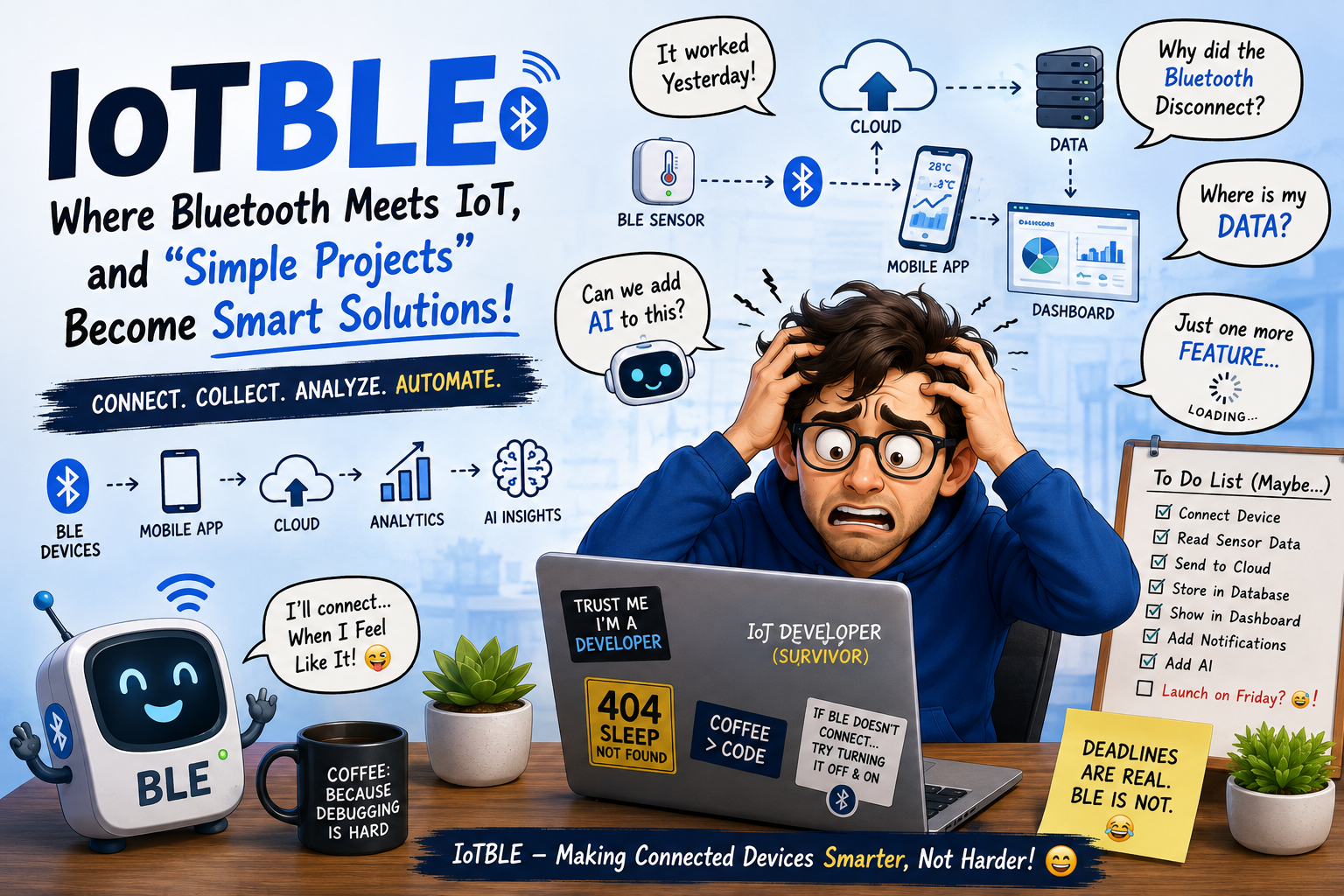
    Introduction: “It’s Just a Small IoT Project” 😂

    Every IoT project starts innocently.

    The client says:

    “We just need to connect one small sensor to a mobile app.”

    The developer smiles.

    “Sure.”

    Then comes the second sentence:

    “It should use Bluetooth.”

    Okay. BLE development.

    Then:

    “The data should go to the cloud.”

    Okay. IoT development.

    Then:

    “Can we add an admin dashboard?”

    Okay.

    “Can users get notifications?”

    Sure.

    “Can AI analyze the data?”

    Absolutely.

    “Can it work on iPhone and Android?”

    Of course.

    “And can we launch next Friday?”

    Welcome to IoT development. 😂


    What Is BLE IoT Anyway?

    In simple terms, BLE IoT combines Bluetooth Low Energy with connected devices, mobile applications, gateways, cloud platforms, and data systems.

    A typical architecture looks like:

    Sensor 📡

    BLE 🔵

    Mobile App 📱

    Cloud ☁️

    Database 🗄️

    AI 🤖

    Dashboard 📊

    The customer sees:

    “The temperature is 28°C.”

    The developer sees:

    “Why did the BLE connection disappear exactly when the temperature reached 28°C?” 😂


    The BLE Connection: A Love Story 💔

    BLE developers know this relationship very well.

    Developer:

    “Connect to device.”

    BLE device:

    “No.”

    Developer:

    “Please?”

    BLE device:

    “Maybe.”

    Developer:

    “Scan again.”

    BLE device:

    “I don’t exist.”

    Developer:

    “Restart Bluetooth.”

    BLE device:

    “Fine. I’ll connect now.”

    😂

    Bluetooth Low Energy is incredibly useful, but sometimes it feels like the device has its own personality.

    And apparently, its personality is:

    “I will connect when I feel like it.”


    “It Worked Yesterday”

    These are probably the most dangerous words in software development.

    “It worked yesterday.”

    Yesterday:

    ✅ Device connected
    ✅ Data arrived
    ✅ App worked
    ✅ Cloud received everything

    Today:

    ❌ Device won’t connect

    Developer:

    “What changed?”

    Everyone:

    “Nothing.”

    😂

    Something definitely changed.

    It always does.


    The Famous “Just Add One Sensor”

    Client:

    “Can we add another sensor?”

    Developer:

    “Sure.”

    Then:

    “And another one?”

    Okay.

    “And maybe five more?”

    Fine.

    “Actually, we have 10,000 devices.”

    Developer:

    👁️👄👁️

    That’s when a small BLE application suddenly becomes a large-scale IoT platform.

    Now you need to think about:

    • Device management
    • Cloud architecture
    • Data storage
    • Scalability
    • Authentication
    • Security
    • Firmware updates
    • Monitoring
    • Analytics
    • API design

    Congratulations.

    Your “simple project” has become an IoT ecosystem. 😂


    BLE vs Wi-Fi: The Family Argument

    BLE:

    “I use very little power.”

    Wi-Fi:

    “But I have more bandwidth.”

    BLE:

    “I can run on tiny batteries.”

    Wi-Fi:

    “I can connect directly to the internet.”

    BLE:

    “Your battery is crying.”

    Wi-Fi:

    “At least I don’t need a gateway.”

    BLE:

    “At least I don’t drain the battery.”

    😂

    The truth?

    Neither is automatically better.

    The right technology depends on:

    • Range
    • Power consumption
    • Data volume
    • Connectivity
    • Hardware
    • Cost
    • Application requirements

    Sometimes the smartest architecture uses both.


    When the Smartphone Becomes the IoT Gateway

    One of the coolest things about BLE is that a smartphone can act as the bridge between the physical device and the internet.

    For example:

    BLE Sensor

    Android/iOS App

    Internet

    Cloud

    Simple, right?

    Well…

    Then the developer gets questions like:

    “Will it work when the app is closed?”

    😐

    “What if Bluetooth is turned off?”

    😐

    “What if the user walks 100 meters away?”

    😐

    “What if the phone battery dies?”

    😐

    “What if the user has an iPhone?”

    😐

    “What if they have Android?”

    😐

    And suddenly that simple diagram has become a 50-page technical discussion.

    😂


    GATT: The Word That Makes BLE Developers Nod

    If you’re new to BLE development, you may hear:

    GATT

    No, it isn’t someone’s name.

    GATT stands for Generic Attribute Profile.

    BLE devices organize information using:

    • Services
    • Characteristics
    • Descriptors

    A developer might say:

    “The device exposes a custom service with three characteristics.”

    A normal person:

    “…English please?”

    😂

    Basically, GATT defines how BLE devices organize and exchange information.

    It’s one of the foundations of serious BLE application development.


    The Mysterious BLE Device

    Every BLE developer eventually encounters The Device.

    It has:

    • No documentation
    • Strange UUIDs
    • Random disconnects
    • One mysterious characteristic
    • Firmware from 2019

    And the client says:

    “Can you connect it to our app?”

    Developer:

    “Do you have the protocol documentation?”

    Client:

    “No.”

    “SDK?”

    “No.”

    “Firmware documentation?”

    “No.”

    “Technical contact?”

    “Maybe.”

    😂

    And that’s how detective work begins.


    IoT Data: From Tiny Sensor to Giant Database

    A sensor sends one small value.

    For example:

    Temperature = 28°C

    Seems harmless.

    Now imagine:

    10,000 devices.

    Each device sends data every 10 seconds.

    Suddenly you’re dealing with a huge amount of IoT data.

    Now you need:

    • Data ingestion
    • APIs
    • Databases
    • Data retention
    • Cloud infrastructure
    • Analytics
    • Monitoring
    • Security

    The sensor may be tiny.

    The backend definitely isn’t.

    😂


    Then Someone Says: “Let’s Add AI”

    Everything is going smoothly.

    Sensors work.

    BLE works.

    Cloud works.

    Dashboard works.

    Then someone says:

    “Can we add AI?”

    Of course.

    Now AI needs to analyze:

    • Sensor readings
    • Historical data
    • Device behavior
    • Anomalies
    • Trends

    Suddenly:

    BLE + IoT + Cloud + AI

    is on the project roadmap.

    The developer opens another coffee.

    ☕😂


    AI + IoT: Actually Pretty Useful

    Jokes aside, combining AI with IoT can be extremely useful.

    Imagine a machine with BLE-connected sensors.

    The system collects:

    Temperature

    Vibration

    Pressure

    Operating Time

    The IoT platform processes the information.

    AI can then look for unusual patterns.

    Instead of simply telling a business:

    “The machine temperature increased.”

    The system could potentially identify:

    “This machine is behaving differently from its historical pattern.”

    That’s where AI-powered IoT becomes interesting.


    The Dashboard Everyone Wants

    Every IoT project eventually needs a dashboard.

    And the dashboard usually starts with:

    “Just show the sensor data.”

    Then:

    “Can we add graphs?”

    Sure.

    “Filters?”

    Okay.

    “Export to Excel?”

    Fine.

    “Real-time updates?”

    Yep.

    “User permissions?”

    Sure.

    “Can we have dark mode?”

    😂

    Eventually the dashboard has:

    17 charts

    8 filters

    12 buttons

    and nobody knows which button does what.

    The lesson?

    Good IoT dashboards should simplify data, not overwhelm users with it.


    The “Real-Time” Problem

    Client:

    “We need real-time data.”

    Developer:

    “How real-time?”

    Client:

    “Instant.”

    Developer:

    “How many milliseconds?”

    Client:

    “Just… instant.”

    😂

    “Real-time” can mean different things depending on the application.

    A temperature dashboard may update every few seconds.

    A safety system might require much faster response.

    A business analytics dashboard may only need updates every few minutes.

    The technical architecture should match the actual business requirement.


    When the Internet Disappears

    Everything is connected.

    Everything is beautiful.

    Then…

    Wi-Fi: Gone.

    Cloud:

    “I’m unavailable.”

    IoT Gateway:

    “What should I do?”

    Sensor:

    “I have data.”

    Developer:

    “Please store it locally.”

    This is why good IoT systems need to consider:

    • Offline operation
    • Local caching
    • Retry mechanisms
    • Data synchronization
    • Connection recovery

    Because in the real world:

    Internet outages happen.


    IoT Security: The Serious Part

    Okay, jokes aside.

    IoT security is extremely important.

    A connected device can become an entry point into a larger system.

    A proper BLE IoT architecture should consider:

    • BLE security
    • Device authentication
    • Secure APIs
    • Encryption
    • Cloud security
    • Access control
    • Secure firmware
    • Data protection

    The goal is simple:

    Connect everything without giving everyone access to everything.


    BLE Firmware Updates: “Can We Update the Device Remotely?”

    Client:

    “Can we update the device software without touching the device?”

    Developer:

    “Yes, through OTA firmware updates.”

    Client:

    “Great!”

    Developer:

    “We just need to design the update process carefully.”

    Because firmware updates can involve:

    • File transfer
    • BLE communication
    • Version management
    • Validation
    • Rollback
    • Battery considerations
    • Connection stability

    In other words:

    It’s not quite the same as updating Instagram. 😂


    IoT Development Is Basically Connecting Everything

    At the end of the day, IoT is about connecting the physical world with digital systems.

    Something happens physically:

    Sensor detects something

    BLE communicates it

    Mobile app or gateway receives it

    Cloud stores it

    Analytics understands it

    AI interprets it

    Business system responds

    That’s powerful.

    And also slightly terrifying when you realize how many things can go wrong.

    😂


    Where BLE IoT Is Being Used

    BLE and IoT can support applications across many industries.

    🏭 Manufacturing

    Machine monitoring, equipment tracking, predictive maintenance.

    🏥 Healthcare

    Connected devices, wearables, monitoring systems.

    🚚 Logistics

    Asset tracking, environmental monitoring, cold-chain applications.

    🛒 Retail

    Beacons, smart stores, customer engagement, asset monitoring.

    🏢 Smart Buildings

    Occupancy, access, environmental sensing, asset tracking.

    🌾 Agriculture

    Environmental monitoring and connected sensors.

    ⌚ Wearables

    Fitness devices, smart accessories, connected health products.

    🏠 Smart Products

    Connected appliances, sensors, and consumer devices.


    The IoT Developer’s Daily Checklist 😂

    ☑ Is Bluetooth enabled?

    ☑ Is the device advertising?

    ☑ Did the phone discover it?

    ☑ Did it connect?

    ☑ Did the service appear?

    ☑ Did the characteristic respond?

    ☑ Did the gateway receive the data?

    ☑ Did the API receive the data?

    ☑ Did the database save it?

    ☑ Did the dashboard update?

    ☑ Why is the dashboard showing yesterday’s data?

    ☑ Who changed the firmware?

    ☑ Why is the device offline?

    ☑ Coffee?

    ☑ Definitely coffee. ☕


    What Makes a Good BLE IoT Solution?

    A good IoT solution isn’t simply about connecting a device.

    It needs to be:

    Reliable

    Devices should communicate consistently.

    Secure

    Data and devices need appropriate protection.

    Scalable

    The architecture should support future growth.

    Efficient

    Battery and bandwidth should be used intelligently.

    User-Friendly

    Complex technology should remain invisible to users.

    Maintainable

    The system should be manageable after launch.

    Data-Driven

    Collected information should create actual business value.


    The Future of BLE IoT

    The future of connected technology isn’t simply:

    More Devices.

    It’s:

    Smarter Devices.

    The next generation of BLE IoT systems will increasingly combine:

    BLE

    Edge Computing

    Cloud

    AI

    Automation

    Real-Time Analytics

    This means devices won’t just collect information.

    They will increasingly help businesses understand and act on that information.


    Why IoTBLE?

    Building a successful connected product requires more than knowing how to connect a BLE device.

    It can involve:

    Hardware → Firmware → BLE → Mobile → IoT → Cloud → AI → Analytics

    IoTBLE focuses on this connected technology ecosystem.

    Solutions can include:

    • BLE IoT applications
    • BLE mobile applications
    • IoT application development
    • BLE device integration
    • IoT gateway solutions
    • Sensor applications
    • Wearable technology
    • Asset tracking
    • Smart-device solutions
    • Cloud-connected IoT platforms
    • AI-powered IoT applications

    The goal is simple:

    Make connected technology actually useful.


    Final Thoughts 😂

    IoT sounds simple.

    Until you build it.

    BLE sounds simple.

    Until the device refuses to connect.

    Cloud sounds simple.

    Until 10,000 devices start sending data.

    AI sounds simple.

    Until someone asks:

    “Why did the AI make that decision?”

    😂

    But that’s exactly what makes IoT development exciting.

    The real challenge isn’t simply connecting devices.

    It’s creating a reliable ecosystem where devices, software, cloud platforms, AI, and people work together.

    So the next time someone says:

    “It’s just a small BLE IoT project.”

    Smile.

    Open your laptop.

    And order another coffee. ☕😂

    IoTBLE — Where Bluetooth meets IoT, and “simple projects” become smart connected solutions.


    • BLE IoT solutions
    • BLE IoT applications
    • Bluetooth Low Energy IoT
    • IoT BLE
    • BLE development
    • IoT development
    • BLE app development
    • BLE IoT development
    • Bluetooth IoT
    • connected devices

    Commercial keywords:

    • BLE IoT development company
    • BLE IoT development services
    • BLE application development company
    • IoT development company
    • BLE IoT solutions provider
    • custom BLE IoT solutions
    • BLE developers

    • What is BLE IoT?
    • How does BLE work with IoT?
    • What are BLE IoT applications?
    • Is BLE suitable for IoT?
    • Can BLE devices connect to the cloud?
    • Can a smartphone act as a BLE gateway?
    • What is BLE used for in IoT?
    • What is the difference between BLE and IoT?
    • Can AI be used with BLE IoT?
    • What are the challenges of BLE IoT development?

    Suggested CTA:
    👉 Have a “simple” BLE IoT idea? Let IoTBLE turn it into a connected solution.

  • IoT BLE Services: How BLE and IoT Are Transforming Connected Devices in 2026

    IoT BLE Services: How BLE and IoT Are Transforming Connected Devices in 2026

    The Internet of Things is moving from simple connected devices to intelligent ecosystems that can collect data, communicate securely, and respond to real-time events. At the center of many of these connected experiences is Bluetooth Low Energy (BLE).

    From smart sensors and wearables to industrial equipment, healthcare devices, asset trackers, and smart buildings, businesses are using BLE IoT solutions to connect physical devices with mobile applications, gateways, cloud platforms, and analytics systems.

    But building a successful connected product requires more than simply adding Bluetooth connectivity.

    A production-ready IoT ecosystem needs reliable BLE device development, IoT system integration, secure device pairing, embedded firmware, cloud connectivity, real-time data monitoring, and scalable device management.

    This is where professional IoT BLE services become important.

    What Are IoT BLE Services?

    IoT BLE services are development and integration services that connect Bluetooth Low Energy devices with mobile applications, gateways, cloud platforms, and IoT systems.

    A typical BLE IoT architecture can include:

    BLE Device → Mobile App/Gateway → Internet → Cloud Platform → Database → Analytics → Business Application

    BLE provides the low-power wireless communication layer, while IoT infrastructure manages connectivity, data processing, monitoring, automation, and cloud-based intelligence.

    For businesses developing connected products, combining BLE with IoT can create secure, scalable, and energy-efficient connected experiences.

    Why BLE Is Important for IoT

    Bluetooth Low Energy was designed for applications that need wireless communication while keeping power consumption low.

    This makes BLE particularly useful for battery-powered IoT devices.

    Common BLE IoT applications include:

    • Wearable devices
    • Fitness trackers
    • Medical devices
    • Smart sensors
    • Asset tracking systems
    • Industrial monitoring
    • Smart locks
    • Smart home devices
    • Retail technology
    • Location and proximity systems
    • EV charging solutions
    • Connected equipment
    • Environmental monitoring

    A BLE device can collect information from sensors and communicate with a smartphone, tablet, gateway, or other connected system.

    The data can then be processed and stored in an IoT cloud environment.

    How BLE IoT Architecture Works

    A modern BLE IoT solution typically consists of several interconnected layers.

    1. BLE Device

    The physical device contains sensors, a BLE chipset, firmware, and other hardware components.

    Depending on the application, it may measure:

    • Temperature
    • Humidity
    • Motion
    • Pressure
    • Location
    • Heart rate
    • Equipment status
    • Battery level
    • Environmental conditions

    2. BLE Communication

    The device communicates using Bluetooth Low Energy.

    BLE supports both peripheral and central roles.

    A BLE peripheral generally advertises its presence and provides services that another device can connect to.

    A central device, such as a smartphone or gateway, can scan for BLE peripherals and establish communication.

    3. Mobile Application

    A mobile application can act as the communication bridge between the BLE device and the cloud.

    For example:

    BLE Sensor → iOS/Android App → Cloud API

    Mobile BLE development commonly involves technologies such as iOS CoreBluetooth and Android Bluetooth APIs.

    4. IoT Gateway

    In some deployments, a dedicated IoT gateway collects data from multiple BLE devices and forwards it to the cloud.

    This architecture is particularly useful for industrial, commercial, and large-scale deployments.

    5. Cloud Platform

    The cloud provides infrastructure for:

    • Data storage
    • Device management
    • Authentication
    • Analytics
    • Monitoring
    • API integration
    • Automation
    • Remote management

    BLE IoT solutions can be integrated with platforms such as:

    • AWS IoT
    • Microsoft Azure IoT
    • Google Cloud

    6. Analytics and Applications

    The final layer turns connected-device data into useful business information.

    Organizations can use dashboards and analytics systems to monitor devices, identify patterns, generate alerts, and automate business processes.

    BLE Device Development for IoT Products

    Successful BLE IoT products start with reliable device development.

    BLE device development can involve:

    • BLE peripheral implementation
    • BLE central implementation
    • GATT service development
    • GATT characteristic design
    • Advertising configuration
    • Connection management
    • Power optimization
    • Security implementation
    • Firmware development
    • Device provisioning
    • OTA firmware updates
    • Hardware and software testing

    The BLE architecture should be designed around the actual product requirements.

    A wearable device, for example, may prioritize extremely low power consumption.

    An industrial sensor may prioritize range, reliability, data availability, and long-term field operation.

    Custom GATT Services

    Generic Attribute Profile, commonly known as GATT, defines how BLE devices expose services and characteristics.

    For custom IoT products, developers can create custom GATT services based on the application’s data model.

    For example, an industrial sensor might expose characteristics for:

    • Temperature
    • Pressure
    • Device status
    • Battery level
    • Error codes
    • Configuration settings

    A mobile application or gateway can then read, write, subscribe to, or monitor these characteristics.

    Proper GATT architecture is important because a poorly designed data model can create unnecessary complexity as the product scales.

    BLE Device Pairing and Provisioning

    Device onboarding is another critical component of a BLE IoT solution.

    A typical onboarding process may include:

    Device Discovery → Authentication → Pairing → Configuration → Cloud Registration → Device Activation

    Secure provisioning helps associate a physical device with a particular customer, account, location, or IoT environment.

    For enterprise deployments, device identity and authentication should be carefully designed from the beginning.

    OTA Firmware Updates

    Connected devices may remain in the field for years.

    Updating firmware manually can be expensive and difficult, especially when thousands of devices are deployed across different locations.

    Over-the-air firmware updates, or OTA updates, allow manufacturers to update device software remotely.

    A robust OTA system should consider:

    • Secure firmware packages
    • Version management
    • Update validation
    • Interrupted connections
    • Rollback mechanisms
    • Battery limitations
    • Device authentication

    OTA capability can significantly improve long-term device maintainability.

    Smart Sensor Networks

    One of the strongest use cases for BLE IoT is the development of smart sensor networks.

    Instead of collecting information manually, organizations can deploy connected sensors that continuously monitor physical environments.

    For example:

    Sensors → BLE → Gateway → Cloud → Dashboard → Alert

    A smart sensor network can support applications such as:

    • Equipment monitoring
    • Environmental monitoring
    • Warehouse monitoring
    • Industrial automation
    • Asset tracking
    • Smart buildings
    • Healthcare monitoring

    Real-time data can help organizations make faster operational decisions.

    Gateway and Cloud Connectivity

    BLE works well for short-range communication, but many IoT applications require data to travel beyond the local BLE environment.

    This is where gateway and cloud connectivity becomes important.

    A gateway can communicate with nearby BLE devices and then send information to a cloud platform through Wi-Fi, Ethernet, cellular connectivity, or another network technology.

    This creates an architecture such as:

    BLE Devices → IoT Gateway → Cloud → API → Business Application

    This approach allows organizations to manage large numbers of devices without requiring every BLE device to have direct internet connectivity.

    Real-Time Data Monitoring

    IoT becomes valuable when device data can be converted into actionable information.

    Real-time data monitoring allows businesses to see the current state of connected devices.

    A monitoring dashboard might display:

    • Device connectivity
    • Battery status
    • Sensor readings
    • Temperature
    • Location
    • Equipment status
    • Alerts
    • Historical trends

    For example, if a sensor detects an abnormal temperature, the IoT platform could trigger an alert before the situation becomes a major operational problem.

    BLE Beacons and Location-Aware IoT

    BLE beacon technologies can also support proximity and location-aware applications.

    Beacon-based systems can be used for:

    • Indoor positioning
    • Asset discovery
    • Proximity notifications
    • Retail experiences
    • Visitor management
    • Smart building applications
    • Location-aware mobile applications

    Beacon technologies such as iBeacon and Eddystone can become part of a larger BLE and IoT ecosystem.

    BLE + IoT + AI

    The next evolution of connected systems is the combination of BLE, IoT, cloud computing, and artificial intelligence.

    A connected architecture could look like:

    BLE Sensors

    IoT Gateway

    Cloud Platform

    Real-Time Data

    AI/ML Processing

    Prediction or Decision

    Automated Action

    For example, sensors installed on industrial equipment could continuously collect operational data.

    An AI system could analyze that information and identify unusual patterns.

    The system could then notify an operator or trigger an automated workflow.

    This moves IoT from simple monitoring toward intelligent automation.

    IoT BLE Solutions Across Industries

    IoT BLE technology can be applied across many industries.

    Healthcare

    BLE-enabled medical and healthcare devices can communicate with mobile applications and cloud platforms to support remote monitoring and connected healthcare experiences.

    Manufacturing

    Industrial sensors can monitor machinery, environmental conditions, equipment performance, and operational parameters.

    Retail

    BLE beacons and connected devices can support proximity experiences, asset tracking, inventory systems, and customer engagement.

    Logistics

    BLE trackers and sensors can provide information about assets, shipments, storage conditions, and equipment.

    Fitness and Wearables

    BLE provides an efficient communication layer for fitness trackers, smart devices, health sensors, and wearable applications.

    Smart Buildings

    Connected sensors can monitor temperature, occupancy, environmental conditions, equipment, and energy-related information.

    What Makes a Scalable BLE IoT Solution?

    Building a prototype is different from building an enterprise-ready IoT ecosystem.

    A scalable solution should consider:

    Security

    Device authentication, encryption, secure pairing, access control, and secure cloud communication should be part of the architecture.

    Reliability

    Connected devices must continue operating under real-world conditions, including unstable connectivity and varying environmental conditions.

    Power Efficiency

    Battery-powered BLE devices require careful optimization of advertising intervals, connection parameters, data transmission, and firmware behavior.

    Scalability

    The architecture should support growth from a few prototype devices to potentially thousands or millions of connected devices.

    Data Management

    IoT systems generate significant amounts of data. Data storage, processing, retention, and analytics should be planned early.

    Device Management

    Organizations need tools to monitor, configure, update, and troubleshoot connected devices throughout their lifecycle.

    Why Choose Custom IoT Solutions?

    Every connected product has different requirements.

    An off-the-shelf solution may work for simple applications, but complex products often require custom development.

    A custom IoT solution can integrate:

    • BLE hardware
    • Embedded firmware
    • Mobile applications
    • Web applications
    • IoT gateways
    • Cloud platforms
    • APIs
    • Databases
    • Analytics
    • AI/ML
    • Device management

    This creates a complete technology ecosystem around the business requirement rather than forcing the product into a predefined platform.

    How QuartusTech Supports BLE and IoT Development

    QuartusTech provides end-to-end IoT BLE services, covering connected-device development, BLE integration, mobile applications, cloud connectivity, IoT integration, and real-time data systems.

    Its BLE and IoT capabilities include:

    • BLE peripheral and central development
    • Custom GATT services
    • BLE device provisioning and pairing
    • OTA firmware updates
    • BLE beacon technologies
    • Embedded firmware integration
    • iOS CoreBluetooth development
    • Android Bluetooth API integration
    • AWS IoT integration
    • Azure IoT integration
    • Google Cloud integration
    • IoT gateway development
    • Real-time data monitoring
    • Custom IoT solutions

    This end-to-end approach allows businesses to connect devices, applications, cloud platforms, and data into a unified IoT ecosystem.

    Frequently Asked Questions About IoT BLE Services

    What are IoT BLE services?

    IoT BLE services are development and integration services that connect Bluetooth Low Energy devices with mobile applications, gateways, cloud platforms, and IoT systems.

    Is BLE suitable for IoT?

    Yes. BLE is particularly useful for battery-powered IoT devices because it provides low-power wireless communication and can connect sensors and devices with smartphones, gateways, and other systems.

    What is BLE IoT integration?

    BLE IoT integration connects BLE-enabled devices with an IoT ecosystem that may include mobile applications, gateways, cloud platforms, APIs, databases, dashboards, and analytics.

    Can BLE devices connect to AWS IoT?

    Yes. BLE devices can communicate with gateways or mobile applications that forward data to AWS IoT and other cloud-based IoT platforms.

    What is BLE device provisioning?

    BLE device provisioning is the process of securely onboarding and configuring a BLE device so it can communicate with an application, gateway, or cloud environment.

    Why are OTA firmware updates important?

    OTA firmware updates allow manufacturers to update connected devices remotely without physically accessing each device, making large IoT deployments easier to maintain.

    What industries use BLE IoT solutions?

    BLE IoT solutions are used across healthcare, manufacturing, logistics, retail, fitness, smart buildings, automotive, industrial monitoring, asset tracking, and connected consumer products.

    The Future of BLE and IoT

    The future of connected technology is moving toward systems where devices don’t simply communicate—they continuously generate data, understand their environment, and participate in intelligent workflows.

    The combination of:

    BLE + IoT + Cloud + Mobile + AI + Analytics

    can create connected ecosystems capable of real-time monitoring, predictive insights, automation, and smarter decision-making.

    For companies building connected products in 2026 and beyond, the right BLE and IoT architecture can become a significant competitive advantage.

    Build Your Next BLE IoT Solution

    Whether you are developing a wearable, medical device, industrial sensor, smart lock, fitness tracker, asset tracker, EV charger, or enterprise IoT platform, the technology needs to work as one connected ecosystem.

    From BLE device development and embedded firmware to mobile apps, IoT gateways, cloud integration, OTA updates, and real-time monitoring, every layer needs to work together.

    QuartusTech can help businesses design and develop scalable IoT BLE solutions tailored to their product and business requirements.

    Ready to build your connected product?

    Explore professional IoT BLE services and turn your connected-device idea into a scalable IoT solution.

  • How Bluetooth Low Energy Is Transforming IoT Device Connectivity in 2026

    How Bluetooth Low Energy Is Transforming IoT Device Connectivity in 2026

    The Internet of Things (IoT) is moving toward smaller, smarter, and more energy-efficient connected devices. From wearable sensors and smart home products to industrial equipment and asset-tracking systems, IoT devices need reliable wireless communication without constantly consuming battery power.

    This is where Bluetooth Low Energy (BLE) has become an important connectivity technology.

    BLE was designed for low-power wireless communication and is particularly suitable for applications that exchange relatively small amounts of data. Its broad availability across smartphones, tablets, computers, and embedded devices makes it an attractive option for connecting IoT products with mobile applications and cloud-based platforms.

    What Is BLE in IoT?

    Bluetooth Low Energy is a wireless communication technology optimized for devices that need to operate efficiently on limited power.

    Unlike traditional Bluetooth applications that often focus on continuous data transmission such as audio, BLE is well suited to sensors, trackers, wearables, controllers, and other IoT devices that periodically transmit data.

    A typical BLE-enabled IoT ecosystem can include:

    • BLE sensors
    • Microcontrollers
    • Mobile applications
    • IoT gateways
    • Cloud platforms
    • Analytics dashboards
    • Backend APIs

    For example, a temperature sensor can collect environmental data, transmit it through BLE to a smartphone or gateway, and then send that information to a cloud platform for monitoring and analysis.

    Why BLE Is Important for IoT

    IoT developers have to balance several factors when selecting a connectivity technology, including power consumption, range, data requirements, device cost, and network architecture. Bluetooth technology offers different options depending on these requirements, while BLE is particularly attractive for low-power applications.

    1. Low Power Consumption

    Battery life is one of the biggest challenges in IoT development.

    Many IoT sensors are installed in locations where replacing batteries frequently is inconvenient or expensive. BLE’s low-energy design helps devices communicate while minimizing power consumption.

    This makes BLE useful for:

    • Fitness trackers
    • Environmental sensors
    • Smart locks
    • Asset trackers
    • Wearable devices
    • Industrial sensors
    • Healthcare monitoring devices

    2. Smartphone Compatibility

    One of BLE’s biggest advantages is its compatibility with modern smartphones.

    Android provides built-in BLE APIs that allow applications to discover nearby devices, access services, and exchange information with BLE peripherals.

    This enables a common architecture:

    BLE Device → Mobile App → Cloud Platform

    For IoT companies, this can eliminate the need for a dedicated hardware controller in many consumer applications.

    3. Cost-Effective Connectivity

    IoT products often need to be affordable enough for large-scale deployment.

    BLE can provide wireless connectivity without requiring every sensor to have a cellular connection or high-power Wi-Fi radio. This can make it suitable for applications where devices primarily communicate with a nearby smartphone, gateway, or hub.

    4. Flexible IoT Architectures

    BLE can be used in different IoT architectures depending on the product requirements.

    A simple solution may connect one sensor directly to a smartphone.

    A larger deployment can use multiple BLE devices communicating through gateways or mesh-based networks.

    This flexibility allows BLE to support applications ranging from personal devices to larger connected environments.

    Major BLE IoT Applications

    BLE is being used across a wide range of IoT applications.

    Smart Home

    Smart home products can use BLE for:

    • Smart locks
    • Temperature sensors
    • Motion sensors
    • Lighting controls
    • Door sensors
    • Smart appliances

    For example, a smartphone can communicate with a BLE smart lock when the user approaches the door.

    Healthcare and Medical Devices

    Healthcare devices frequently need to transmit small amounts of sensor data while operating on limited battery power.

    Potential applications include:

    • Patient monitoring
    • Temperature monitoring
    • Fitness and wellness devices
    • Medical sensors
    • Rehabilitation equipment
    • Wearable monitoring devices

    Security and privacy should receive particular attention when BLE is used for sensitive information. Android’s documentation specifically recommends application-layer security when applications handle sensitive BLE data.

    Industrial IoT

    Industrial environments can contain thousands of sensors and connected devices.

    BLE can support applications such as:

    • Equipment monitoring
    • Machine sensors
    • Temperature monitoring
    • Asset identification
    • Predictive maintenance
    • Worker safety systems

    BLE can also work alongside other connectivity technologies rather than replacing them completely.

    For example:

    BLE → Gateway → Wi-Fi/Ethernet → Cloud

    This architecture allows low-power sensors to communicate locally while the gateway handles internet connectivity.

    Asset Tracking

    BLE beacons and tags can help organizations monitor the location or proximity of assets.

    Possible applications include:

    • Warehouse equipment
    • Medical equipment
    • Retail inventory
    • Tools
    • Industrial assets
    • Logistics containers

    For applications requiring highly precise positioning, BLE may be combined with other positioning technologies depending on the required accuracy.

    Wearable Technology

    Wearables are one of the most recognizable BLE IoT applications.

    Smartwatches, fitness trackers, sensors, and other wearable devices can exchange information with smartphones while operating with limited battery capacity.

    BLE vs Wi-Fi for IoT

    BLE and Wi-Fi are not direct replacements for one another.

    FeatureBLEWi-Fi
    Power consumptionVery lowGenerally higher
    Typical useSensors and peripheralsHigh-bandwidth connectivity
    Smartphone supportExcellentExcellent
    Data requirementsSmall/intermittent dataHigher data volumes
    Battery-powered sensorsExcellentOften less suitable
    Internet connectivityUsually through gateway/deviceDirect
    Best forLow-power IoTData-intensive IoT

    The right choice depends on the application’s range, bandwidth, power, topology, and cost requirements.

    The Role of BLE Gateways

    A BLE gateway can act as the bridge between local BLE devices and internet-based systems.

    A common architecture looks like this:

    BLE Sensors → BLE Gateway → Internet → Cloud → Dashboard

    The gateway can collect data from multiple devices and forward it to a backend platform.

    This approach is particularly useful in:

    • Smart buildings
    • Warehouses
    • Manufacturing facilities
    • Retail environments
    • Healthcare facilities
    • Agriculture

    BLE Mesh and Larger IoT Deployments

    For larger environments, BLE-based mesh networking can extend the communication model beyond simple one-to-one connections.

    BLE mesh technology has been researched for applications requiring low-power, multi-device communication and can be relevant to IoT environments where many devices need to interact.

    However, developers should select the network architecture based on actual requirements rather than assuming mesh is always the best solution.

    Security Considerations for BLE IoT

    Connectivity alone is not enough for a production-ready IoT product.

    Security should be considered throughout the system, including:

    • Device authentication
    • Secure pairing
    • Encryption
    • Secure firmware updates
    • API security
    • Cloud security
    • Access control
    • Data privacy

    Recent research continues to examine authentication and reliability challenges in BLE-based IoT systems, showing why security should be incorporated during product architecture rather than added later.

    BLE and the Future of IoT

    The future of IoT is increasingly focused on low-power, intelligent, and highly distributed devices.

    Research into technologies such as ambient IoT is exploring devices that can operate with extremely low maintenance requirements by harvesting energy from sources such as light, motion, heat, or radio waves.

    BLE can play an important role in this broader ecosystem because IoT devices increasingly need efficient short-range communication.

    At the same time, BLE does not have to work alone. Modern IoT systems can combine BLE with Wi-Fi, cellular, LoRaWAN, UWB, Thread, and other technologies depending on the application’s requirements.

    Conclusion

    Bluetooth Low Energy has become an important connectivity option for modern IoT products because it combines low-power communication, broad device compatibility, flexible architectures, and support for a wide range of sensors and connected devices.

    From smart homes and healthcare to industrial IoT, asset tracking, and wearable technology, BLE can provide an efficient communication layer between physical devices and digital applications.

    For businesses developing connected products, the key is not simply choosing BLE, but designing the complete ecosystem—including hardware, firmware, BLE communication, mobile applications, gateways, APIs, cloud infrastructure, and security—around the product’s specific requirements.

    A well-designed BLE IoT architecture can help businesses build connected products that are efficient, scalable, and ready for the next generation of IoT.