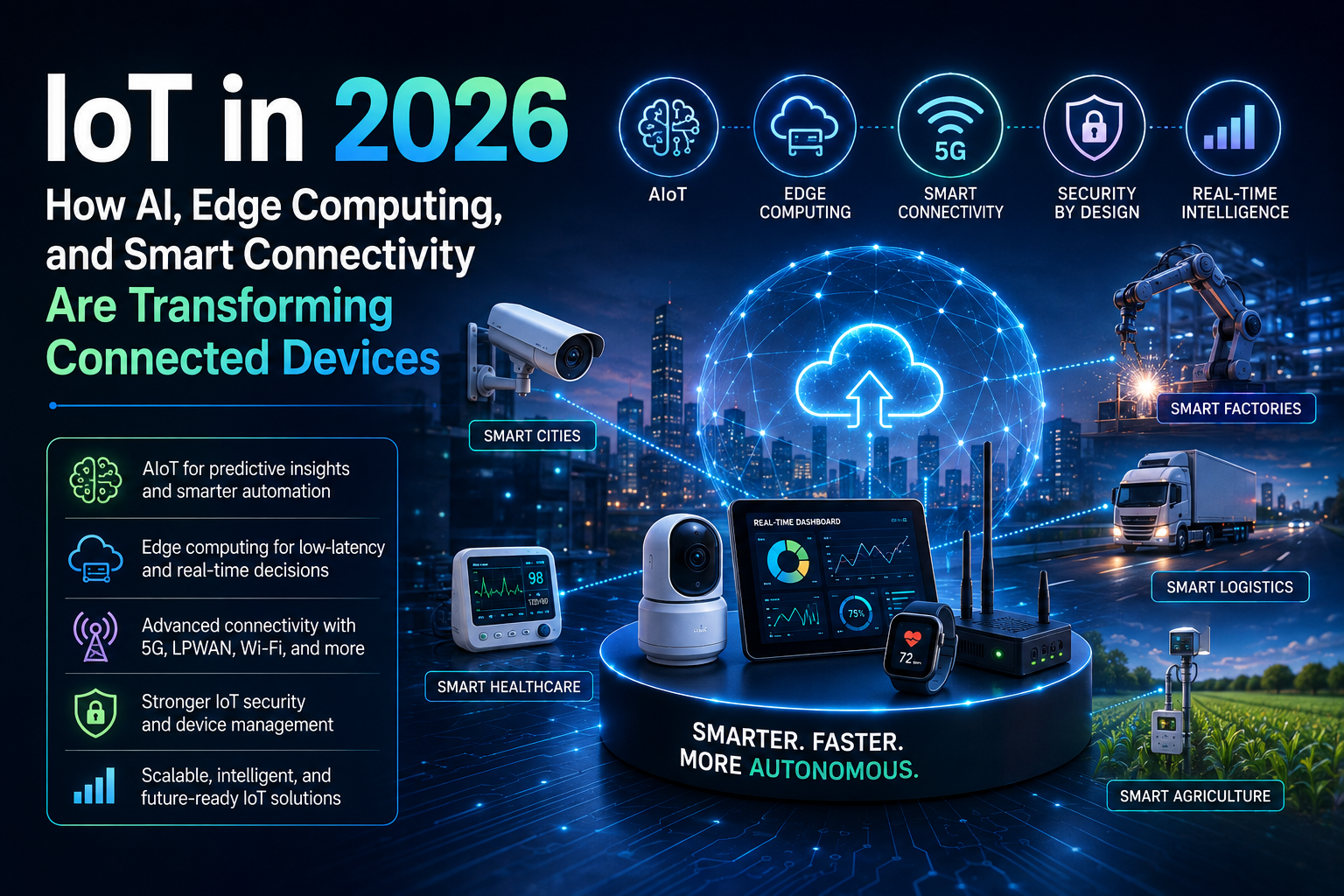
The Internet of Things (IoT) is entering a new phase in 2026. Connected devices are no longer limited to collecting data and sending it to the cloud. With AI, edge computing, advanced connectivity, and stronger cybersecurity, IoT systems are becoming smarter, faster, and more autonomous.
For businesses, this means IoT is shifting from simple monitoring to real-time decision-making, predictive maintenance, automation, and intelligent operations.
What Is IoT?
The Internet of Things connects physical devices such as sensors, machines, wearables, vehicles, appliances, and industrial equipment to software platforms and networks.
These devices can collect information, communicate with other systems, and trigger actions automatically.
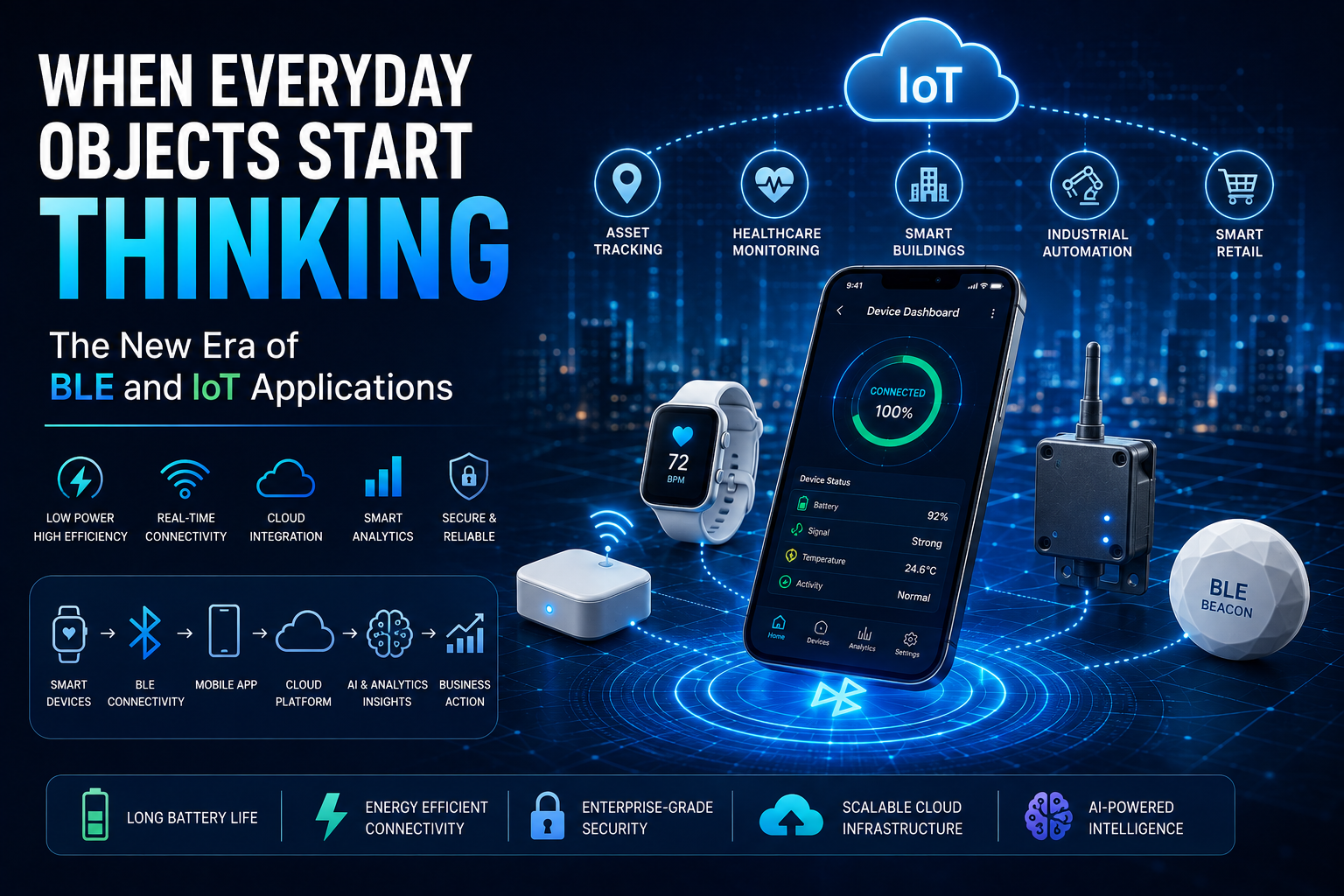
A modern IoT ecosystem typically includes:
- Smart sensors and connected devices
- Embedded software and firmware
- Bluetooth, Wi-Fi, 5G, LPWAN, or other connectivity
- Edge computing infrastructure
- Cloud platforms
- Mobile and web applications
- AI and machine learning
- IoT security and device management
The real value comes from connecting these components into a system that can turn raw device data into useful business decisions.
1. AIoT Is Making IoT More Intelligent
One of the biggest developments in 2026 is the convergence of Artificial Intelligence and IoT, often called AIoT.
Traditional IoT answers questions such as:
What is happening?
AI-powered IoT can go further:
Why is it happening, what is likely to happen next, and what should the system do?
For example, an industrial sensor may detect unusual vibration in a machine. Instead of simply sending an alert, an AI-powered system can analyze the pattern and identify a potential equipment failure before it happens.
This enables:
- Predictive maintenance
- Anomaly detection
- Intelligent automation
- Energy optimization
- Demand forecasting
- Real-time decision-making
AIoT is therefore transforming connected devices from passive data collectors into intelligent systems.
2. Edge Computing Brings Intelligence Closer to Devices
Cloud computing remains important, but businesses increasingly need IoT systems that can make decisions without sending every piece of data to a remote server.
That’s where edge computing comes in.
Instead of this:
Device → Cloud → Decision
modern IoT architectures can use:
Device → Edge → Decision → Cloud
Processing data closer to the source can reduce latency, lower unnecessary data transfers, and allow systems to continue operating when internet connectivity is unreliable. This is especially valuable for manufacturing, healthcare, energy, transportation, and other time-sensitive applications.
3. IoT Security Is Becoming a Core Requirement
More connected devices also mean a larger attack surface.
An IoT ecosystem can include thousands of devices, gateways, applications, APIs, and cloud services. A weakness in one component can potentially create security risks across the wider system.
Modern IoT development therefore needs security throughout the device lifecycle, including:
- Secure device authentication
- Encrypted communication
- Secure firmware
- Access control
- Device monitoring
- Regular software updates
- Data privacy
- Network segmentation
- Vulnerability management
NIST’s 2026 IoT cybersecurity work highlights the continuing need to develop security requirements and risk-management approaches as IoT technology evolves.
The ITU has also outlined AIoT threats across hardware, system, data, network, and application layers, showing why security needs to be considered across the entire architecture rather than added at the end.
4. 5G and Advanced Connectivity Are Expanding IoT
Connectivity is the foundation of every IoT system.
Different applications require different communication technologies. Depending on the use case, developers may combine:
- Bluetooth Low Energy
- Wi-Fi
- 5G
- NB-IoT
- LTE-M
- LoRaWAN
- Private cellular networks
5G is particularly useful for applications requiring reliable connectivity, higher bandwidth, and low latency.
This can support use cases such as connected vehicles, smart factories, industrial automation, remote monitoring, and large-scale infrastructure.
5. Smart Devices Are Becoming More Autonomous
The next generation of IoT devices will increasingly be capable of making decisions locally.
Consider a smart security camera.
A traditional camera might continuously send video to the cloud.
A smarter edge-enabled camera could identify an unusual event locally and send only relevant information to the central platform.
This approach can reduce unnecessary data transmission while improving response times and privacy.
The same concept can be applied to:
- Industrial cameras
- Smart wearables
- Agricultural sensors
- Fleet tracking devices
- Healthcare monitoring systems
- Smart home equipment
- Retail systems
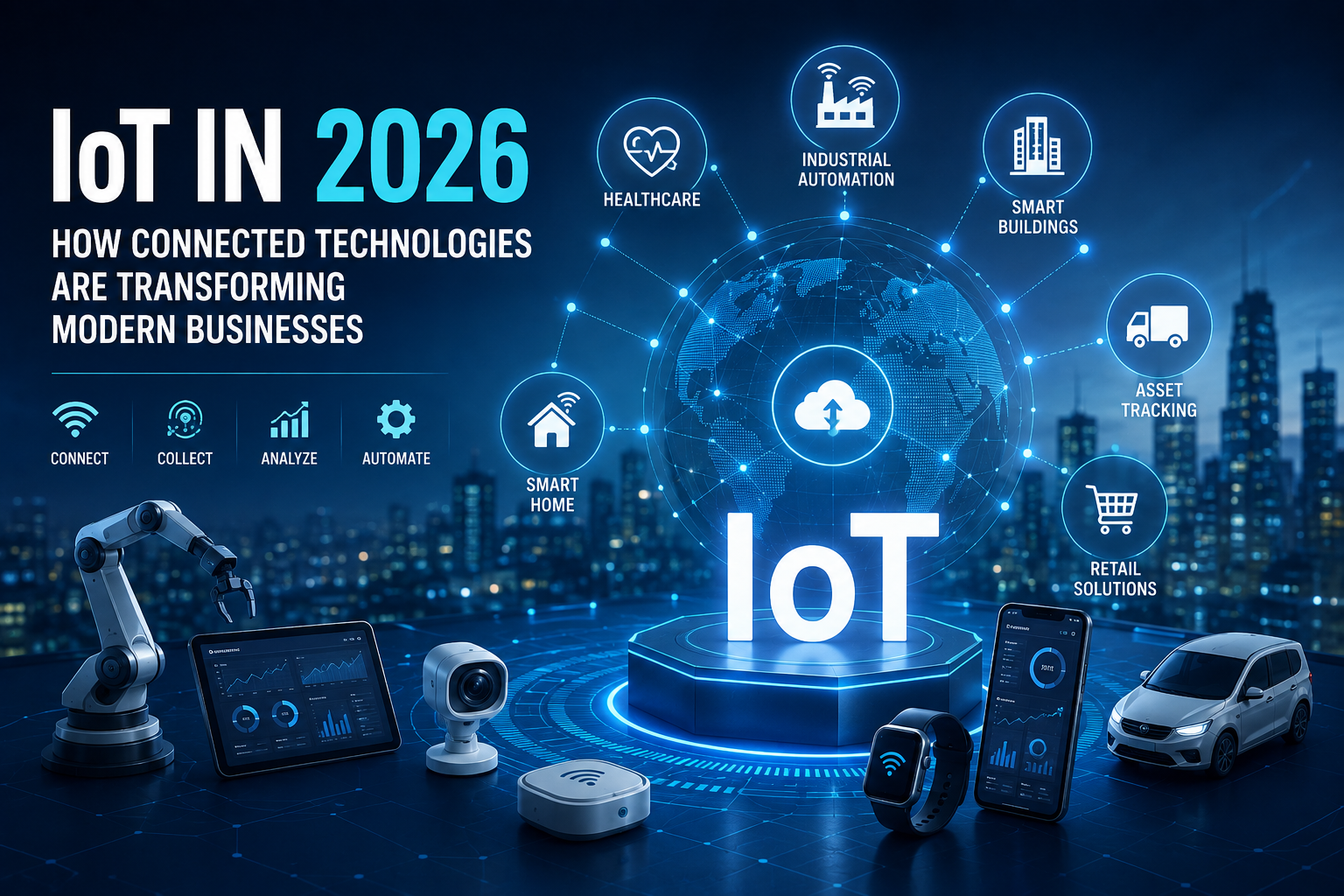
6. IoT Is Transforming Industries
IoT is no longer limited to smart homes.
Manufacturing
Connected machines can monitor temperature, vibration, pressure, and performance to support predictive maintenance and reduce unexpected downtime.
Healthcare
Connected medical devices and wearables can support continuous monitoring and generate alerts when abnormal patterns are detected.
Agriculture
IoT sensors can monitor soil moisture, temperature, humidity, and environmental conditions to help optimize irrigation and resource usage.
Logistics
Connected tracking devices can provide visibility into vehicles, shipments, temperature-sensitive products, and supply chains.
Smart Cities
IoT can support intelligent traffic systems, smart lighting, environmental monitoring, waste management, and infrastructure monitoring.
Energy
Connected meters and sensors can help organizations monitor consumption, detect abnormalities, and optimize energy usage.
7. The Future of IoT Is Not Just More Devices
The biggest change in IoT isn’t simply the number of connected devices.
It’s what those devices can understand and do.
A sensor that only reports temperature provides information.
A sensor combined with edge computing and AI can identify an abnormal temperature pattern, predict a potential problem, and trigger an automated response.
That is the transition from connected IoT to intelligent IoT.
What Businesses Should Consider Before Building an IoT Solution
Companies planning an IoT project should think beyond hardware.
A successful IoT solution requires a complete technology strategy covering:
- Device and sensor selection
- Embedded software
- Connectivity
- Mobile or web applications
- Cloud and edge architecture
- Data processing
- AI and analytics
- Security
- Device management
- Scalability
Choosing the right architecture at the beginning can make it much easier to scale an IoT product from a prototype into a production-ready solution.
Conclusion
IoT in 2026 is becoming smarter, more distributed, and more autonomous.
AI is turning device data into actionable intelligence. Edge computing is moving processing closer to the source. Advanced connectivity is supporting increasingly distributed deployments, while cybersecurity is becoming a fundamental part of IoT architecture.
For businesses, the opportunity is no longer simply to connect a device.
The opportunity is to build an intelligent ecosystem where devices sense, software understands, AI predicts, and systems act.
That is what will define the next generation of IoT.
SEO Keywords
Primary keywords: IoT development, IoT solutions, IoT development company, Internet of Things, IoT technology 2026
Secondary keywords: AIoT, AI-powered IoT, edge computing, IoT security, smart devices, IoT applications, industrial IoT, IoT software development, IoT solutions for business, connected devices, IoT application development
Long-tail keywords: custom IoT development services, AI-powered IoT solutions, IoT development for businesses, edge AI IoT solutions, secure IoT application development, industrial IoT development services