It’s Friday.
The week is almost over.
Your laptop has 37 browser tabs open.
Your coffee has become a dependency.
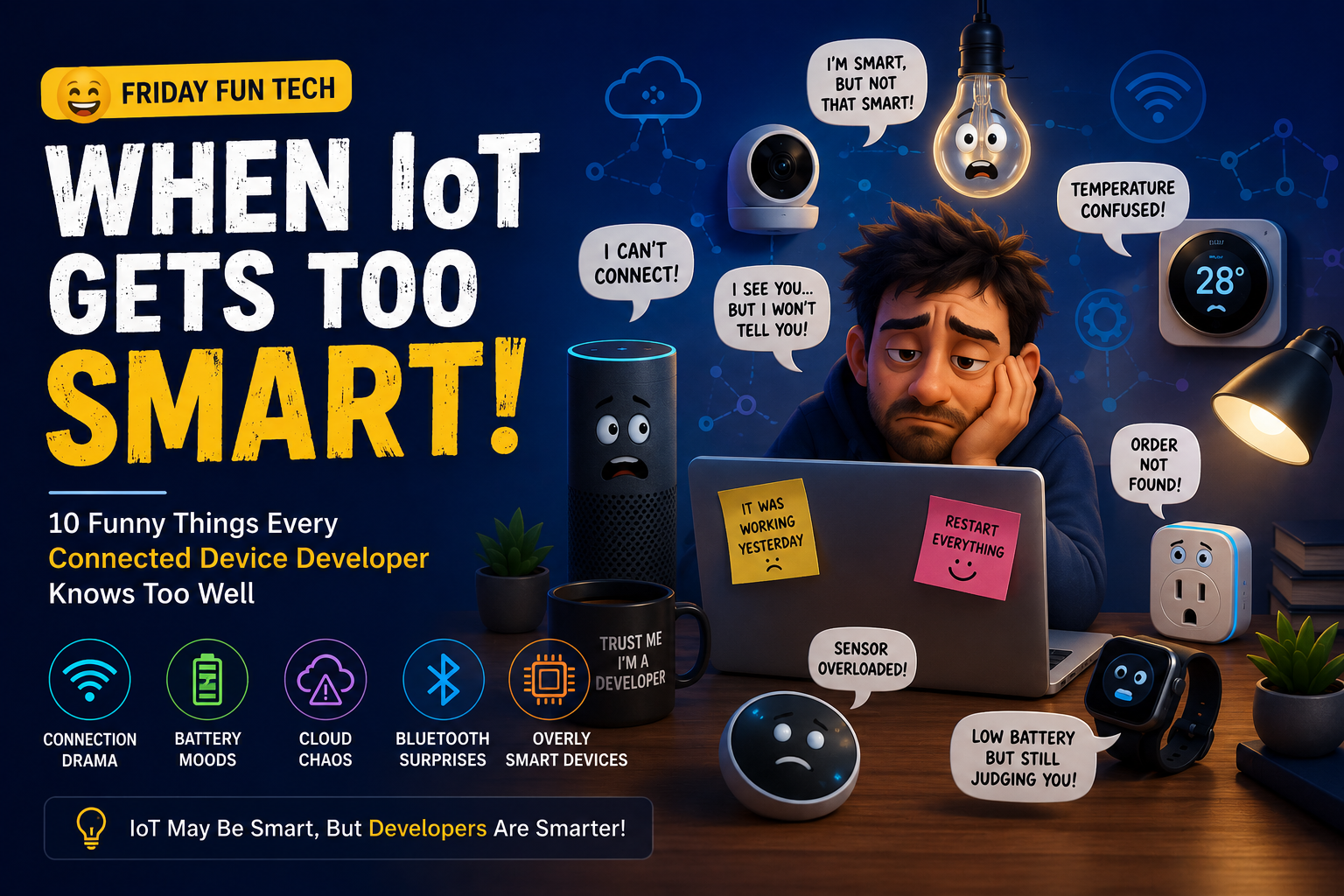
And somewhere in the office, an IoT device has decided that “connected” is more of a suggestion than a guarantee. 😄
Welcome to the wonderful world of the Internet of Things—where everyday objects are getting smarter, while developers are occasionally wondering whether the objects are becoming smarter than their developers.
Let’s look at some of the funniest situations that happen when businesses start connecting everything to everything.
1. The Smart Device That Isn’t Feeling Very Smart
You buy a smart device.
You connect it to Wi-Fi.
You download the application.
You create an account.
You verify your email.
You accept 14 permissions.
You restart the device.
And finally…
“Device not found.”
At this point, the device isn’t smart.
It’s just emotionally unavailable.
Reliable IoT development requires careful device discovery, connectivity management, error handling, and recovery mechanisms.
Because users shouldn’t need a computer science degree to turn on a smart light.
2. “It’s Connected!”
The IoT developer:
“The device is connected.”
The mobile app:
“Connecting…”
The cloud:
“Waiting…”
The user:
“Nothing is happening.”
The developer:
“Can you restart Bluetooth?”
The user:
“I already did.”
Developer:
“…Can you restart it again?”
This is why real-world IoT systems need robust connection management, reconnection logic, device state synchronization, and proper diagnostics.
A green Bluetooth icon isn’t necessarily the end of the story.
Sometimes it’s just the beginning.
3. The Smart Fridge Knows Everything Except What You Want
Modern IoT can monitor temperature, energy usage, door activity, and other conditions.
Imagine a refrigerator that can tell you:
“Temperature: 4°C.”
“Door open for 32 seconds.”
“Energy consumption increased 7%.”
And then you ask:
“Do we have milk?”
Silence.
Congratulations.
You’ve built a highly intelligent refrigerator that still requires human intelligence.
This illustrates an important IoT principle:
Collecting data isn’t the same as creating useful intelligence.
The real value comes from turning device data into meaningful information and actions.
4. Bluetooth Works Perfectly…
…until you actually need it.
BLE is excellent for connecting nearby devices while keeping power consumption low.
But developers know the reality:
Developer environment: Perfect.
Testing device: Perfect.
Second testing device: Mostly perfect.
Customer’s phone: “Interesting.”
BLE applications need to account for:
- Device discovery
- Pairing
- Connection drops
- Reconnection
- Background operation
- OS differences
- Firmware compatibility
- Battery optimization
- Data synchronization
Because your application doesn’t get to choose which smartphone the customer bought.
5. The IoT Device Has 1% Battery and a Big Personality
Battery-powered IoT devices have one simple job:
Stay alive.
But every sensor reading, wireless transmission, and background operation consumes energy.
Developers therefore need to carefully balance:
Performance ↔ Connectivity ↔ Battery Life
Sometimes the smartest thing an IoT device can do is simply…
go to sleep.
And honestly, after a long Friday, developers can relate.
6. The Sensor That Reports Everything
IoT devices can generate enormous amounts of data.
Temperature.
Humidity.
Movement.
Location.
Battery level.
Signal strength.
Device status.
Error codes.
And eventually someone asks:
“Why are we storing all of this?”
Good question.
IoT architecture should define what data needs to be collected, how frequently it should be collected, where it should be stored, and what business purpose it serves.
Because a million data points nobody uses are still…
a million data points nobody uses.
7. When the Cloud Becomes the Family Group Chat
An IoT ecosystem may have:
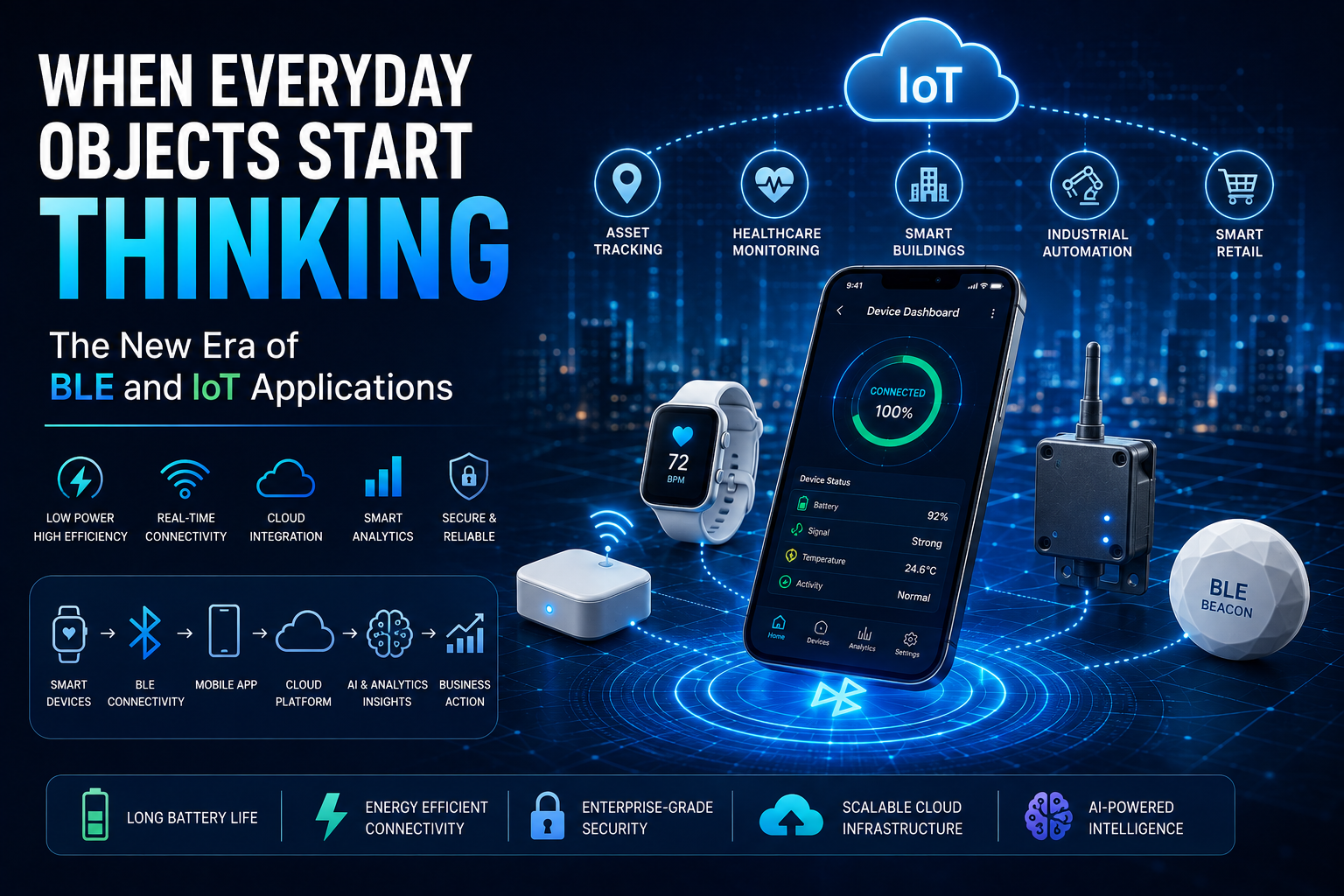
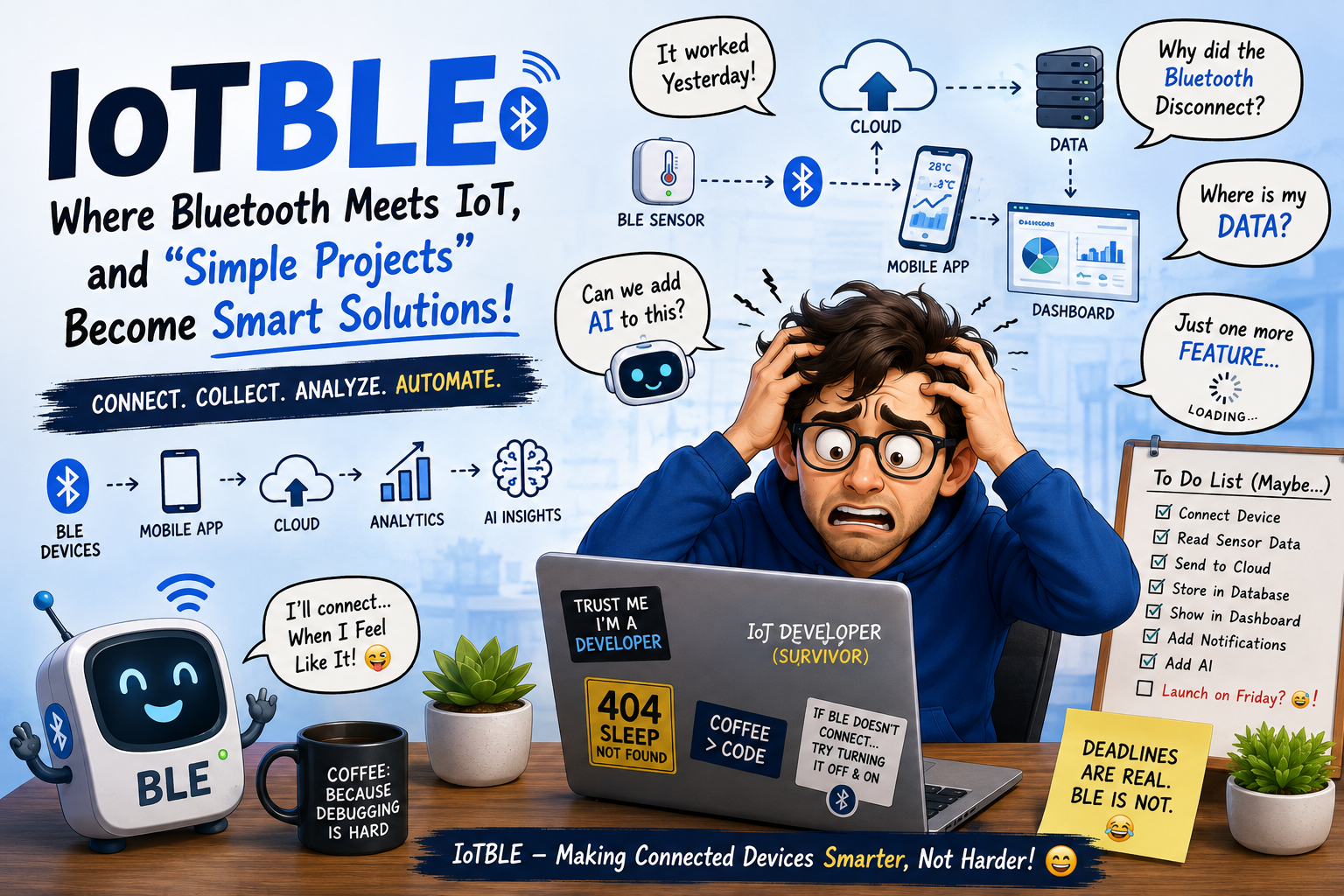
Device → BLE/Wi-Fi → Mobile App → API → Cloud → Database → Analytics
Every component has something to say.
The device says:
“Here’s some data.”
The app says:
“I received it.”
The API says:
“I’m processing it.”
The cloud says:
“Stored.”
The analytics engine says:
“Interesting pattern.”
And the developer says:
“Why did the device send that data 47 times?”
That’s why scalable IoT architecture, monitoring, logging, and event management are essential.
8. The Smart Lock That Makes You Feel Less Smart
Smart locks are a great IoT use case.
Your smartphone can communicate with the lock.
The application can manage access.
The system can track activity.
Everything is wonderfully connected.
Until you stand outside your own house saying:
“Why isn’t my phone connecting?”
Suddenly, the traditional key looks like a technological masterpiece.
IoT products should always consider failure scenarios.
What happens when:
- Bluetooth is unavailable?
- The battery is low?
- The phone is offline?
- The device loses connectivity?
- The cloud service is unavailable?
Smart products need sensible fallback mechanisms.
9. “Can We Add AI?”
This is becoming one of the most popular questions in IoT projects.
“We have an IoT device. Can we add AI?”
Of course.
But first:
What should the AI actually do?
AI can add significant value when it is used for:
- Predictive maintenance
- Anomaly detection
- Demand forecasting
- Intelligent automation
- Pattern recognition
- Energy optimization
- Personalized experiences
The goal shouldn’t be:
IoT + AI = Cool
The goal should be:
IoT Data + AI → Useful Business Decision
Otherwise, you’re just giving your sensor a very expensive brain.
10. The Friday IoT Deployment
And finally…
The sentence every experienced developer fears:
“Let’s deploy it today. It’s Friday.”
Suddenly:
- The device doesn’t reconnect.
- The firmware update fails.
- The API returns an unexpected response.
- The mobile app crashes.
- The dashboard shows 14,000 devices offline.
And someone asks:
“Can we fix it before Monday?”
The entire development team:
“…”
For IoT systems, deployment should include proper testing, monitoring, rollback procedures, firmware management, and staged releases.
Because Friday should be about finishing the week—not becoming part of the incident report.
The Funny Problems Are Actually Important
Behind the jokes are some serious IoT development challenges.
A successful IoT ecosystem needs to consider:
Connectivity
Devices must communicate reliably.
Power Management
Battery-powered devices need efficient communication strategies.
Scalability
The architecture must support growth from hundreds to thousands or millions of devices.
Security
Devices, applications, APIs, and cloud systems all need protection.
Data Management
Businesses need to determine what information should be collected and how it should be used.
Device Management
Organizations need ways to monitor, configure, update, and troubleshoot connected devices.
User Experience
The technology should make life easier—not create another troubleshooting manual.
What a Good IoT Ecosystem Looks Like
A mature IoT solution can connect:
Sensors & Devices
↓
BLE / Wi-Fi / Cellular
↓
Mobile or Gateway Application
↓
Secure APIs
↓
Cloud Platform
↓
Data Analytics & AI
↓
Business Applications
↓
Automated Actions
The technology may be complex behind the scenes.
But for the user, it should feel simple.
That’s the real definition of smart technology.
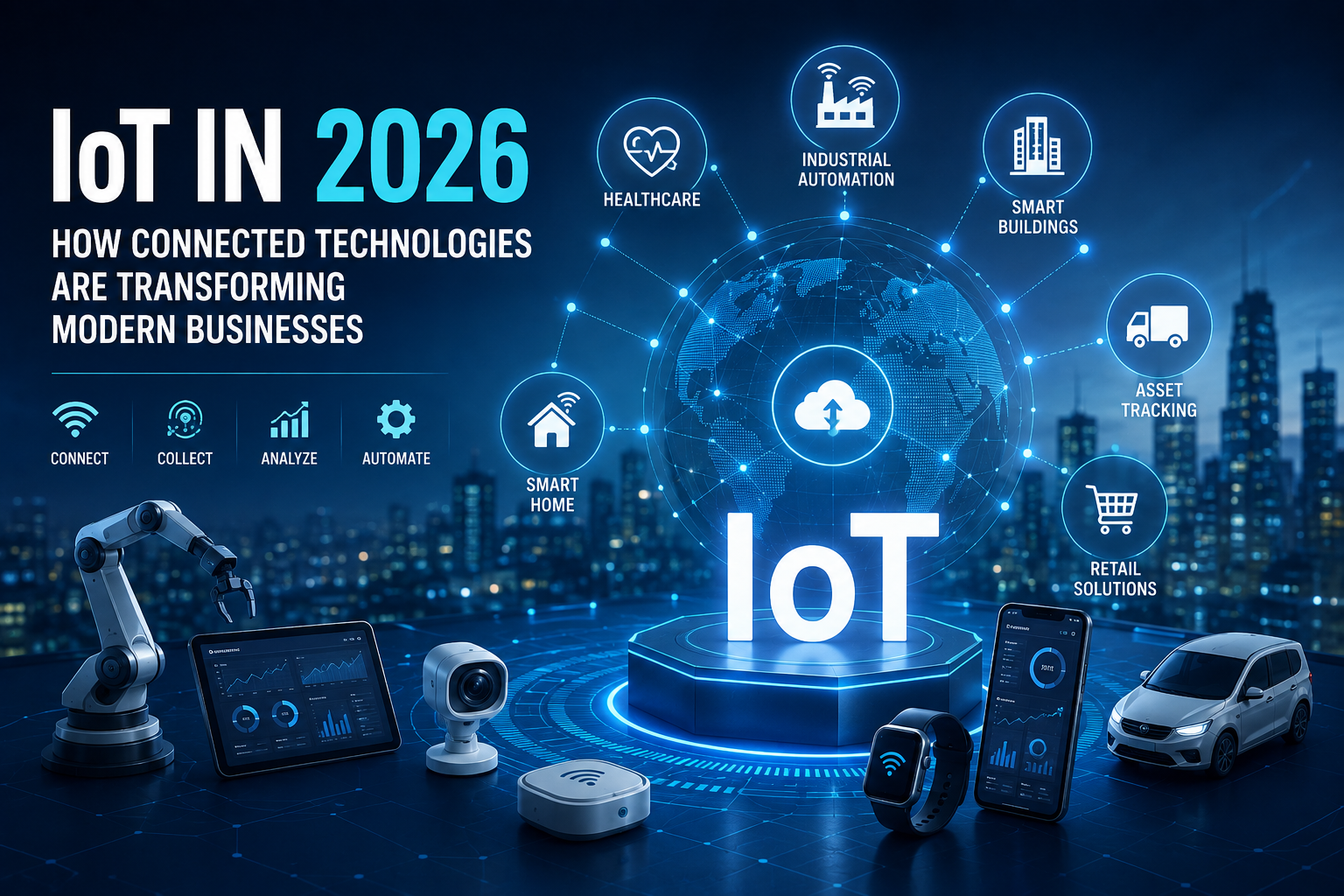
Where IoT Is Making a Difference
IoT isn’t limited to smart homes.
Connected technology is being used across:
- Healthcare
- Manufacturing
- Logistics
- Retail
- Agriculture
- Automotive
- Fitness
- Smart buildings
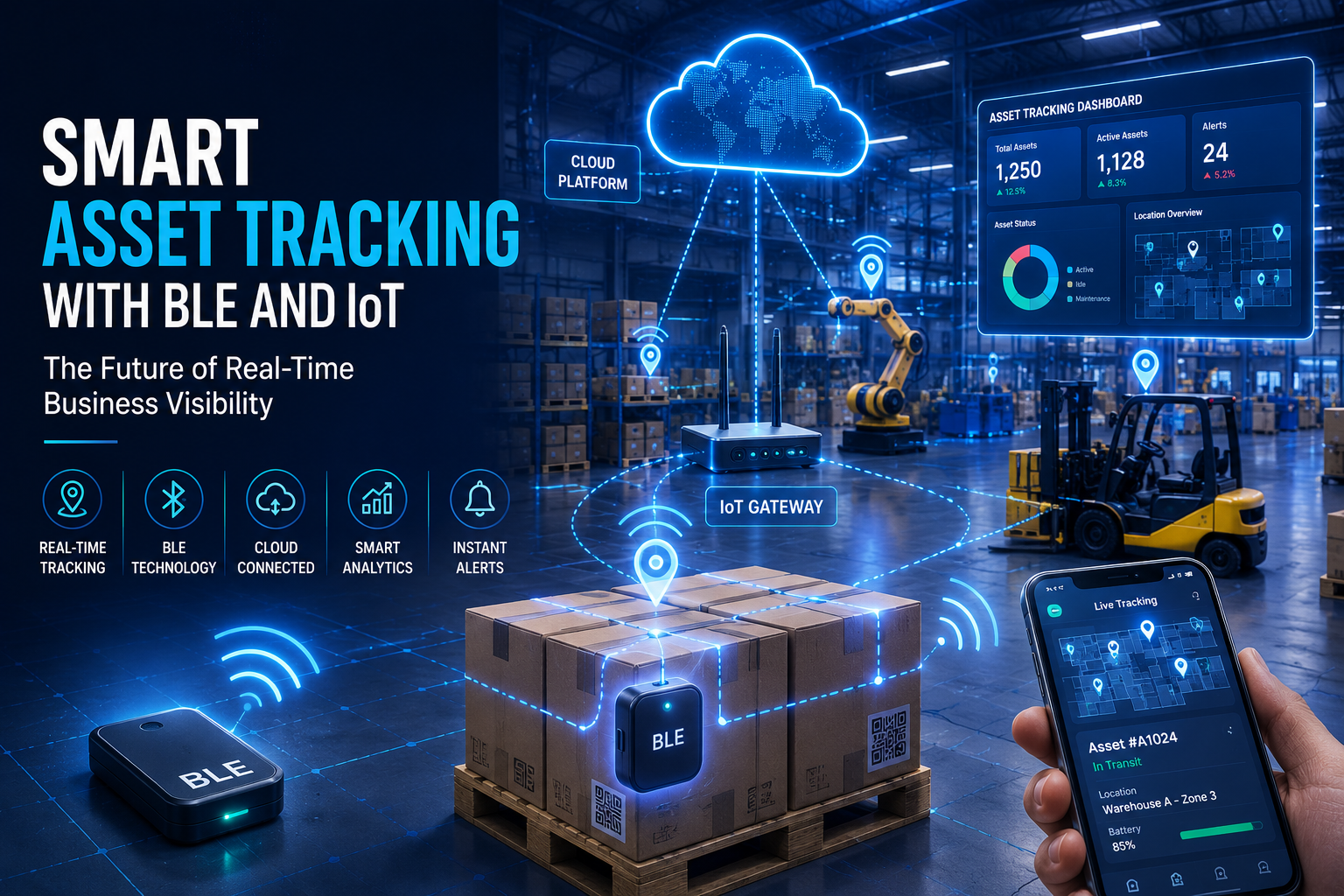
- Asset tracking
- Industrial monitoring
- Consumer electronics
The use case changes, but the basic idea remains the same:
Connect physical things to digital intelligence.
The IoT Rule for Friday
Here’s a simple rule for every IoT project:
If the device needs a 47-page manual to explain how to connect it, it probably isn’t smart enough yet. 😄
Good IoT products hide complexity.
The user shouldn’t need to know about:
- BLE characteristics
- MQTT messages
- API endpoints
- Cloud instances
- Database schemas
- Firmware versions
They should simply see:
“Connected.”
And preferably…
Actually connected.
Final Thoughts
IoT is transforming ordinary products into connected digital experiences.
But making something connected isn’t the same as making it useful.
Successful IoT development requires a combination of:
Hardware + BLE + Mobile + Cloud + APIs + Data + Security + AI
When these technologies are designed together, businesses can create products that monitor, communicate, analyze, and respond intelligently.
And if your IoT device starts talking back to you on a Friday afternoon…
Don’t panic.
Just check the logs.
Then check Bluetooth.
Then restart the device.
And if that doesn’t work…
It’s probably Wi-Fi. 😂
SEO Title
Funny IoT Technology Problems: 10 Things Every IoT Developer Knows
Meta Description
Explore the funny side of IoT development, from Bluetooth connection problems and smart devices to cloud systems, AI, battery life, and Friday deployments.
Primary Keywords
IoT development, IoT solutions, IoT development company, IoT applications
Secondary Keywords
IoT device development, BLE IoT development, connected device development, IoT software development, smart device development, IoT mobile app development, Bluetooth IoT, industrial IoT, IoT cloud solutions, IoT technology